
Website Development That Builds Your Digital Presence
OptiRanker builds CMS-powered websites designed around usability, performance, responsive design and clear business goals. Whether you need a new business site, a redesign or an eCommerce store, we build with SEO readiness and conversions in mind from the start.
Works across devices.
Manageable content.
Built to be found.
Built to perform.
What Is Website Development?
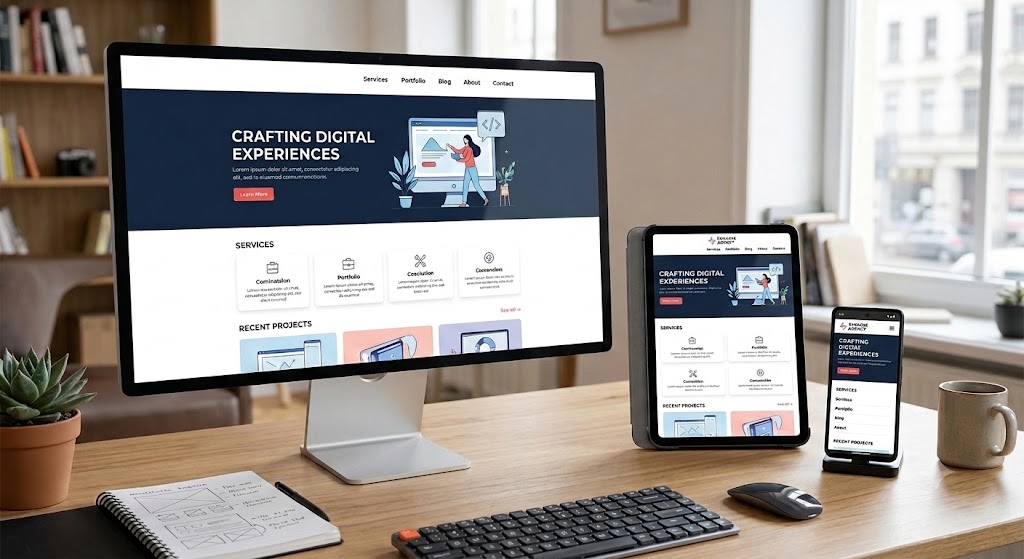
Website development is the process of building and structuring a website so it works reliably for visitors and for the business behind it. It brings together layout, content, functionality and technical foundations — not just the visual design you see on screen.
A well-developed website loads quickly, works across screen sizes, guides visitors clearly and makes it easy for them to take the next step. It also needs to be structured so search engines can understand and index it properly.
For businesses, the goal is not simply to have a website. It is to have a website that supports real objectives — visibility, enquiries, sales and long-term credibility.
The Development Journey
- Planning
- Design
- Development
- Testing
- Launch
What Is CMS Website Development?
A Content Management System (CMS) is a platform that lets you manage website content — pages, blog posts, images and menus — without needing to edit code for every change. CMS-based development means the website is built on top of that system, so it stays manageable after launch.
Traditional Website Management
- More manual updates
- Higher development dependency
- Slower content changes
CMS Website Management
- Easier content updates
- Manageable page structure
- Scalable as your business grows
What Is Required to Build a Website?
Every professional website depends on a handful of core components. Understanding them makes it easier to plan a project realistically and avoid gaps later.
Domain Name
The web address visitors use to access your website.
Web Hosting
The infrastructure where website files and databases are hosted.
Website Structure
Planning pages, navigation and content hierarchy.
UI / UX Design
Creating a clear, attractive and user-friendly experience.
CMS / Platform
Selecting an appropriate CMS or development approach.
Content
Text, images, videos and the business information users need.
Functionality
Forms, integrations, eCommerce features or other required functions.
Mobile Responsiveness
Ensuring the website works well on mobile, tablet and desktop.
SEO Foundations
Creating technically sound structures that support search visibility.
Security & Maintenance
Keeping the website protected and maintained after launch.
Why Does Your Business Need a Professional Website?
A website is often the first real interaction a customer has with your business. What they find there shapes how they judge your credibility and whether they take the next step.
Build Credibility
A professional website helps establish trust before a visitor has spoken to your business.
Strengthen Your Brand
The website becomes the consistent digital identity that ties together everything else you do.
Generate Leads
Strategic landing pages and clear contact paths help turn interest into enquiries.
Improve Customer Experience
Easy navigation and accessible information reduce friction for every visitor.
Support Digital Marketing
SEO, ads, social and email campaigns all depend on a website that can convert traffic.
Grow With Your Business
A scalable CMS-based website can evolve as your services, team and goals change.
Core Services We Offer
Corporate & Business Websites
- Detailed Definition: A corporate website is a comprehensive multi-page platform designed specifically to represent an established business or organization online. Rather than focusing on direct online sales, its primary purpose is to establish brand authority, showcase services, and build institutional trust. Think of it as a highly polished, interactive corporate brochure that works 24/7. It communicates your company’s mission, introduces your executive team, showcases case studies, and outlines your core B2B or B2C services.
- Why Your Business Needs It: Today’s clients research a company online before signing any contract. A corporate website acts as your primary credibility anchor. It provides professional touchpoints for stakeholders, potential investors, and high-value clients, ensuring you stand out as an industry leader.
- Best Suited For: B2B service providers, consulting firms, manufacturing companies, startups seeking funding, real estate agencies, law firms, and medical practices.
E-Commerce Online Stores
- Detailed Definition: An E-Commerce website is a specialized dynamic platform built to handle commercial transactions over the internet. It transforms your business into a virtual store where customers can browse physical or digital product catalogs, add items to a shopping cart, and check out securely. This infrastructure requires advanced technical integrations, including product inventory management systems, multi-currency payment gateways (like Stripe, PayPal, or Razorpay), automated shipping calculator APIs, and secure customer account portals.
- Why Your Business Needs It: It eliminates geographical boundaries and traditional retail operational hours. With an E-Commerce platform built by Tarkworld, you can sell to hundreds of customers simultaneously across the globe at any time of day, vastly increasing your revenue potential without the overhead costs of a physical retail outlet.
- Best Suited For: Retail brands, fashion and apparel labels, consumer electronics sellers, digital product creators, and traditional wholesalers transitioning into the online marketplace.

Custome Landing Pages
- Detailed Definition: A custom landing page is a standalone, single web page created specifically for a targeted marketing or advertising campaign. Unlike traditional websites that encourage users to explore multiple pages, a landing page is stripped of all regular navigation links. It is mathematically engineered around one singular focal point, known as a Call-To-Action (CTA). Whether you want the user to download an eBook, sign up for a webinar, or request a callback, every graphic, headline, and testimonial on this page is positioned to drive the visitor toward that single action.
- Why Your Business Needs It: Sending paid ad traffic (from Google Ads, Meta Ads, or LinkedIn Campaigns) to a standard homepage wastes ad spend because visitors get distracted and leave. Custom landing pages eliminate distractions, drastically lowering your Cost-Per-Acquisition (CPA) and maximizing the Return on Investment (ROI) of your marketing campaigns.
- Best Suited For: Digital marketers running PPC ad campaigns, product launches, event promotions, app downloads, and businesses offering high-ticket specialized services looking to capture immediate leads.
CMS & Blog Platforms
- Detailed Definition: A CMS (Content Management System) and Blog Platform is a user-friendly framework that allows businesses to create, edit, organize, and publish digital content on the web without writing a single line of code. Built on robust software like WordPress or Shopify, a CMS separates the design architecture from the actual content. This gives you an intuitive backend dashboard where your internal marketing team can upload weekly blog posts, update service text, swap out banner images, or publish industry news instantly with simple drag-and-drop actions.
- Why Your Business Needs It: It gives you complete independence and agility. You no longer have to wait for a technical developer or pay agency fees every time you want to fix a typo or upload a new article. Furthermore, keeping a fresh, active blog is the number one strategy for boosting your Organic SEO rankings on Google.
- Best Suited For: Content creators, media publications, educational institutions, and businesses focusing heavily on inbound content marketing, SEO traffic, and thought leadership.
Built With SEO in Mind
Website development and SEO should not be treated as separate projects. When the site is built with search in mind from the start, everything downstream becomes easier.
- Clean site structure
- Crawlable architecture
- Logical page hierarchy
- Mobile usability
- Performance-conscious builds
- Heading and metadata readiness
- Internal linking structure
- Image optimization basics
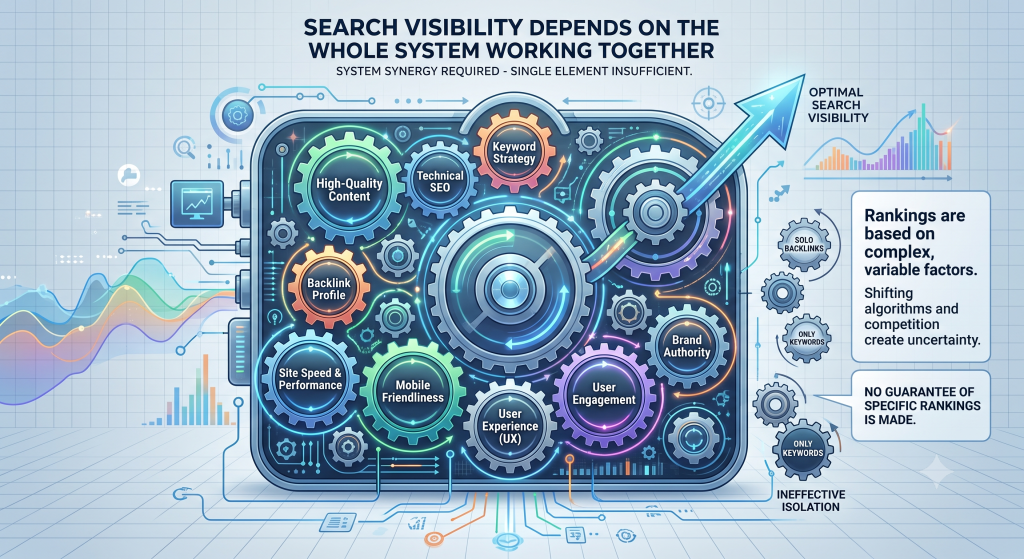
Your Website Is the Foundation of Your Digital Marketing
SEO, ads, social and email all lead back to the same place — your website. When the site is fast, clear and built around conversion, every other marketing channel works harder.
SEO
Organic visibility.
Google Ads
Paid traffic.
SMM
Social media.
Email Marketing
Direct communication.
Content Marketing
Valuable content.
AI Search
AIO & GEO readiness.
Lead Generation
Turning interest into enquiries.
Conversion Optimization
Improving user journeys.
What We Consider After Launch
A website is not finished on launch day. These are the practical indicators we look at once a site is live and being used.
User Engagement
How visitors interact with the site.
Enquiries
Form submissions and direct contacts.
Conversion Rate
Visitors completing a key action.
Page Performance
Load times and interaction speed.
Organic Visibility
Impressions and organic clicks.
Traffic Quality
Whether visitors match intent.
Mobile Usability
How the site performs on phones.
Content Performance
Which pages are working best.
These are the indicators we track — no specific client results are shown.
Why Choose OptiRanker for Website Development?
We build websites the same way we approach marketing — starting with the objective, then applying the right structure, design and functionality to support it.
- Business-focused approach
- Clean and modern design
- CMS-friendly websites
- Elementor expertise
- SEO-aware development
- Conversion-focused thinking
- Responsive experiences
- Long-term support mindset
Frequently Asked Questions
CMS website development means building a website on top of a Content Management System so that content, pages and media can be managed without editing code. WordPress is one example. The result is a website you can update and grow over time.
At minimum: a domain name, web hosting, a clear site structure, UI/UX design, a CMS or development platform, content, required functionality, mobile responsiveness, SEO foundations and a plan for security and maintenance.
A CMS makes content updates practical, keeps the site manageable as it grows and reduces reliance on developers for every change. It also gives the business administrative control over pages, media and blog content.
WordPress is flexible, widely supported, easy to manage and scalable. Its ecosystem of themes, plugins and integrations makes it suitable for many types of business websites. That said, it is not the only option — the right platform depends on the project.
Yes. We use Elementor extensively for WordPress development. It allows structured, responsive layouts and gives clients a familiar editing experience after launch. We can also work with other builders where appropriate.
Yes. Redesigns are a common project. We review what is working, what is not and what needs to change structurally, then rebuild or refactor the site with improved usability, performance and presentation.
Yes. We build e-commerce sites on appropriate platforms, with a focus on product presentation, browsing experience, checkout flow and conversion. The specific platform depends on catalogue size, payment requirements and business model.
Yes. Every website we build is designed to work across desktop, tablet and mobile. We test responsive behaviour as part of the development process, not as an afterthought.
Yes. We build with SEO fundamentals in mind — clean structure, crawlable architecture, logical headings, fast-loading pages and metadata readiness. Deeper SEO work such as ongoing keyword strategy can be handled as a separate engagement.
Yes. Because we build on a CMS, you will be able to update pages, blog posts, images and menus yourself. We can also provide a short handover to walk through the editor.
Yes. Maintenance services cover updates, small changes, backups, security monitoring and ongoing technical support. Scope and frequency depend on your requirements.
Timelines vary by project. A focused business site is typically quicker than a complex multi-section or e-commerce build. After a discovery discussion we can give a realistic estimate based on your specific requirements, content readiness and feedback speed.
Ready to Build a Website That Works for Your Business?
Tell us about your website goals, CMS requirements and growth plans. We will come back with a clear, realistic proposal — including recommended platform, structure and scope.
