
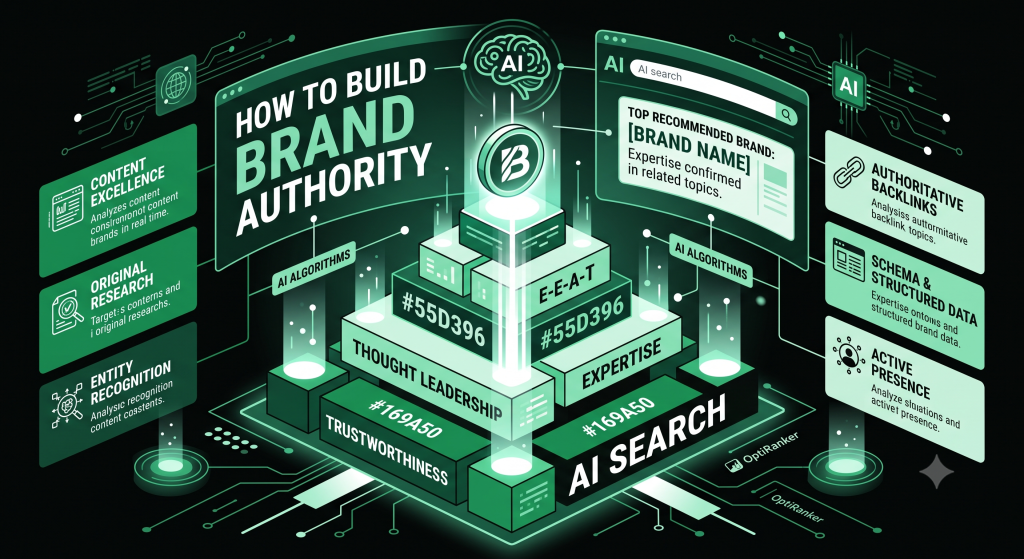
How to Build Brand Authority for AI Search
Introduction When someone asks an AI assistant for a recommendation, a shortlist, or an explanation, the answer they receive is assembled from sources the system has reason to trust. That trust is not random. It is usually connected to how clearly a brand communicates its expertise, how consistently it appears across the web, and how useful its content is to real people. This is where brand authority becomes a practical concern rather than an abstract marketing idea. Authority is the accumulated result of doing good work, explaining it well, and being recognized for it over time. In an AI-driven search environment, that reputation matters more than ever because AI systems draw on it to decide what is worth repeating. This guide explains how to build brand authority for AI search in a way that is honest, realistic, and actionable. You will learn how AI systems understand brands, how to build topical and entity authority, what trust signals matter, how SEO, AEO, and GEO work together, and what small businesses can do without a large budget. What Does Brand Authority Mean in AI Search? Brand authority in AI search means how consistently and credibly a business demonstrates expertise, trustworthiness, and relevance in the areas it claims to serve. AI-powered systems use multiple signals from across the web to understand a brand, but there is no single universal formula that determines what they will cite or recommend. Authority is not something you declare. It is something others recognize because of what you publish, how you work, and how your customers and peers talk about you. In practical terms, it combines several things: Demonstrated expertise – content that shows genuine understanding, not surface-level summaries Consistency – the same name, services, and messaging everywhere your brand appears Trust signals – clear business information, authorship, and transparency about who is behind the content Recognition – mentions, links, and references from relevant and reputable sources Relevance – being clearly associated with specific topics rather than trying to cover everything AI-powered search systems do not read your website the way a human does. They combine information from many sources including your site, third-party mentions, structured data, and public records. Your goal is not to decode a hidden algorithm. It is to make the information about your brand clear, accurate, and easy to connect across all the places it appears. Why Brand Authority Matters for AI Search Visibility When a generative AI system produces an answer, it draws on sources it has learned to associate with relevant topics. It is not evaluating just one page. It is making a judgement about which sources are coherent, credible, and consistent enough to include in a synthesised response. A brand that is widely recognized in its field has a different starting position from a brand that appears only on its own website. Recognition comes from being mentioned, referenced, and discussed by others. It is also supported when the information about a brand is consistent everywhere it appears, so the system can connect the dots. Trust: Content is more likely to be used when it is accurate, well-sourced, and clearly written. Content quality: Depth and original insight tend to outlast surface-level information. Consistent information: Matching details across the web help systems form a clean picture of your brand. Expertise: Subject knowledge shown through detailed, specific content is easier to verify. Brand recognition: Familiar names carry more weight when a system is deciding what to reference. Reputation: Reviews, mentions, and public discussion contribute context that supports or undermines trust. Accuracy: Outdated or conflicting information can weaken how confidently a brand is described. There is a clear chain at work: authority leads to trust, trust leads to better understanding, and better understanding creates more opportunities for visibility. That chain is not guaranteed, and no business can force an AI system to cite it. What you can do is improve the conditions that make recognition more likely. How AI Search Systems Understand Brands Generative AI systems build an internal understanding of a brand by pulling together information from many places. They do not rely on a single page or a single signal. Here are the main concepts involved, explained in plain language. Entity Understanding An entity is a distinct thing, such as a business, a person, or a product. Systems try to recognise that your brand is a specific entity with a name, a purpose, and a set of associated topics. Clear naming, a consistent description, and structured data help this process. Contextual Relevance Systems assess whether your content is relevant to the query being asked. A page about SEO is relevant to SEO questions. A page about SEO on a bakery website may be less relevant unless the bakery also does SEO consulting. Topical Associations The more consistently your brand publishes and is mentioned in connection with a topic, the stronger the association becomes. This is why breadth without depth rarely builds authority. Consistent Brand Information If your business name, address, phone number, services, and description differ across the web, systems may struggle to connect everything to a single entity. Consistency reduces ambiguity. Third-Party Validation Mentions and references from other reputable sources act as external confirmation that a brand is real, relevant, and worth paying attention to. These are not the only signal, but they carry weight. Note: The exact weighting of these factors is not publicly disclosed by the companies that operate AI search systems. The explanations above describe general principles, not a guaranteed formula. 1. Define What Your Brand Wants to Be Known For A brand cannot be an authority on everything. Attempting to cover too many unrelated topics dilutes the signal and makes it harder for systems and people to understand what you actually stand for. Start by answering a few honest questions about your business: What problem do we solve? Who do we solve it for? What topics are we genuinely qualified to discuss? What makes our knowledge or approach useful? What do we want people to associate with