SEO vs GEO vs AEO: What’s the Difference and Which One Does Your Business Need?
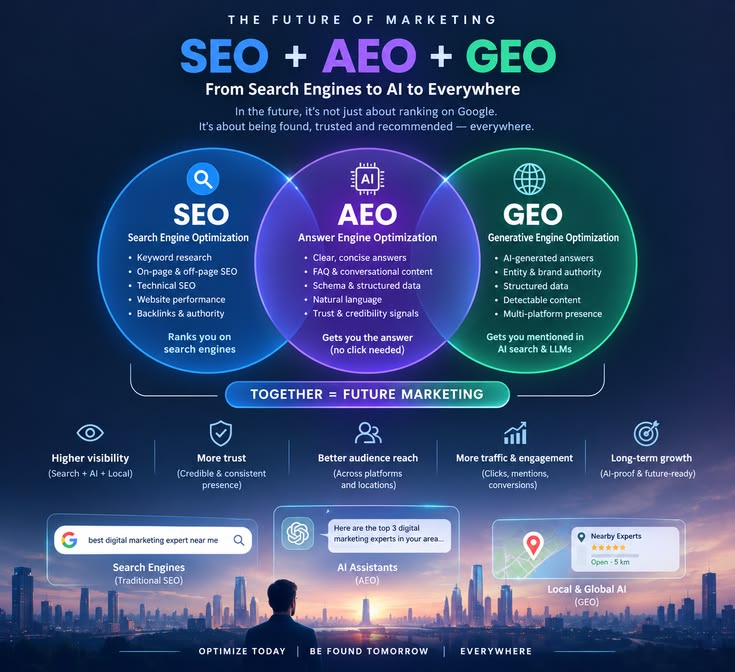
SEO vs GEO vs AEO at a Glance Here is the short version before we go deep. SEO Environment: Google, Bing, traditional organic search Objective: Rank higher and earn qualified organic traffic Methods: Keyword & intent research, on-page, technical SEO, internal linking, backlinks, topical authority Experience: User searches, scans, clicks a link Example: A local dentist ranks for “emergency dentist in Austin” and gets booked calls AEO Environment: Featured snippets, People Also Ask, voice assistants Objective: Be the source that directly answers a question Methods: Question-based headings, concise definitions, FAQ blocks, schema, semantic clarity Experience: User asks, receives a direct answer Example: Your page supplies the snippet for “how long does SEO take” GEO Environment: AI Overviews, ChatGPT, Perplexity, Copilot Objective: Be understood, retrieved, and cited in AI answers Methods: Entity clarity, original research, first-hand expertise, consistent brand data, citable claims Experience: User asks naturally, receives a synthesised answer Example: An AI assistant cites your original industry survey What Is SEO? Definition: SEO (Search Engine Optimization) is the practice of improving how visible your website is in traditional search engine results — the organic listings on Google, Bing, and similar platforms. It is the most mature of the three disciplines and remains the foundation most other search visibility work is built on. How Traditional Search Engines Work Search engines discover pages by crawling links, store what they find in a massive index, and then rank the most relevant and useful results for a query. Google’s own documentation describes ranking as a combination of meaning, relevance, quality, and usability — not a single secret score. In practice, that means the job is to make your pages easy to find, easy to understand, and genuinely worth ranking. Why Organic Visibility Still Matters Organic search traffic converts well because it is intent-driven. Someone typing “emergency plumber near me” is not browsing — they are buying. And unlike paid ads, organic visibility does not switch off when the budget runs dry. It compounds. The Core Pillars of SEO On-page SEO — optimizing titles, headings, copy, and structure around real search intent Technical SEO — crawlability, indexation, site speed, mobile usability, clean URL architecture Off-page SEO — earning authority through backlinks, brand mentions, and reputation signals Content quality — depth, accuracy, originality, and genuine usefulness to the reader Search intent — matching format and depth to what the searcher actually wants Internal linking — helping crawlers understand structure and passing authority Backlinks — other sites linking to you, a trust signal for search engines Topical authority — covering a subject thoroughly rather than scattered posts User experience — clear layout, readable formatting, low friction Site performance — Core Web Vitals and fast load times across devices Structured data — schema markup that helps search engines interpret content A Practical SEO Example Say you run a small accounting firm. You publish a page targeting “bookkeeping services for freelancers.” You optimize the title and headings, add an internal link from your main services page, answer common pricing questions directly, keep the page fast on mobile, and earn a few links from freelancer communities. Over time, that page starts ranking and brings in enquiries. That is SEO working exactly as intended. What Is AEO? Definition: AEO (Answer Engine Optimization) is the practice of structuring content so that it directly answers a specific question in a format answer-focused systems can easily extract, quote, or display. If SEO is about being found, AEO is about being the answer. How Answer-Focused Search Differs Traditional search hands you a list of options. Answer-focused search tries to hand you the answer. Think featured snippets, People Also Ask boxes, voice assistant responses, and the short answer panels that appear above the first organic result. In all of these, the system needs to pull a clean, self-contained response from somewhere — and it would rather pull it from a page that makes the answer obvious. Why Direct Answers Matter Zero-click behaviour is now normal. A meaningful share of searches are resolved on the results page itself. If your content never provides a clean, extractable answer, you leave that visibility on the table — and your competitor takes it instead. What AEO Actually Involves Question-based searches — building content around how real people phrase questions Featured snippets — a 40–60 word answer right under a relevant heading People Also Ask — addressing follow-up questions alongside related searches Voice search — answering in natural, conversational language Conversational queries — longer, specific phrasing like “is SEO worth it for a small bakery” FAQ content — real questions with genuinely useful answers, not filler Structured content — logical heading hierarchy, short paragraphs, clear lists Clear headings — each heading states the question the section answers Concise answers — the answer comes first, the explanation after Semantic relevance — covering related concepts so systems understand context A Practical AEO Example A SaaS company writes an article titled “How Much Does Project Management Software Cost?” Under that heading, the very first paragraph says: “Most project management software costs between $8 and $30 per user per month, with enterprise plans priced higher.” That is a snippet-ready, voice-ready answer. Everything below it supports and qualifies the claim. That structure is AEO in practice. What Is GEO? Definition: GEO (Generative Engine Optimization) is the practice of making your brand, content, and expertise more likely to be understood, retrieved, and accurately represented inside generative AI search experiences — tools like AI Overviews, ChatGPT, Perplexity, and Copilot. One important note: GEO is a young discipline. Terminology varies across the industry, and no single definition is universally accepted yet. Treat this as a practical working model, not a fixed standard. Why Generative AI Is Changing Search Behaviour People increasingly ask full questions in plain language and expect a synthesised answer, not a list of links. That changes the unit of competition. You are no longer only competing for a position on a page — you are competing to be part of the material a generative system