Author name: Laraib khan

Uncategorized

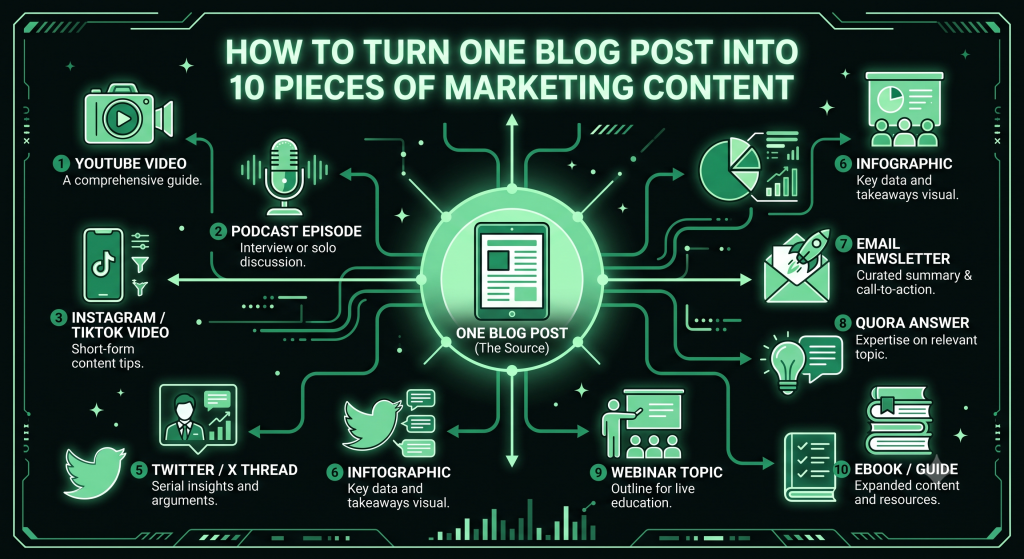
How to Turn One Blog Post Into 10 Pieces of Marketing Content

Introduction Many businesses spend hours researching, writing, and publishing a blog post. Then they move on to creating completely different content for social media, email, video, and other channels. The result is often content fatigue, inconsistent publishing, wasted research, and a growing sense of marketing burnout. There is a better approach. Instead of treating each platform as a separate content project, you can take one strong blog post and strategically transform it into multiple marketing assets. Not by copying and pasting, but by adapting the ideas into formats that fit each platform. This guide walks through exactly how to turn one blog post into ten pieces of marketing content, what to extract from the original article, how to adapt each piece, and how to make the whole system work together. What Is Content Repurposing? Content repurposing is the process of taking useful information from an existing content asset and adapting it into different formats and experiences for different audiences and platforms. The key word is adapting. Repurposing is not the same as: Copying the same text across every platform Republishing the same article on a different website Duplicating content without any change in format or angle Good repurposing changes the format, the angle, the depth, and the user experience while preserving the core idea. A blog post about local SEO can become a LinkedIn discussion, a short video on one specific tip, a carousel on common mistakes, and an email newsletter that summarises the key insight. Each piece stands on its own and serves a different purpose, but they all trace back to the same source material. Why Content Repurposing Matters for Businesses Saves time. One research effort supports many pieces of content instead of starting from scratch each time. Extends content lifespan. A blog post that gets published once can stay useful for months or years when it is continually reshaped. Reaches different audiences. Some people read blogs. Others watch video, listen to podcasts, or scroll LinkedIn. Repurposing meets them where they are. Supports multiple platforms. One core idea can maintain a consistent presence across several channels without multiplying the workload. Improves distribution. Most content fails not because it is bad, but because nobody sees it. Repurposing multiplies the number of places your ideas appear. Creates consistency. A regular publishing rhythm becomes easier when your content plan is built around fewer, stronger source pieces. Reinforces important ideas. Repeating a core message across different formats helps it stick with your audience. Helps smaller teams compete. A small team working from a smart repurposing system can maintain a visible presence that rivals much larger marketing departments. Note: Repurposing does not automatically guarantee more traffic, higher rankings, or increased sales. It improves your efficiency and reach, but results still depend on quality, strategy, and consistency. Start With One Strong Blog Post Repurposing works best when the source content is genuinely valuable. Weak source content creates weak derivative content. Before you repurpose anything, make sure the original blog post has: A clear topic and purpose Strong alignment with search intent Genuinely useful information Logical structure with clear sections Practical examples and specifics Clear takeaways the reader can act on Accurate information with verified sources where relevant Good readability and short paragraphs Solid on-page SEO fundamentals When the source is strong, everything derived from it inherits that strength. When it is thin or generic, every derivative piece suffers the same weakness. The 10 Pieces of Marketing Content You Can Create From One Blog Post The exact number of assets you create will depend on your resources and platforms. The following ten formats offer a practical starting point that covers the most common channels. 1. Turn the Blog Into Multiple Social Media Posts One blog post can contain several standalone ideas, each of which can become its own social media post. Look for: Key lessons the article teaches Common mistakes the article warns against Statements or definitions worth highlighting Quick tips pulled from longer sections Questions the article answers Short explanations of a concept Example: A 2,000-word article on local SEO might contain ten distinct tips. Each one can become its own social post with a headline, a short explanation, and a link back to the article. Instead of posting once, you now have ten posts scheduled across several weeks, each covering a different angle from the same research. 2. Create a LinkedIn Thought-Leadership Post LinkedIn rewards a specific style: direct, human, and often opinionated. Take the strongest insight from the blog post and rewrite it as a LinkedIn post with a clear point of view. Structure to consider: Hook: A short, attention-grabbing opening line Problem: Describe the challenge your audience faces Insight: Share the key idea from the blog post Lesson: Explain what it means in practice Example: Give a real or hypothetical illustration Conclusion: Summarise the takeaway Prompt: Ask a question to invite comments The mistake to avoid is pasting the blog introduction. LinkedIn users respond to conversational writing, not formal blog prose. 3. Create an Instagram or LinkedIn Carousel A carousel works well for step-by-step content, lists, or comparisons. It breaks a bigger idea into small, digestible slides. A simple structure: Slide 1: Strong hook. What is this about and why should someone care? Slide 2: The problem or context Slides 3 to 7: One key insight per slide, kept short Slide 8: Practical action steps Final slide: CTA pointing to the blog or another resource Visual carousels often perform well because they make complex information easier to consume and easier to save for later. 4. Turn the Blog Into a Short-Form Video or Reel Short-form video does not need to summarise the whole article. It works best when it delivers one focused idea clearly. A sample structure: Hook (first 3 seconds): A question or surprising statement Problem: Quickly describe the challenge Insight: Give one useful tip or idea Example: Show it in action CTA: Ask viewers to follow, comment, or read the full article One blog post with ten sections
Uncategorized

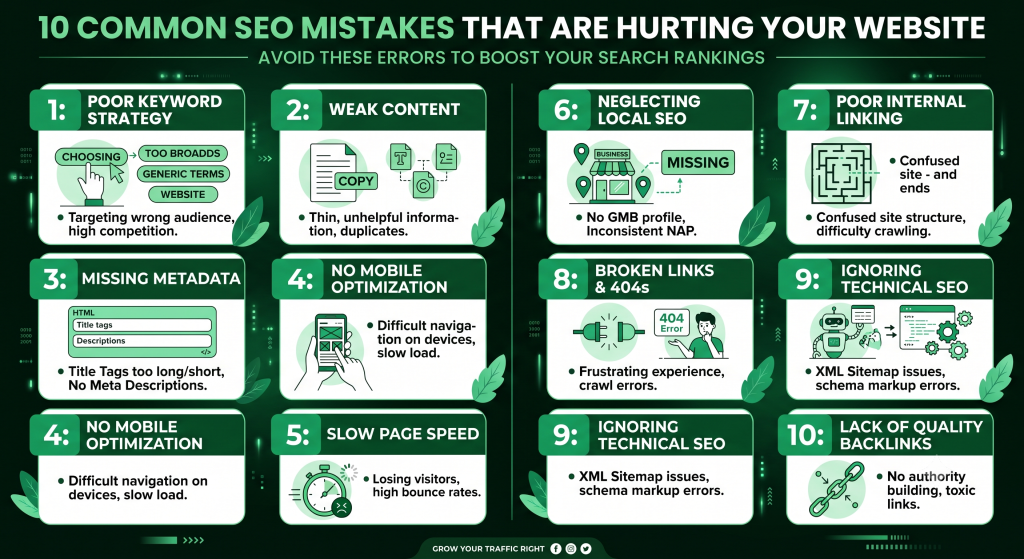
10 Common SEO Mistakes That Are Hurting Your Website

Introduction A website can have excellent products, useful services, well-written content, and a clean design, and still struggle to attract organic traffic. The problem is rarely a single dramatic issue. It is usually a collection of small technical, structural, content, or strategic problems that quietly limit performance. Most SEO problems are not penalties. They are missed opportunities. A page that targets the wrong intent will not rank no matter how well it is written. A site with broken redirects wastes crawl budget. Thin content dilutes the overall quality signal across an entire domain. This guide covers the ten most common SEO mistakes and explains how to find, fix, and prevent each one. Every section follows the same structure: what the mistake is, why it matters, how to identify it, how to fix it, and how to avoid repeating it. Quick Summary: The 10 SEO Mistakes Covered in This Guide Targeting the wrong keywords or ignoring search intent Publishing thin, generic, or low-value content Ignoring basic on-page SEO Neglecting technical SEO Creating a weak internal linking structure Ignoring mobile usability and page experience Allowing broken links, redirects, and indexing problems to accumulate Ignoring local SEO when your business serves a local market Failing to build trust, authority, and quality references Publishing content without measuring, updating, or improving it Each mistake below follows the same structure: what it is, why it matters, how to find it, how to fix it, and how to prevent it. Why SEO Mistakes Matter More Than You Think SEO does not work like a single switch that turns on visibility. It depends on many interconnected elements working together: technical accessibility, content quality, search intent matching, site structure, user experience, and authority signals. When one element breaks, the impact is often smaller than people expect. When several break together, the effect compounds. A slow site with thin content and no internal links may struggle for reasons that are hard to diagnose from any single metric. This is why SEO should be treated as an ongoing process rather than a task you complete once. Search engines, competitors, and user expectations all change. What worked two years ago may be holding you back today. The goal of this guide is not to make you paranoid about every minor issue. It is to help you identify the mistakes that genuinely limit performance and prioritize the ones that matter most for your site. 1. Targeting the Wrong Keywords and Ignoring Search Intent What it is: Targeting keywords based only on search volume without considering what the searcher actually wants. Search intent is the underlying reason behind a query, and it falls into four main types. Informational: The searcher wants to learn something (“what is SEO”) Navigational: They are looking for a specific site or brand Commercial investigation: They are comparing options before buying Transactional: They want to take action (“buy running shoes”) Why it hurts: A page that does not match the dominant intent behind a query rarely satisfies anyone. A product page targeting an informational keyword will not rank against in-depth guides. A blog post targeting a transactional keyword will not convert buyers who want to purchase now. How to identify it: Look at the top-ranking pages for your target keyword. If they are all guides and yours is a product page, there is a mismatch. Check Google’s “People Also Ask” and related searches to confirm the dominant intent. How to fix it: Align page type with search intent. If you want to rank for informational queries, write thorough guides. If you want to rank for transactional queries, create product or service pages designed to convert. How to prevent it: Before writing, always check the search results. Search intent should guide format, depth, and structure more than keyword volume. Example: A local plumber targeting “how to fix a leaking pipe” is unlikely to rank against DIY blogs. Targeting “emergency plumber in [city]” matches transactional intent and attracts people ready to call. 2. Publishing Thin, Generic, or Low-Value Content What it is: Content that says very little of value. It might be short, repetitive, generic, or written only to target a keyword. Thin content includes pages that lack depth, original insight, or a clear reason to exist. Why it hurts: Search engines aim to reward genuinely useful content and reduce visibility for pages that do not add value. When a site accumulates many low-quality pages, the overall quality signal can suffer. How to identify it: Ask whether the page genuinely helps someone solve a problem, or whether it repeats what other pages already say. Check pages with high bounce rates and low engagement for clues. How to fix it: Improve, merge, or remove weak pages. Add original insight, examples, or specifics that cannot be found elsewhere. Make sure every page serves a clear purpose. How to prevent it: Set a minimum quality bar before publishing. Every new page should answer a real question better than what already exists. Note on AI content: AI can help with research, outlining, and drafting, but publishing raw AI output rarely produces strong results. Content should be reviewed, fact-checked, and improved by humans who understand the topic and the audience. 3. Ignoring Basic On-Page SEO What it is: Missing or poorly implemented on-page elements that help search engines and users understand a page. Why it hurts: On-page SEO is the foundation. Without clear titles, headings, and descriptions, pages are harder to understand and less likely to perform well in search. Common on-page mistakes: Missing, duplicate, or vague title tags Missing or unclear H1 headings Poor heading hierarchy Missing meta descriptions Keyword stuffing Non-descriptive URLs Missing image alt text No contextual internal links How to identify it: Use a site crawler or Google Search Console to check for missing titles, duplicate meta descriptions, and other on-page issues. Review important pages manually. How to fix it: Write unique, descriptive title tags for every page. Use one clear H1. Structure content with logical H2 and H3 headings. Write helpful

Uncategorized

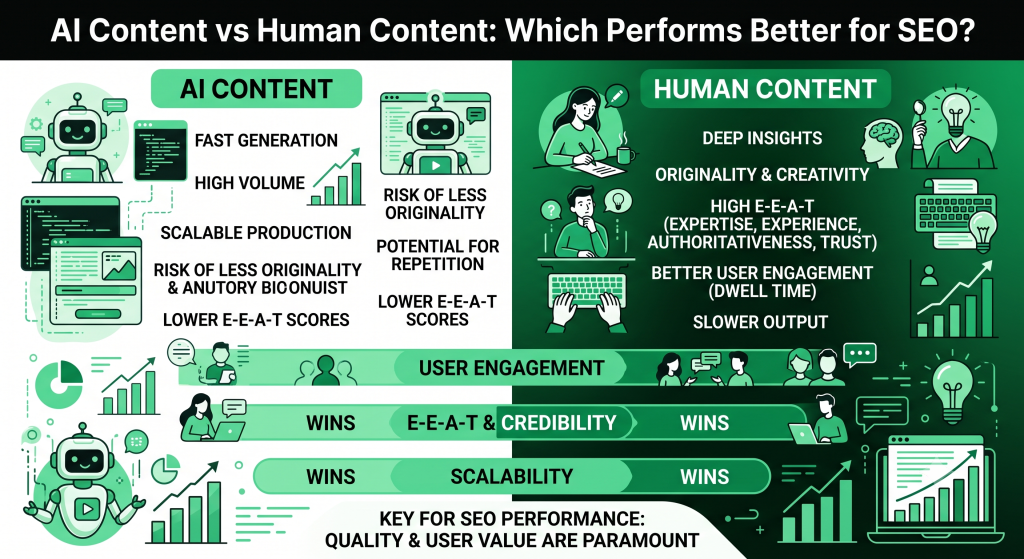
AI Content vs Human Content: Which Performs Better for SEO?

Introduction A tool can now produce a thousand well-formed words in under a minute. A human writer with genuine expertise may take hours to produce the same length. Yet the human version often performs better in search. Meanwhile, some AI-assisted content clearly outperforms poorly written human articles. This is the part most debates miss. The SEO question is not simply whether content was created by AI or a human. The question is whether the content genuinely satisfies the searcher better than the alternatives. This guide compares AI-generated content, AI-assisted content, and human-written content in a practical way. It explains what actually drives search performance, where each approach has real advantages, and how businesses can build a workflow that combines efficiency with expertise. AI Content vs Human Content: What Is the Difference? Not all content falls neatly into one category. It helps to separate three distinct approaches. AI-generated content: Content produced primarily by AI with little or no meaningful human review. It is often fast and cheap, but usually requires heavy editing to be useful. AI-assisted content: Content where AI is used for research support, ideation, outlining, drafting, editing, or analysis, with significant human oversight throughout the process. Human-written content: Content primarily researched, developed, and written by a human, possibly with AI used for small tasks like grammar checking. The table below compares the three approaches across the factors that matter most for SEO. Factor AI-Generated AI-Assisted Human-Written Speed Very fast Fast with review Slower Scalability High Moderate to high Limited by capacity Original insight Often limited Strong if humans add value Typically strong Personal experience Rarely genuine Possible with input Genuine where present Editing needs Heavy Moderate Standard Research support Fast but needs verification Strong with verification Depends on writer Consistency Variable Good with editing Depends on writer SEO potential Variable High with proper workflow High with genuine expertise Can AI-Generated Content Rank on Google? Yes, AI-generated content can rank in search results. Search engines evaluate content based on quality, usefulness, and relevance, not based on whether AI or a human produced it. That said, low-quality, inaccurate, or unhelpful content can struggle to rank regardless of how it was created. The distinction that matters is between how content is produced and whether the resulting content is useful and compliant with search guidelines. Google’s public guidance has been consistent for years: the company focuses on rewarding helpful, people-first content and reducing the visibility of content created primarily for search engines rather than users. This applies whether the content is written by a person or generated with AI. That means AI-generated content is not automatically penalized simply because AI was used. It can perform well when it is accurate, useful, and appropriately reviewed. It can also fail when it is thin, repetitive, inaccurate, or produced purely to chase keywords. Note: Search engine policies and algorithms change over time. For the most current guidance, consult official documentation from the search engines themselves. What Makes Content Perform Well in Search? Before comparing approaches, it helps to be clear about what search engines actually reward. These factors matter more than production method: Search intent: Does the content match what the searcher was actually looking for? Relevance: Is the topic clearly connected to the query being asked? Helpfulness: Does it solve a real problem or answer a real question well? Accuracy: Is the information factually correct and up to date? Original value: Does it offer something beyond what already exists? Expertise and experience: Does it reflect genuine knowledge and understanding? Trust: Is the source transparent and credible? User experience: Is the page fast, easy to read, and mobile-friendly? Technical accessibility: Can search engines crawl and understand the page? Topical coverage: Does the site address the topic comprehensively across related pages? The rest of this comparison is judged against these factors rather than against the label of AI or human. Advantages of AI-Generated Content for SEO AI brings real advantages when it is used thoughtfully, not blindly. Faster Content Production Drafting and ideation can happen in minutes rather than hours. This helps teams move from concept to first draft quickly, leaving more time for review and refinement. Content Scalability With proper supervision, AI can support larger content programs. This is useful for covering a broad topic comprehensively, though it does not replace strategic thinking. Brainstorming and Topic Ideation AI can help generate topic ideas, content angles, outlines, and FAQ candidates. This speeds up the early stage of content planning. Repurposing Existing Content AI can help transform an existing article into social posts, summaries, FAQs, email drafts, and video scripts. This extends the reach of content you have already invested in. Research Organization AI can help sort and organize research notes, though any factual claim it produces still needs verification before publication. Disadvantages and Risks of AI-Generated Content The weaknesses of AI-generated content are real and worth understanding. Generic or Repetitive Writing AI often produces content that reads like many other pieces. Formulaic phrasing and predictable structure make it hard to stand out. Factual Errors and Hallucinations AI can state incorrect facts with confidence. Every claim needs verification before publication, especially anything specific, technical, or current. Lack of First-Hand Experience AI cannot have real experience. This limits how far it can go in demonstrating genuine expertise on topics where lived experience matters. Lack of Original Insights Summarizing existing information is not the same as adding new insight. Content that only repeats what is already available rarely earns strong visibility. Overproduction of Low-Value Content Because AI makes publishing easy, some sites produce large volumes of content without a clear audience need. This can dilute a site’s overall quality signal. Brand Voice Problems Raw AI output often does not sound like the business it is supposed to represent. Brand voice requires deliberate human attention. Editorial and Fact-Checking Requirements AI does not remove the need for editing, fact-checking, and quality review. It shifts the work rather than eliminating it. Advantages of Human-Written Content for SEO Human writers bring value that

Uncategorized

How to Turn Social Media Followers Into Customers

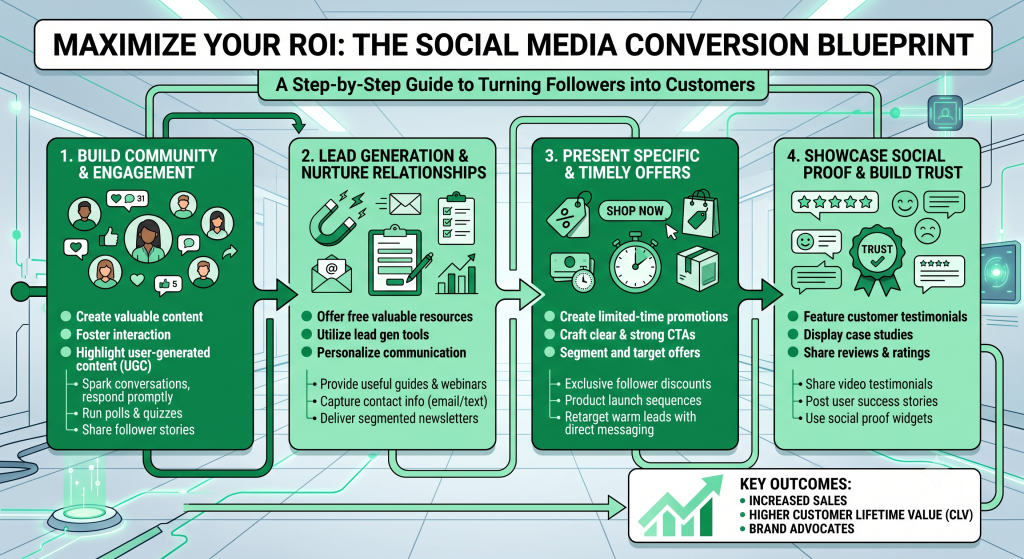
Introduction A business can have twenty thousand followers and still struggle to pay its bills. Another business with a few hundred highly engaged followers can quietly be growing month after month. The difference rarely comes down to content quality alone. It usually comes down to whether the business has a plan for moving people from following to buying. Followers are attention. Customers are outcomes. The gap between the two is the work this article is about. It covers the journey from follower to engaged audience member, then to lead, prospect, and customer, with practical strategies at each stage. If you have been growing an audience but not seeing it translate into sales, the problem is almost always one of relevance, trust, or a missing next step. This guide helps you find and fix all three. Why Having More Followers Does Not Automatically Mean More Customers Follower count measures attention, not purchase intent. Someone who follows your page may be curious, may have stumbled on one post, or may simply have clicked follow on impulse. None of that guarantees they will buy. The people in your audience are at very different stages: Followers – people who have chosen to see your content Engaged audience members – those who like, comment, share, or reply Leads – people who have taken an action indicating interest Prospects – leads who are evaluating whether to buy Customers – people who have made a purchase A business with 1,000 followers who genuinely need what they sell will usually outperform a business with 100,000 followers who do not. This is not a rule, but it reflects a common pattern: relevance beats reach. Relevance means the audience actually has the problem you solve. Purchase intent means they are ready to take action. Trust means they believe you can deliver. Timing means they need it now. A conversion requires all four to line up, which is why follower count alone tells you so little. Understand the Customer Journey Before Trying to Sell Not every follower is ready to buy. Treating them as if they are usually backfires. Understanding where each person is in the journey helps you send the right message at the right time. Awareness The follower discovers your business for the first time. They may not know what you sell yet. Interest They start engaging with your content. They like, comment, or save posts that are relevant to them. Consideration They evaluate whether your business can solve their problem. They compare options, read reviews, and ask questions. Decision They are close to buying. They need one more reason to trust you or one final push. Conversion They become a lead or a customer, depending on your business model. Retention They return, buy again, or recommend you to others. Loyalty compounds. Most businesses make the mistake of treating everyone as if they are in the decision stage. This creates aggressive, sales-heavy content that drives away followers who were still just getting to know the brand. The right approach is to have content for every stage. 1. Attract the Right Followers Instead of Chasing Large Numbers The type of follower you attract determines how easy they will be to convert later. Followers who match your ideal customer profile are more likely to engage, trust, and buy. Start by defining your ideal customer clearly: Who are they? (age, location, occupation, life stage) What problem do they have that you can solve? What are they already searching for or talking about? What content do they consume and where? What objections would keep them from buying? Then choose content and platforms that attract that specific person. A niche business talking only to its audience will attract fewer but more relevant followers. A broad business chasing viral moments often attracts people who will never buy. There is a tradeoff here, and most small businesses are better served by relevance. 2. Optimize Your Social Media Profile for Conversions Your profile is often the first place a curious follower goes when they want to learn more. If it does not quickly answer who you help and what to do next, you lose the moment. A conversion-focused profile should clearly communicate: Who you help What problem you solve What you offer Why people should trust you What action to take next Practical profile checklist: Bio that states clearly who you help and how Professional profile image or logo Cover image that reinforces what you do Single clear link (website, landing page, or link-in-bio tool) Contact method visible (email, phone, or DM instructions) Highlights or featured content covering your services and best content Pinned posts that introduce the business or explain a key offer A call-to-action in the bio itself A strong profile does not convert followers on its own. It removes confusion, which is the first step. 3. Create Content for Different Stages of the Buying Journey Not every post should sell. If every piece of content asks for the sale, you will lose followers who were still getting to know you. If nothing ever sells, you will lose followers who were ready to buy. A balanced content mix looks like this: Awareness Content Educational posts, industry insights, tips, short videos, and problem-focused content. Purpose: attract and inform the right people. Consideration Content Product explanations, comparisons, demonstrations, case studies, and behind-the-scenes content. Purpose: help people evaluate whether you fit their needs. Conversion Content Offers, consultations, free trials, lead magnets, clear CTAs, and product demonstrations. Purpose: help ready buyers take the next step. Retention Content Customer education, tips, community content, product updates, and loyalty-focused posts. Purpose: keep existing customers engaged and encourage repeat purchases. A common starting split is 60 percent awareness, 20 percent consideration, 15 percent conversion, and 5 percent retention. Adjust based on your audience size and business model. 4. Build Trust Before Asking Followers to Buy People rarely buy from a business they do not trust. On social media, trust is built slowly through consistency, transparency, and usefulness. Practical trust builders: Educational content

Uncategorized

How to Improve Your Google Ads Conversion Rate

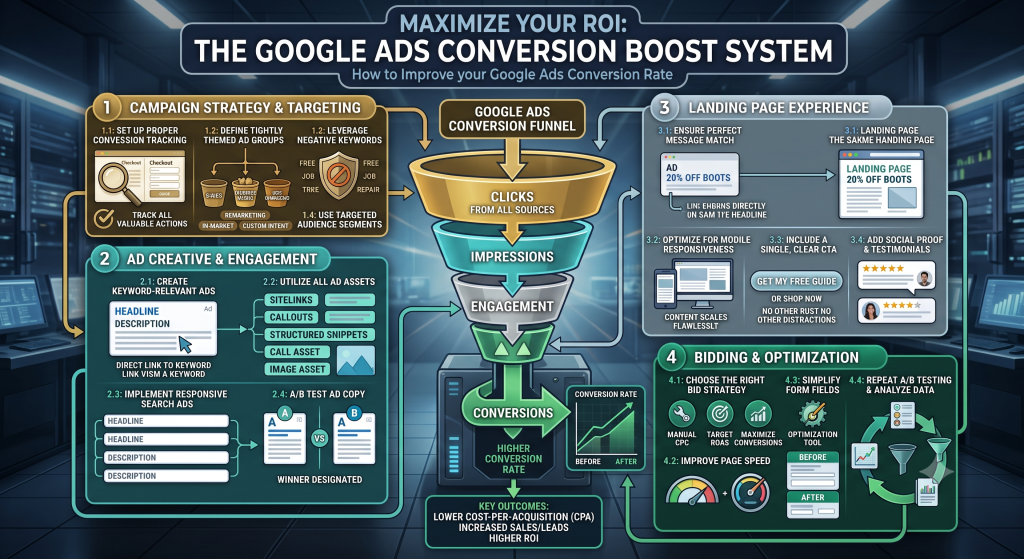
Introduction Your Google Ads campaign may be generating clicks, but clicks alone do not grow a business. If visitors are not calling, submitting forms, booking, or buying, your campaign may be spending money without producing meaningful results. Improving conversion rates is rarely about changing one setting. It usually requires improving the entire journey: Search to Ad to Click to Landing Page to Offer to CTA to Conversion. A weak link anywhere in that chain can reduce results, even if everything else is working well. This guide walks through a practical framework for diagnosing conversion problems, improving traffic quality, strengthening ad relevance, optimizing landing pages, and testing improvements systematically. It focuses on what genuinely helps the right visitor take meaningful action, not on shortcuts or promises. What Is Google Ads Conversion Rate? Google Ads conversion rate is the percentage of ad interactions or visits that result in a desired action, such as a lead, phone call, purchase, booking, or form submission. The basic formula is: Conversion Rate = (Conversions / Relevant Interactions) x 100. The exact calculation can vary depending on campaign settings and how conversions are defined in your account. Conversion rate should never be read in isolation. A high rate can still hide a bad campaign if the conversions are low quality or unprofitable. Consider it alongside: Cost per conversion – how much you pay for each result Conversion value – what each conversion is worth to your business Return on ad spend – revenue relative to ad spend, where applicable Lead quality – whether leads turn into customers Revenue – the actual business outcome, not just the number of leads A campaign with a modest conversion rate but high lead quality and strong revenue is usually more valuable than one with a high rate and no paying customers. Why Are Your Google Ads Getting Clicks but Not Conversions? Clicks without conversions usually mean something in the journey from search to action is broken. The problem may start before the visitor reaches your landing page. Common causes include: Wrong audience. Your ads may be reaching people who are not in a position to buy or are outside your service area. Poor keyword intent. You may be bidding on research-stage keywords that rarely produce buyers. Weak ad-to-landing-page relevance. If the ad promises one thing and the page delivers another, visitors leave. Slow landing pages. Visitors abandon pages that take too long to load, especially on mobile. Unclear CTA. If visitors do not know what to do next, they usually do nothing. Weak offer. No amount of optimization can fix an offer nobody wants. Poor trust signals. Visitors hesitate when they cannot verify who they are dealing with. Complex forms. Long or confusing forms create friction at the last step. Incorrect conversion tracking. If tracking is broken, you may be optimizing based on incomplete or misleading data. Step 1: Make Sure You Are Tracking the Right Conversions Optimization without reliable measurement is guesswork. Before changing anything, confirm that your conversion tracking reflects real business actions. Different types of conversions to consider: Purchases (e-commerce) Form submissions Phone calls from ads or the website Bookings and appointments Quote requests Demo requests Qualified leads, where you can track them back to the source It helps to separate primary business conversions (the actions that directly drive revenue) from secondary engagement actions (newsletter signups, downloads, or page views that indicate interest but are not purchases). Not every click, page view, or button interaction should be treated as a primary conversion. Define conversions based on meaningful business goals, and validate that they fire correctly before drawing conclusions from the data. Step 2: Improve Keyword Targeting and Search Intent Alignment Traffic quality matters more than traffic volume. A keyword that brings 500 visits and no customers is worth less than one that brings 30 visits and 5 qualified leads. Understanding intent behind searches: High Intent Searchers who are actively looking for a product or service. These often include words like “near me,” “hire,” “buy,” “book,” or specific product names. Research Intent Searchers who are still learning. Words like “what is,” “how to,” or “best way to” usually signal this stage. These visitors may convert later but rarely convert on the first visit. Low Relevance Searches from people who are unlikely to become customers. This might include job seekers, students, or people outside your service area. Review your search terms report regularly. Identify which queries produce conversions and which consume budget without results. Match types matter here too, since broad match reaches further but often brings in less relevant traffic. Example: A plumber bidding on “plumbing” may get clicks from people researching how plumbing works. Bidding on “emergency plumber near me” attracts people who need help right now and are far more likely to call. Step 3: Use Negative Keywords to Reduce Wasted Traffic Negative keywords prevent your ads from showing for searches you do not want. They are one of the simplest ways to reduce wasted spend and improve conversion rate, because they filter out traffic that was never going to convert. A practical process: Review your search terms report Identify irrelevant themes (job seekers, free seekers, unrelated topics) Confirm they are genuinely irrelevant to your business Add negative keywords carefully, at the appropriate level Monitor results over the next few weeks Important: Do not add negative keywords blindly. Overly aggressive lists can block valuable searches and reduce your reach. Add them based on real data, not assumptions. Step 4: Improve Ad Relevance Ad relevance is about alignment. The visitor should see a clear connection between what they searched for, the ad they clicked, and the page they land on. The chain looks like this: Search Query -> Keyword Theme -> Ad Copy -> Landing Page. A mismatch anywhere in that chain reduces the likelihood of conversion. Relevant ads usually include: Headlines that reflect what the searcher typed Descriptions that explain the specific benefit A clear offer or next step Language that matches the searcher’s intent An

Uncategorized

How to Create Content That Deserves to Rank

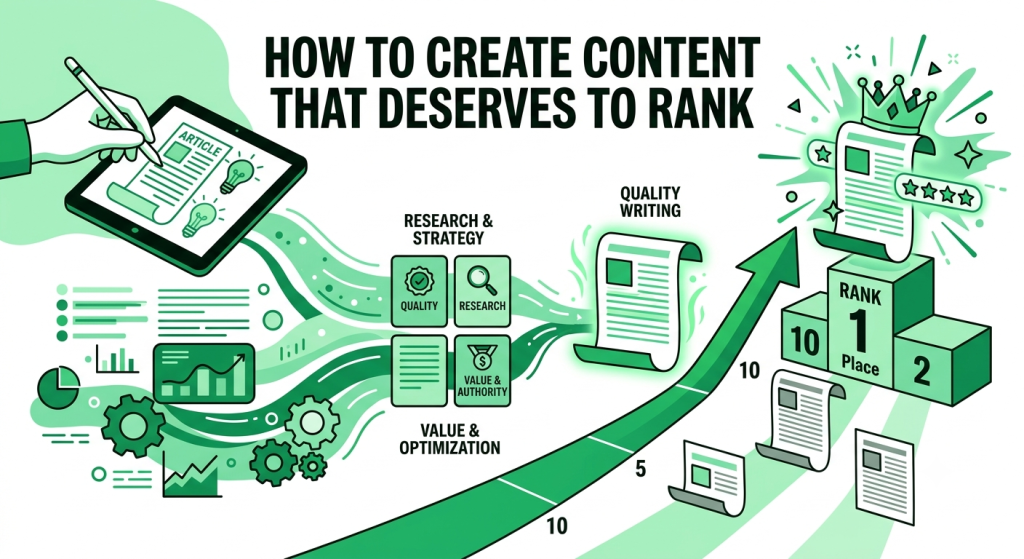
Introduction Most websites do not have a traffic problem. They have a content relevance problem. Articles get published, indexed, and then sit quietly on page four because they answer a slightly different question than the one people are actually asking. Publishing more content does not fix this. Neither does targeting more keywords. What fixes it is creating content that genuinely deserves to be seen, because it answers a real question better than what already exists. This guide walks through a practical framework for creating content that earns visibility: how to understand your reader, match search intent, find information gaps, add original value, and optimize for traditional search, answer engines, and AI-powered search. It is about earning attention through usefulness, not through manipulation. What Does “Content That Deserves to Rank” Actually Mean? Content deserves to rank when it provides a genuinely useful, accurate, and satisfying answer to a real search need, in a format that matches what the searcher expected to find. Ranking-worthy content usually has several qualities in common: It understands who is searching and why It matches the searcher’s intent, not just their keyword It answers the main question directly It goes deep enough to be genuinely useful It is easy to read and navigate It demonstrates real expertise It offers something beyond what already exists It is accurate and current The difference between content written to include keywords and content written to solve a problem is usually obvious within the first paragraph. One reads like a checklist. The other reads like someone actually trying to help. Search engines and AI systems are increasingly good at telling the difference, and so are readers. Why Publishing More Content Does Not Automatically Improve Rankings Volume is not a ranking factor. A blog with five hundred thin articles will usually perform worse than a blog with fifty genuinely useful ones, because the thin content dilutes the site’s perceived quality and makes it harder for readers to find what matters. Common problems that come from a publish-more mindset: Thin content that covers a topic superficially without adding anything new Repetitive articles that say the same thing in slightly different ways Keyword-focused writing that reads like it was written for a machine Generic AI drafts published without human review or genuine insight Content created without understanding the audience Publishing without a clear purpose just to maintain a schedule Fewer high-quality resources that fully answer real questions tend to outperform large volumes of low-value content. This is not a rule that guarantees rankings, but it reflects how both readers and search systems evaluate usefulness. Step 1: Start With the Searcher, Not the Keyword Before writing anything, understand the person behind the search. Keywords tell you what someone typed. They do not tell you who they are, what they already know, or what they are trying to achieve. Ask these questions: Who is searching for this? What problem are they trying to solve? What stage are they at in their research? What do they already know about the topic? What action might they want to take after reading? Example: The query “content marketing” could come from a business owner who has never heard the term, a marketer comparing agencies, or a student writing an essay. Each needs a different type of content. Without knowing which searcher you are writing for, your article will end up vaguely useful to no one. Step 2: Understand Search Intent Before Writing Search intent is the reason behind a query. Matching it matters more than matching the exact keyword, because a page that answers the wrong intent rarely satisfies anyone. Informational The searcher wants to learn something. They usually expect a guide, explanation, or tutorial. Navigational They are trying to reach a specific website or brand. Content is rarely needed here. Commercial Investigation They are comparing options before a purchase. They expect reviews, comparisons, and pros and cons. Transactional They want to take an action such as buying, signing up, or downloading. They expect a product page or landing page. To determine intent, look at the search results themselves. What type of pages are ranking? What are competitors covering? What questions appear in “People Also Ask”? The patterns usually reveal what searchers expect. A well-written article in the wrong format will still fail, because it does not match what the searcher came for. Step 3: Study the Existing Search Landscape Before writing, read what already ranks. Not to copy it, but to understand what the search engines already consider useful for this query. This tells you what searchers expect and where there is room to add something better. Look for: Topics competitors consistently cover Questions they answer and questions they miss Content formats used Strengths and weaknesses Information that is outdated Areas where reader experience could improve The goal is not to replicate. It is to identify what is missing, unclear, or shallow so you can fill that gap with something more useful. Step 4: Find the Information Gap An information gap is a question or detail that searchers want but existing content does not address well. Filling a real gap gives your page a clear reason to exist. Common gaps worth filling: Unanswered follow-up questions Missing practical examples Outdated explanations or references No beginner-friendly guidance Lack of expert depth Missing comparisons between options Poor organization that makes information hard to find No visuals that would clarify a concept Missing step-by-step instructions You do not need to fill every gap. Filling one meaningful gap well is more valuable than a surface attempt at ten. The question to ask is simple: after reading this, would the searcher have gotten something they could not get elsewhere? Step 5: Create a Clear Content Brief Before Writing Strong content usually begins before the first paragraph is written. A short brief keeps the work focused and prevents the article from drifting into generic territory. A practical content brief includes: Primary topic Target audience Search intent Main question to answer Secondary questions to cover Primary keyword

Artificial Intelligence

How to Build Brand Authority for AI Search

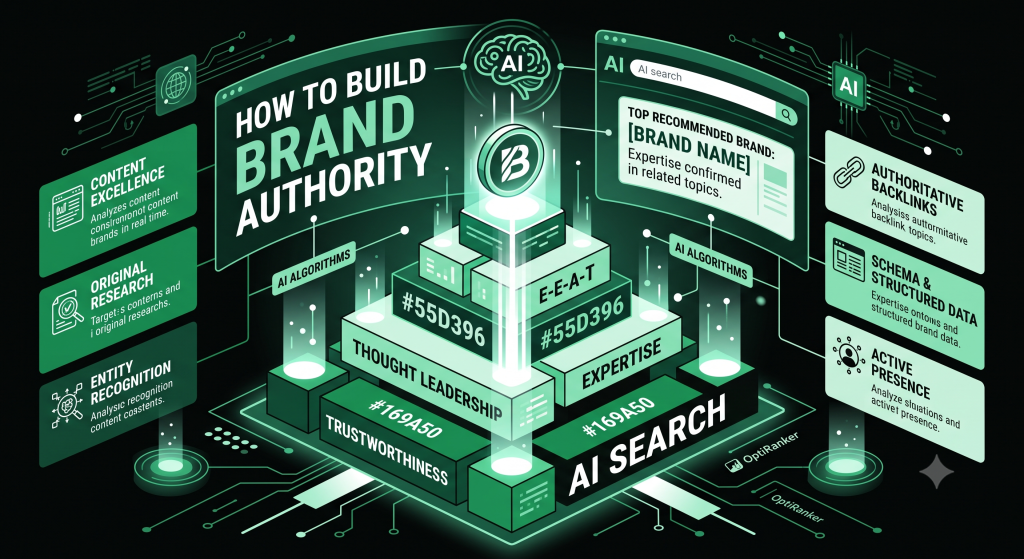
Introduction When someone asks an AI assistant for a recommendation, a shortlist, or an explanation, the answer they receive is assembled from sources the system has reason to trust. That trust is not random. It is usually connected to how clearly a brand communicates its expertise, how consistently it appears across the web, and how useful its content is to real people. This is where brand authority becomes a practical concern rather than an abstract marketing idea. Authority is the accumulated result of doing good work, explaining it well, and being recognized for it over time. In an AI-driven search environment, that reputation matters more than ever because AI systems draw on it to decide what is worth repeating. This guide explains how to build brand authority for AI search in a way that is honest, realistic, and actionable. You will learn how AI systems understand brands, how to build topical and entity authority, what trust signals matter, how SEO, AEO, and GEO work together, and what small businesses can do without a large budget. What Does Brand Authority Mean in AI Search? Brand authority in AI search means how consistently and credibly a business demonstrates expertise, trustworthiness, and relevance in the areas it claims to serve. AI-powered systems use multiple signals from across the web to understand a brand, but there is no single universal formula that determines what they will cite or recommend. Authority is not something you declare. It is something others recognize because of what you publish, how you work, and how your customers and peers talk about you. In practical terms, it combines several things: Demonstrated expertise – content that shows genuine understanding, not surface-level summaries Consistency – the same name, services, and messaging everywhere your brand appears Trust signals – clear business information, authorship, and transparency about who is behind the content Recognition – mentions, links, and references from relevant and reputable sources Relevance – being clearly associated with specific topics rather than trying to cover everything AI-powered search systems do not read your website the way a human does. They combine information from many sources including your site, third-party mentions, structured data, and public records. Your goal is not to decode a hidden algorithm. It is to make the information about your brand clear, accurate, and easy to connect across all the places it appears. Why Brand Authority Matters for AI Search Visibility When a generative AI system produces an answer, it draws on sources it has learned to associate with relevant topics. It is not evaluating just one page. It is making a judgement about which sources are coherent, credible, and consistent enough to include in a synthesised response. A brand that is widely recognized in its field has a different starting position from a brand that appears only on its own website. Recognition comes from being mentioned, referenced, and discussed by others. It is also supported when the information about a brand is consistent everywhere it appears, so the system can connect the dots. Trust: Content is more likely to be used when it is accurate, well-sourced, and clearly written. Content quality: Depth and original insight tend to outlast surface-level information. Consistent information: Matching details across the web help systems form a clean picture of your brand. Expertise: Subject knowledge shown through detailed, specific content is easier to verify. Brand recognition: Familiar names carry more weight when a system is deciding what to reference. Reputation: Reviews, mentions, and public discussion contribute context that supports or undermines trust. Accuracy: Outdated or conflicting information can weaken how confidently a brand is described. There is a clear chain at work: authority leads to trust, trust leads to better understanding, and better understanding creates more opportunities for visibility. That chain is not guaranteed, and no business can force an AI system to cite it. What you can do is improve the conditions that make recognition more likely. How AI Search Systems Understand Brands Generative AI systems build an internal understanding of a brand by pulling together information from many places. They do not rely on a single page or a single signal. Here are the main concepts involved, explained in plain language. Entity Understanding An entity is a distinct thing, such as a business, a person, or a product. Systems try to recognise that your brand is a specific entity with a name, a purpose, and a set of associated topics. Clear naming, a consistent description, and structured data help this process. Contextual Relevance Systems assess whether your content is relevant to the query being asked. A page about SEO is relevant to SEO questions. A page about SEO on a bakery website may be less relevant unless the bakery also does SEO consulting. Topical Associations The more consistently your brand publishes and is mentioned in connection with a topic, the stronger the association becomes. This is why breadth without depth rarely builds authority. Consistent Brand Information If your business name, address, phone number, services, and description differ across the web, systems may struggle to connect everything to a single entity. Consistency reduces ambiguity. Third-Party Validation Mentions and references from other reputable sources act as external confirmation that a brand is real, relevant, and worth paying attention to. These are not the only signal, but they carry weight. Note: The exact weighting of these factors is not publicly disclosed by the companies that operate AI search systems. The explanations above describe general principles, not a guaranteed formula. 1. Define What Your Brand Wants to Be Known For A brand cannot be an authority on everything. Attempting to cover too many unrelated topics dilutes the signal and makes it harder for systems and people to understand what you actually stand for. Start by answering a few honest questions about your business: What problem do we solve? Who do we solve it for? What topics are we genuinely qualified to discuss? What makes our knowledge or approach useful? What do we want people to associate with

Uncategorized

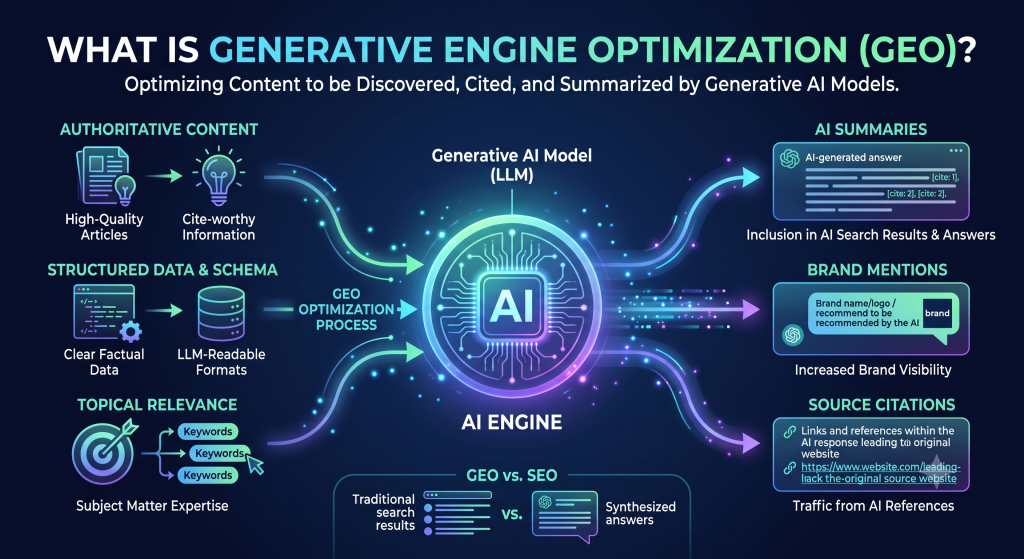
What Is Generative Engine Optimization (GEO)?

Think about the last question you typed into a search bar. Did you scroll through ten blue links and compare them one by one? Or did you ask an AI assistant, read the summary it gave you, and move on with your day? For a growing number of people, it is the second option. Search behaviour is shifting from browsing to asking. Instead of collecting sources, users now expect a single, well-written answer that pulls together information from multiple places. That shift changes something fundamental for businesses. Being on page one is no longer the only goal. What matters now is whether AI systems understand your content well enough to include it, summarise it, and mention your brand in the answers they generate. That is exactly where Generative Engine Optimization comes in. In this guide, you will learn what GEO is, how it works, how it differs from SEO and AEO, and what practical steps you can take to make your website more visible in AI-powered search. Quick Answer: What Is Generative Engine Optimization (GEO)? Generative Engine Optimization (GEO) is the practice of creating, structuring, and improving content so that generative AI systems such as AI assistants and AI-powered search engines can understand it, trust it, and cite it in their generated answers. Instead of optimizing only for ranked links, GEO optimizes for inclusion inside AI-generated responses. In simple terms, traditional SEO asks: ‘Can people find my page?’ GEO asks a slightly different question: ‘Will an AI system use my content when it writes an answer?’ Both questions matter. But as AI-generated summaries become more common, the second one is becoming harder to ignore. What Is Generative Engine Optimization (GEO)? Generative Engine Optimization is a digital marketing approach focused on making your content visible, usable, and citable inside AI-generated answers. A generative engine is any system that produces a written response instead of a list of links. This includes conversational AI assistants, AI-powered search experiences, and search features that summarise results at the top of the page. These systems do not simply match keywords to pages. They read, interpret, and combine information from many sources, then generate a response in natural language. GEO is the work of making sure your content is one of the sources that shapes that response. Increases the chance of your brand being mentioned in AI-generated answers Builds recognition as a credible source within your topic Improves how accurately AI systems describe your products or services Supports long-term brand visibility even when users never click a link Strengthens the same content foundations that already help traditional SEO A simple example Imagine someone asks an AI assistant: ‘What is the best way to choose a digital marketing agency for a small business?’ The assistant generates a short list of things to consider including pricing models, reporting transparency, relevant experience, and questions to ask during a consultation. If your website has a genuinely helpful, clearly structured article on exactly that topic, an AI system may draw on it when forming the answer. You may not get a click, but you may get a mention. That mention is brand visibility in AI search, and it is exactly what GEO is designed to earn. Why Is Generative Engine Optimization Important? GEO matters because the way people find information has changed, and the way visibility is earned has changed with it. Search has become conversational. Users now type or speak full questions instead of short keywords. Content that answers real questions clearly performs better in both traditional and AI-driven search. AI-generated answers reduce clicks. When a summary appears at the top of a results page, many users never visit a website. If your content is not part of that summary, your reach shrinks even if your rankings have not changed. Brand visibility is being decided elsewhere. AI assistants mention brands by name. Whether you are described accurately, and whether you are mentioned at all, depends on how well your content is understood. Trust and authority carry more weight. Generative systems favour content that is accurate, well-sourced, and clearly written by someone who knows the subject. Vague or thin content rarely gets cited. Discoverability is expanding beyond Google. People find answers through AI assistants, chat interfaces, and app-based search experiences. GEO helps your content travel across all of those surfaces. Accuracy protects your reputation. If AI systems pick up outdated or incomplete information from your site, they may describe your business incorrectly. Keeping content current is a form of brand protection. How Does Generative Engine Optimization Work? Generative Engine Optimization works by making your content easier for AI systems to understand, verify, and reuse. There is no single trick. It is a combination of content quality, structure, and clarity. 1. Create genuinely useful content. AI systems favour information that helps people. Content that solves a real problem, answers a real question, or explains a real process has a better chance of being used. 2. Give direct answers. State the answer early, then explain it. A clear two-sentence answer near the top of a section is far easier for an AI system to extract than a long build-up. 3. Build topical authority. Cover your subject in depth across multiple related articles. When your site consistently addresses a topic, it becomes a more obvious source to draw from. 4. Use structured content. Headings, subheadings, bullet points, numbered lists, and tables help both readers and machines understand how information is organised. 5. Improve entity clarity. Be specific about who you are, what you do, and what you are talking about. Name your services, locations, and concepts clearly instead of relying on vague phrasing. 6. Demonstrate expertise and trustworthiness. Show who wrote the content, when it was updated, and what it is based on. Transparency signals reliability. 7. Support claims with reliable information. Where you make a factual statement, give context. Avoid unsupported superlatives such as ‘the best’ or ‘guaranteed number one’ without evidence. 8. Keep content accurate and updated. AI technologies evolve quickly. Reviewing

Uncategorized

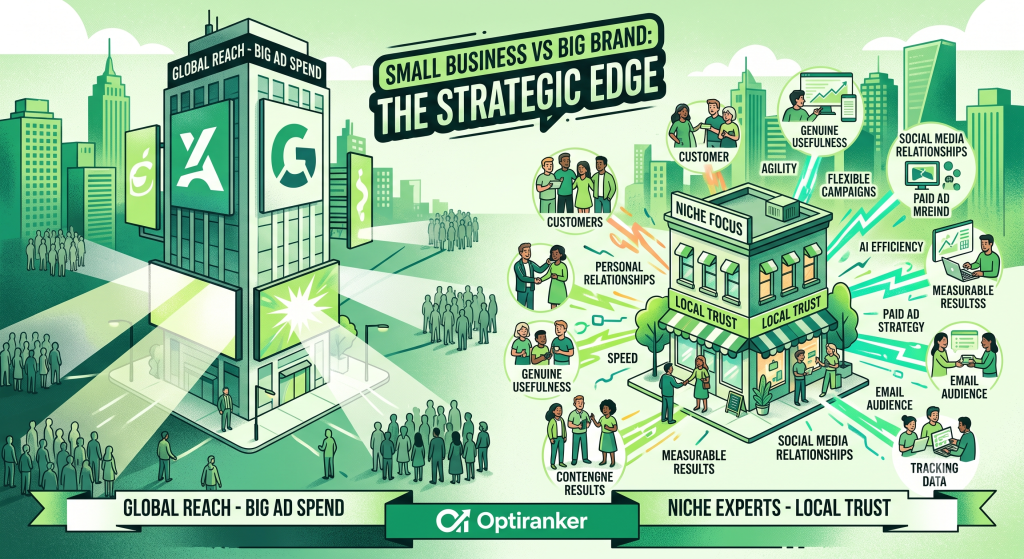
How Small Businesses Can Compete With Big Brands Using Digital Marketing

Competing With Big Brands Isn’t About Budget — It’s About Focus If you run a small business, you’ve probably felt it: a larger competitor spends more on ads, dominates search results, and has a marketing team you can’t afford. It’s easy to assume you can’t compete. But that assumption is wrong — or at least, incomplete. Big brands win on reach. Small businesses win on relevance, speed, personal relationships, and local trust. Digital marketing evens the playing field because it rewards focus, consistency, and genuine usefulness more than raw budget. This guide walks you through 12 practical strategies that small businesses use to compete with larger competitors online. Every tactic is realistic, affordable, and designed to work even if you’re a one-person marketing team. Can Small Businesses Really Compete With Big Brands? Yes — but not by trying to outspend big brands. Small businesses compete by being faster, more personal, more focused, and more local than larger competitors who can’t move as quickly or personalize at scale. Competing doesn’t mean winning everywhere. It means winning where you’re strongest: Focus — You can serve a narrow audience extremely well instead of chasing everyone. Speed — You can test an idea and launch it in days. A big company needs committee approvals. Personalization — You can remember customer names, preferences, and history. Local relevance — You can rank in your city or region where national chains struggle. Customer relationships — Loyal customers who feel connected to your business become your best marketers. Niche expertise — You can become the go-to expert in a specific area rather than a generalist. A local bakery can’t out-advertise a national brand. But it can own the morning commute crowd in its neighborhood, build a loyal email list, and get featured in local media — things the national brand will never prioritize. Why Digital Marketing Gives Small Businesses an Advantage Digital channels removed most of the barriers that used to favor big companies. Today, a well-run small business can reach a specific audience, measure results precisely, and adjust quickly — all without a huge budget. Lower barriers to entry — You can start with a website, a Google Business Profile, and a social page for almost nothing. Precise targeting — Digital ads and content let you reach specific people by location, interest, or behavior. Measurable results — You can track exactly what brings in traffic, leads, and sales. Flexible campaigns — You can pause, adjust, or scale campaigns weekly instead of being locked into annual contracts. Faster experimentation — Small budgets let you test ten ideas quickly; big brands often can’t. Cost control — You can cap daily ad spend and only pay for results you can track. The advantage isn’t access — it’s agility. A small business can respond to a customer question, launch a new service, or pivot a campaign in a day. A larger company usually can’t. 12 Practical Strategies Small Businesses Can Use Right Now Each strategy below is practical, budget-friendly, and focused on outcomes that matter — not vanity metrics. You don’t need to do all 12 at once. Pick two or three, execute them well, and add more as you grow. 1. Focus on a Specific Niche Instead of Trying to Reach Everyone Big brands often speak to everyone. That’s a weakness, not a strength — because broad messaging rarely resonates deeply with anyone. Why it works: A focused niche lets you speak directly to a specific person’s problem, which makes your marketing more relevant and your offer more compelling. How to do it: Identify the specific customer segment you serve best (e.g., “eco-conscious parents in Austin” instead of “families”). Write copy, create content, and design offers around that segment’s exact needs. Refuse to be everything to everyone — this is a strength, not a limitation. Example: A fitness trainer who specializes in “postnatal strength for new moms” will out-market a general personal trainer in that niche, even against a big gym chain. 2. Build a Strong and Memorable Brand Identity A strong brand isn’t about budget — it’s about consistency and clarity. Big brands spend millions reinforcing their identity. You can build yours with discipline. What to focus on: Clear positioning — One sentence that explains who you serve and why you’re different. Consistent messaging — Same tone, same promise, everywhere you show up. Brand voice — Decide if you’re warm, professional, playful, or direct — and stick with it. Visual identity — Logo, colors, and fonts used consistently across your site, social, and print. Unique value proposition — The specific thing you do better or differently than competitors. Example: A local coffee roastery built its entire brand around “small-batch, single-origin, roasted weekly.” Every post, label, and email reinforces that promise. Customers remember it because it’s specific — not because it’s loud. 3. Invest in Local SEO to Compete Where Big Brands Are Less Personal Local SEO is one of the highest-ROI channels for small businesses. When someone searches “plumber near me” or “best bakery in [city],” you want to be the answer. Actionable steps: Optimize your Google Business Profile — Add accurate hours, services, photos, and respond to every review. Use local keywords — Include your city, neighborhood, and service area in page titles and content. Create location pages — If you serve multiple areas, build a dedicated page for each. Encourage customer reviews — Ask satisfied customers to leave a review on Google. Respond to all feedback professionally. Build local backlinks — Get listed in local directories, chambers of commerce, and community sites. Keep NAP consistent — Your Name, Address, and Phone number should match everywhere online. Example: A family-owned hardware store outranks a national chain for “hardware store in [neighborhood]” because it has a fully optimized Google Business Profile, dozens of local reviews, and community mentions — signals the chain doesn’t prioritize. 4. Create Helpful Content That Answers Real Customer Questions Content marketing is how you build trust before someone buys. Big brands publish a lot,

Uncategorized

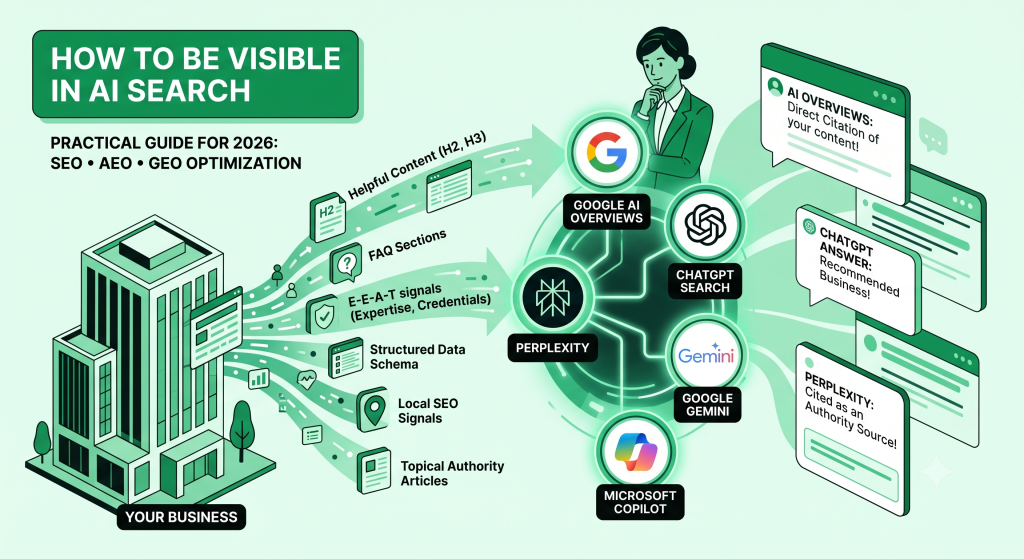
How to Make Your Business Visible in Al Search

More people are asking AI-powered systems questions instead of scrolling through traditional search results. They open ChatGPT, Gemini, Perplexity, or Google’s AI Overviews and type things like “best digital marketing agency for a small business” or “how do I improve my Google rankings?” The AI gives them a direct answer. Sometimes it mentions specific businesses. Sometimes it doesn’t. That shift creates a new visibility opportunity for businesses. It’s not about replacing SEO. It’s about extending your search strategy so your business can be discovered, cited, or recommended across both traditional search and AI-powered search experiences. This guide explains how AI search works, how AI systems find information about your business, and exactly what you can do to increase the chances of being visible. No guarantees. No shortcuts. Just practical steps you can start using today. What Is AI Search? AI search is a type of search experience where artificial intelligence generates a direct answer to your question instead of just showing a list of links. It synthesizes information from multiple sources, provides a conversational response, and often includes citations or links to the sources it used. Common examples include: Google AI Overviews and AI Mode — AI-generated summaries that appear at the top of Google search results for many queries. ChatGPT Search — OpenAI’s search feature that lets models access up-to-date information from the internet and provide answers with sourced citations. Google Gemini — Google’s AI assistant that can search the web and generate conversational answers. Microsoft Copilot — Microsoft’s AI-powered search and chat experience integrated into Bing and Windows. Perplexity — An AI search engine that provides direct answers with cited sources. The key difference from traditional search: AI search doesn’t just rank pages. It reads, synthesizes, and generates. Your business needs to be part of the information that AI systems can find, understand, and trust. Why AI Search Visibility Matters for Businesses AI search visibility matters because more people are using AI tools to research products, services, and businesses before they make decisions. If your business isn’t part of the information those tools draw from, you’re invisible to a growing segment of potential customers. Here’s what AI visibility can influence: Brand discovery — When someone asks an AI tool for a recommendation in your industry, you want your business to be mentioned. Customer research — People increasingly use AI to compare options before contacting a business. Local business discovery — AI Overviews now appear in a significant share of local searches. Brand authority and trust — Being cited by AI systems signals credibility to potential customers. Referral traffic — AI-generated answers often include links to sources, which can drive qualified visitors to your website. Consideration-stage visibility — AI search is often used during the research phase, before a customer is ready to buy. None of this is guaranteed. Visibility depends on relevance, authority, crawlability, content quality, trust, reputation, query context, freshness, competition, and the systems each platform uses. But the businesses that invest in understanding AI search today are building an advantage for tomorrow. SEO vs AEO vs GEO: What’s the Difference? SEO, AEO, and GEO are related approaches that overlap. They are not completely separate marketing systems. Think of them as layers of the same strategy. Approach Full Name Focus Primary Goal SEO Search Engine Optimization Visibility in traditional search results Rank higher and earn organic clicks AEO Answer Engine Optimization Structuring content to answer questions clearly Be the source AI systems extract answers from GEO Generative Engine Optimization Optimizing for generative AI search experiences Be cited, mentioned, or recommended by AI SEO is about being found in search results. It focuses on keywords, rankings, backlinks, technical health, and user experience. AEO is about making your content easy for AI systems to extract and present as a direct answer. It focuses on clear definitions, direct answers, structured formatting, and question-led headings. GEO is about improving your visibility across generative AI search platforms like ChatGPT, Google AI Overviews, Perplexity, and Copilot. It focuses on entity clarity, content structure, authoritative mentions, and technical accessibility. Google’s official guidance confirms that the best practices for SEO continue to be relevant for generative AI search because these features are rooted in Google’s core Search ranking and quality systems. AEO and GEO are not replacements for SEO. They are extensions of it. How AI Search Finds Information About Your Business AI search systems don’t magically know about your business. They rely on a combination of crawling, indexing, and reasoning about information from across the web. Here’s what matters: Crawlable website content — AI systems need to be able to access your pages. If your robots.txt file blocks AI crawlers like GPTBot, ClaudeBot, or PerplexityBot, your content won’t be part of their training or retrieval process. Indexable pages — Your important pages need to be indexed by search engines. Clear business information — Your business name, services, location, and expertise should be easy to find and understand on your website. Consistent brand information — Your business details should be consistent across your website, Google Business Profile, social profiles, directories, and third-party mentions. Relevant topical content — AI systems look for content that demonstrates depth and relevance on topics related to your business. Trusted third-party references — Mentions and citations from authoritative sources help AI systems verify and trust information about your business. Reviews where relevant — Customer reviews on platforms like Google Business Profile can influence how AI systems describe your business. Local signals — For local businesses, consistent NAP (Name, Address, Phone) data, local citations, and Google Business Profile signals matter. Authoritative mentions — Being referenced by credible industry publications, news outlets, or experts strengthens your brand’s authority. Structured data where appropriate — Schema markup can help AI systems understand your content. Website architecture and internal links — A clear site structure helps AI systems understand the relationships between your pages. No single trick or tactic guarantees inclusion in AI answers. AI visibility is the result of many signals working together. 15

Scroll to Top