
Introduction
Many businesses spend hours researching, writing, and publishing a blog post. Then they move on to creating completely different content for social media, email, video, and other channels. The result is often content fatigue, inconsistent publishing, wasted research, and a growing sense of marketing burnout.
There is a better approach. Instead of treating each platform as a separate content project, you can take one strong blog post and strategically transform it into multiple marketing assets. Not by copying and pasting, but by adapting the ideas into formats that fit each platform.
This guide walks through exactly how to turn one blog post into ten pieces of marketing content, what to extract from the original article, how to adapt each piece, and how to make the whole system work together.
What Is Content Repurposing?
Content repurposing is the process of taking useful information from an existing content asset and adapting it into different formats and experiences for different audiences and platforms.
The key word is adapting. Repurposing is not the same as:
- Copying the same text across every platform
- Republishing the same article on a different website
- Duplicating content without any change in format or angle
Good repurposing changes the format, the angle, the depth, and the user experience while preserving the core idea. A blog post about local SEO can become a LinkedIn discussion, a short video on one specific tip, a carousel on common mistakes, and an email newsletter that summarises the key insight.
Each piece stands on its own and serves a different purpose, but they all trace back to the same source material.
Why Content Repurposing Matters for Businesses
- Saves time. One research effort supports many pieces of content instead of starting from scratch each time.
- Extends content lifespan. A blog post that gets published once can stay useful for months or years when it is continually reshaped.
- Reaches different audiences. Some people read blogs. Others watch video, listen to podcasts, or scroll LinkedIn. Repurposing meets them where they are.
- Supports multiple platforms. One core idea can maintain a consistent presence across several channels without multiplying the workload.
- Improves distribution. Most content fails not because it is bad, but because nobody sees it. Repurposing multiplies the number of places your ideas appear.
- Creates consistency. A regular publishing rhythm becomes easier when your content plan is built around fewer, stronger source pieces.
- Reinforces important ideas. Repeating a core message across different formats helps it stick with your audience.
- Helps smaller teams compete. A small team working from a smart repurposing system can maintain a visible presence that rivals much larger marketing departments.
Note: Repurposing does not automatically guarantee more traffic, higher rankings, or increased sales. It improves your efficiency and reach, but results still depend on quality, strategy, and consistency.
Start With One Strong Blog Post
Repurposing works best when the source content is genuinely valuable. Weak source content creates weak derivative content. Before you repurpose anything, make sure the original blog post has:
- A clear topic and purpose
- Strong alignment with search intent
- Genuinely useful information
- Logical structure with clear sections
- Practical examples and specifics
- Clear takeaways the reader can act on
- Accurate information with verified sources where relevant
- Good readability and short paragraphs
- Solid on-page SEO fundamentals
When the source is strong, everything derived from it inherits that strength. When it is thin or generic, every derivative piece suffers the same weakness.
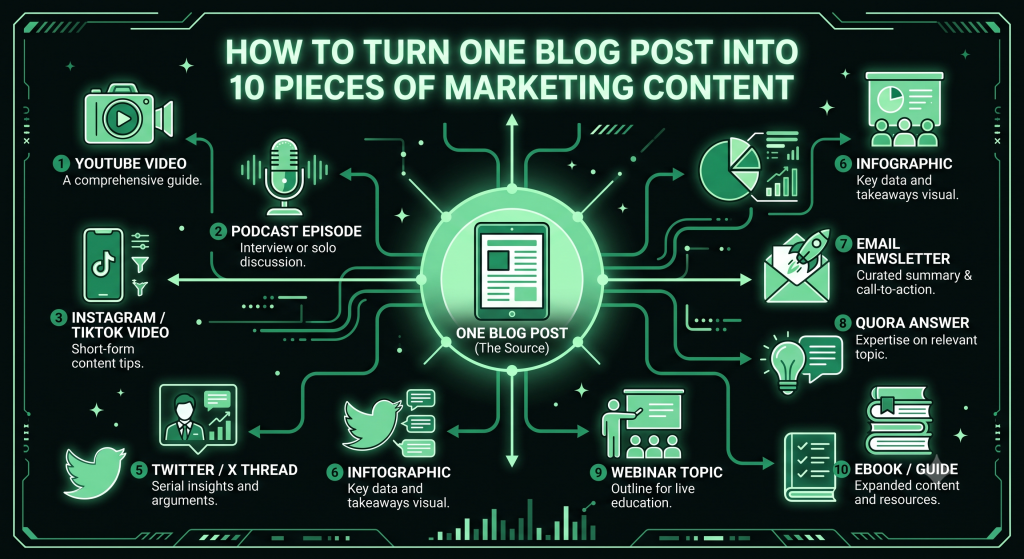
The 10 Pieces of Marketing Content You Can Create From One Blog Post
The exact number of assets you create will depend on your resources and platforms. The following ten formats offer a practical starting point that covers the most common channels.
1. Turn the Blog Into Multiple Social Media Posts
One blog post can contain several standalone ideas, each of which can become its own social media post. Look for:
- Key lessons the article teaches
- Common mistakes the article warns against
- Statements or definitions worth highlighting
- Quick tips pulled from longer sections
- Questions the article answers
- Short explanations of a concept
Example: A 2,000-word article on local SEO might contain ten distinct tips. Each one can become its own social post with a headline, a short explanation, and a link back to the article.
Instead of posting once, you now have ten posts scheduled across several weeks, each covering a different angle from the same research.
2. Create a LinkedIn Thought-Leadership Post
LinkedIn rewards a specific style: direct, human, and often opinionated. Take the strongest insight from the blog post and rewrite it as a LinkedIn post with a clear point of view.
Structure to consider:
- Hook: A short, attention-grabbing opening line
- Problem: Describe the challenge your audience faces
- Insight: Share the key idea from the blog post
- Lesson: Explain what it means in practice
- Example: Give a real or hypothetical illustration
- Conclusion: Summarise the takeaway
- Prompt: Ask a question to invite comments
The mistake to avoid is pasting the blog introduction. LinkedIn users respond to conversational writing, not formal blog prose.
3. Create an Instagram or LinkedIn Carousel
A carousel works well for step-by-step content, lists, or comparisons. It breaks a bigger idea into small, digestible slides.
A simple structure:
- Slide 1: Strong hook. What is this about and why should someone care?
- Slide 2: The problem or context
- Slides 3 to 7: One key insight per slide, kept short
- Slide 8: Practical action steps
- Final slide: CTA pointing to the blog or another resource
Visual carousels often perform well because they make complex information easier to consume and easier to save for later.
4. Turn the Blog Into a Short-Form Video or Reel
Short-form video does not need to summarise the whole article. It works best when it delivers one focused idea clearly.
A sample structure:
- Hook (first 3 seconds): A question or surprising statement
- Problem: Quickly describe the challenge
- Insight: Give one useful tip or idea
- Example: Show it in action
- CTA: Ask viewers to follow, comment, or read the full article
One blog post with ten sections can support ten different short videos, each focused on a single idea.
5. Turn the Blog Into a YouTube Video
YouTube allows for longer, more educational content. A blog post naturally translates into a video walkthrough because both formats benefit from structure and depth.
Suggested structure:
- Hook that states the problem
- Why the topic matters
- What viewers will learn
- Main points from the article, one by one
- Examples or demonstrations
- Practical steps viewers can take
- Summary of key takeaways
- CTA that links back to the original article
Where appropriate, include the article link in the video description so viewers can read the full version.
6. Turn the Blog Into an Email Newsletter
An email newsletter should not reproduce the full article. It should give subscribers a reason to click through and read it.
Elements to include:
- Subject line: Specific and benefit-oriented
- Personal opening: A short, human note
- Main insight: The most useful idea from the article
- Short explanation: Two or three sentences of context
- Takeaway: What the reader gets by reading more
- Link: To the full article
- CTA: One clear next step
Emails that feel like they were written by a person, not generated by a template, tend to perform better over time.
7. Turn the Blog Into an Infographic
Infographics work well for visual summaries of processes, comparisons, and data. From a single article, you can extract:
- Statistics or key numbers
- Step-by-step processes
- Frameworks or models
- Comparisons between options
- Checklists and do’s and don’ts
A simple structure for a blog-derived infographic:
- Title that captures the core idea
- Brief context
- Main framework or list
- Key supporting details
- Summary or CTA
Visual summaries are easier to share and can be pinned, saved, and referenced for a long time.
8. Create Quote Cards and Educational Graphics
Strong statements from an article can become simple branded graphics. These often work well on social media because they are quick to consume and easy to share.
Look for:
- Key principles or rules
- Practical advice stated concisely
- Clear definitions
- Short, memorable insights
- Common mistakes and what to do instead
- Simple frameworks
Important: Only use statements from your own article or clearly label them as your brand’s original messaging. Do not invent quotes and attribute them to other people.
9. Turn the Blog Into FAQs and Answer-Based Content
Any question the article answers can become its own piece of content. This is one of the most useful types of repurposing because it aligns with how people search today.
Possible outputs:
- FAQ sections on service pages
- Social media Q&A posts
- Short videos answering one question
- Voice-search-friendly content
- Answer-engine-friendly content
Use a simple structure: Question, Direct Answer, Explanation. This format works well for both readers and answer systems.
10. Turn the Blog Into Podcast or Audio Content
Audio content is often overlooked, but it is one of the easiest formats to create from a strong article.
Possible outputs:
- Podcast episode
- Audio newsletter
- Interview discussion based on the article’s themes
- Short educational audio clips
Suggested podcast structure:
- Introduction and context
- The problem the article addresses
- Walkthrough of the main ideas
- Examples and stories
- Practical takeaways
- Closing thoughts and CTA
Spoken content should sound natural, not like someone reading a blog word for word. Rephrase sentences for the ear.
How to Choose Which Parts of a Blog to Repurpose
Not every paragraph in a blog post deserves its own piece of content. The goal is to extract the parts that can stand alone and serve a specific purpose on another platform.
Look for sections that contain:
- The most useful or practical idea
- A strong opinion or point of view
- Commonly asked questions
- Surprising or counterintuitive insights
- Step-by-step processes
- Verified data or statistics
- Realistic examples
- Mistakes to avoid
- Frameworks or mental models
- Checklists or templates
Read through the article once and highlight anything that would be useful on its own. Those highlights become your content ideas for the next several weeks.
Create a Content Repurposing Workflow
- Step 1: Research. Choose a topic that is genuinely useful to your audience and aligned with search intent.
- Step 2: Write. Publish the main blog post with strong structure, examples, and clear takeaways.
- Step 3: Extract. Identify the most useful ideas, questions, examples, and insights inside the article.
- Step 4: Adapt. Convert each extracted idea into a format that fits the platform it will live on.
- Step 5: Distribute. Publish the assets across the channels where your audience is active.
- Step 6: Connect. Link the different assets where useful so audiences can move between them.
- Step 7: Measure. Review how each format performs against its stated goal.
- Step 8: Improve. Update content, repeat successful formats, and refine the workflow over time.
How AI Can Help Repurpose One Blog Into Multiple Content Formats
AI tools can support repurposing by taking on repetitive or time-consuming tasks. When used well, they free up human time for strategy and quality.
Areas where AI can help:
- Extracting key ideas from a long article
- Generating content angles for different platforms
- Creating outlines for videos or carousels
- Converting articles into video or podcast scripts
- Producing first drafts of social media captions
- Drafting email newsletter copy
- Identifying FAQs from article content
- Summarising sections for shorter formats
- Assisting with content calendars
- Adapting tone for different platforms
Important: AI-generated drafts should be reviewed, fact-checked, edited, and aligned with brand voice by a human. Repurposing is not about mass-producing low-quality content.
Human judgment remains responsible for:
- Accuracy and fact-checking
- Originality and insight
- Brand voice
- Strategy
- Final publishing decisions
How Content Repurposing Supports SEO
Repurposing supports SEO in several indirect but important ways:
- Increased distribution: More places where your ideas appear means more chances for people to discover your site.
- Brand visibility: Consistent presence across channels builds recognition, which can lead to more branded searches.
- Supporting content: Related pieces reinforce each other and strengthen topic coverage.
- Internal linking: Repurposed content often links back to the original article, improving its internal link profile.
- Topical coverage: A broader content ecosystem around a topic signals depth and expertise.
- Audience engagement: Different formats reach different people, expanding the total audience.
Important: Simply posting duplicate versions of an article across multiple websites does not automatically improve SEO. Duplicate content can even work against you. The value comes from adapting content thoughtfully so each format provides something appropriate for its platform.
How Content Repurposing Supports AEO
Answer Engine Optimization (AEO) focuses on structuring information so it can be presented as a direct answer. Repurposing fits naturally into AEO because it forces you to pull out clear, standalone answers from longer content.
A blog can generate several AEO-friendly assets:
- Direct answers to specific questions
- FAQ content for service pages
- Question-based social posts
- Short definitions
- Step-by-step answers
Use a consistent structure: Question, Answer, Context. This format is easy for readers to consume and helps answer systems extract information more reliably.
No approach guarantees featured snippets or AI citations, but clearly organised answers improve the conditions for being understood.
How Content Repurposing Supports GEO and AI Search Visibility
Generative Engine Optimization (GEO) focuses on making content easier for AI-powered systems to understand, summarise, and reference. A well-repurposed content ecosystem can support GEO by providing:
- Consistent information about your brand and topics
- Clear definitions of key concepts
- Original insight that adds something new
- Structured content that is easy to parse
- Strong topical relevance across multiple assets
- Accurate, verifiable information
GEO is not about creating huge amounts of duplicated content to trick AI systems. It is about building a body of work that consistently demonstrates your expertise and serves your audience clearly.
No technique guarantees inclusion in AI-generated answers, but a clear, useful content ecosystem improves the conditions for being understood across search experiences.
How to Avoid Creating Duplicate or Low-Value Content
Repurposing can easily drift into duplication if you are not careful. The result is content that technically exists but adds little value anywhere.
Avoid these approaches:
- Copying the exact article and pasting it on multiple platforms
- Posting identical captions across every social channel
- Generating dozens of low-value AI posts from one source
- Repeating the same message without any adaptation
- Publishing content only to increase volume
Instead, change the format, angle, context, depth, and user experience.
A practical example: the same insight about “consistency matters in SEO” could appear as:
- A short quote graphic on Instagram
- A brief LinkedIn post about a mistake a client made
- A 30-second video explaining why inconsistency hurts rankings
- An FAQ entry on a service page answering “how often should I publish?”
- A podcast segment discussing a real example
Each version uses the same underlying idea but delivers it in a way that fits its platform.
Build a Content Distribution System From One Blog
The individual pieces should not exist in isolation. They should work together as a connected ecosystem that supports your broader content goals.
A sample flow:
Blog Post
↓
LinkedIn Post
↓
Instagram Carousel
↓
Short Video
↓
YouTube Video
↓
Email Newsletter
↓
Infographic
↓
Quote Graphics
↓
FAQ Content
↓
Podcast Episode
Each piece points audiences toward the core resource where appropriate. The blog post acts as the central hub. Social content drives awareness. Email builds the relationship. Video and audio reach people who prefer those formats. FAQ content supports answer engines and service pages.
Example: Turning One Blog Post Into 10 Marketing Assets
Imagine a hypothetical blog post titled “10 Ways Small Businesses Can Improve Local SEO.” Here is how that single article could be repurposed into ten different assets.
- Blog article: The full guide, published on your website
- LinkedIn post: A post on one specific tip, written conversationally with an observation about common mistakes
- Instagram carousel: A 7-slide walkthrough of the top five tips with short visuals
- Short-form video: A 45-second clip covering the most overlooked local SEO fix
- YouTube video: A 10-minute tutorial walking through all ten tips with screenshots
- Email: A newsletter highlighting one tip and inviting readers to the full article
- Infographic: A visual checklist of the ten tips, shareable on social media
- Quote graphic: A single bold statement on the biggest local SEO mistake
- FAQ content: An entry answering “How do I improve my local SEO?” for a service page
- Podcast episode: A discussion episode on local SEO for small businesses with real examples
None of these requires starting from zero. They all flow from the same research and writing effort. Note that performance results would depend on execution, audience, and many other factors beyond the repurposing itself.
Create a Weekly Content Calendar From One Blog
Here is a sample 7-day schedule built around one blog post. This is an example, not the only correct approach.
- Monday: Publish the blog post
- Tuesday: LinkedIn thought-leadership post
- Wednesday: Instagram carousel
- Thursday: Short-form video
- Friday: Email newsletter
- Saturday: Infographic and quote graphic
- Sunday: Podcast episode or additional FAQ content
The exact schedule depends on your platforms, team capacity, and audience behavior. Use this as a starting template and adjust to fit your workflow.
Common Content Repurposing Mistakes
Fix: Decide why you are repurposing and which platforms actually matter for your audience. Not every piece needs to be everywhere.
Fix: Adapt each piece to fit its platform. Different channels have different conventions, expectations, and reader behaviors.
Fix: Study what works on each platform before posting. LinkedIn, Instagram, email, and YouTube all require different styles.
Fix: Focus on ideas that genuinely help your audience. Do not repurpose something just because it is easy.
Fix: Treat AI drafts as starting points, not finished pieces. Review, fact-check, and adapt before publishing.
Fix: Aim for useful pieces rather than more pieces. A few well-crafted assets outperform a flood of thin content.
Fix: Measure what works and adjust. Metrics vary by format, but some form of tracking should be built into the workflow.
Fix: Keep the source article’s purpose in mind so derivative content stays true to the original message.
Fix: Adjust tone for the platform without losing the personality that makes your brand recognisable.
Fix: If the source article changes, revisit derivative content. Old versions that contradict current information create confusion.
How to Measure the Success of Repurposed Content
The right metric depends on the objective of each format. Relevant metrics by channel:
Blog: Organic traffic, engagement, conversions, search visibility.
Social media: Reach, engagement, saves, shares, profile visits, clicks.
Email: Open rate, click-through rate, conversions.
Video: Views, watch time, retention, engagement, clicks.
Lead generation: Leads, conversion rate, cost per lead.
No single metric proves business success. Interpret numbers in context and use them to guide adjustments rather than to declare absolute winners.
How Often Should You Repurpose a Blog Post?
There is no universal schedule. The right frequency depends on several factors:
- How long the content remains relevant
- The topic’s current importance to your audience
- Which platform the content is going to
- Audience behavior and engagement patterns
- Whether the content is evergreen or timely
- How the original piece performed
- Seasonal relevance of the topic
Successful evergreen content can often be refreshed and repurposed periodically. Timely content, on the other hand, may have a short window. Pay attention to how each piece performs and use that data to guide future repurposing decisions.
A Complete One-Blog-to-10-Content Checklist
Before Publishing
- Research the topic thoroughly
- Understand search intent
- Create genuinely useful, original content
- Optimize on-page SEO
- Add examples, data, and visuals where useful
After Publishing
- Extract key ideas for social posts
- Create a carousel
- Create a short-form video
- Create a long-form video
- Create an email newsletter
- Create an infographic
- Create quote graphics
- Extract FAQs for answer-based content
- Record a podcast or audio version
After Distribution
- Track performance by format
- Identify winning topics and angles
- Update the original article when needed
- Repurpose successful ideas again later
Final Thoughts
You do not always need more ideas. Sometimes you need to get more value from the ideas you already have. A strong blog post can become the foundation of an entire content campaign when it is strategically repurposed.
Focus on quality, strategy, distribution, and platform-specific adaptation. Treat repurposing as a system rather than a collection of one-off tasks. Build a workflow that fits your team, measure what works, and improve over time.
The businesses that consistently publish useful content across multiple channels are rarely the ones creating something new every single day. They are the ones who built a smart process for getting more from what they already have.
Key Takeaways
- Content repurposing is the practice of adapting useful information from one asset into multiple formats for different audiences and platforms.
- Repurposing is not duplication. Adapt the format, angle, and depth instead of copying the same text everywhere.
- Start with a genuinely strong blog post. Weak source content produces weak derivatives.
- One blog can support social posts, LinkedIn, carousels, short video, YouTube, email, infographics, quote graphics, FAQs, and podcasts.
- Extract the strongest ideas from the article: frameworks, examples, questions, mistakes, and insights.
- AI can help with drafting and adaptation, but human review, fact-checking, and voice remain essential.
- Repurposing supports SEO, AEO, and GEO by increasing distribution, reinforcing topics, and providing clear answers.
- Avoid posting identical content on every platform. Each format should provide value appropriate to its channel.
- Build a repeatable workflow: research, write, extract, adapt, distribute, connect, measure, and improve.
- Measure success by format-specific metrics and focus on usefulness over volume.
One Blog Post to 10 Content Pieces: Summary Table
| # | Content Format | What to Extract | Platform | Primary Goal |
|---|---|---|---|---|
| 1 | Social Media Posts | Tips, lessons, mistakes | Twitter, Facebook | Awareness |
| 2 | LinkedIn Post | Strong opinion, insight | Authority | |
| 3 | Carousel | Steps, comparisons | Instagram, LinkedIn | Education |
| 4 | Short Video | One key lesson | Instagram, TikTok | Reach |
| 5 | YouTube Video | Full topic walkthrough | YouTube | Depth |
| 6 | Email Newsletter | One main insight | Email list | Nurture |
| 7 | Infographic | Steps, data, frameworks | Web, Pinterest | Shareability |
| 8 | Quote Graphics | Strong statements | Social media | Recognition |
| 9 | FAQ Content | Questions & answers | Website, social | AEO support |
| 10 | Podcast / Audio | Full discussion | Podcast platforms | Loyalty |
Frequently Asked Questions
Content repurposing is the process of taking useful information from an existing content asset and adapting it into different formats and experiences for different audiences and platforms. It is not the same as copying or duplicating content.
Start by extracting the strongest ideas from the article. Then adapt each one into a format that suits a specific platform: a social post, a short video, an email section, an FAQ entry, or a podcast segment. Always adapt for the platform rather than copying directly.
A single strong blog post can realistically support ten or more derivative pieces, including social posts, carousels, videos, emails, infographics, quote graphics, FAQ content, and podcast segments.
Social media posts, LinkedIn posts, carousels, short-form video, YouTube videos, email newsletters, infographics, quote graphics, FAQ content, and podcast episodes are all common options.
Repurposing can support SEO indirectly by improving distribution, building brand visibility, reinforcing topics, and generating internal links back to the original article. However, simply duplicating content across sites does not automatically improve SEO and can create duplicate content issues.
Yes, and one blog post can often support many social posts. Extract individual tips, lessons, mistakes, and insights from the article and adapt each one into a post that fits the platform.
Start with a strong hook based on the article’s core idea. Then structure the video around a problem, an insight, an example, and a call to action. Longer videos can follow the article’s main sections, while short videos should focus on one specific idea.
AI can help extract key ideas, generate content angles, draft scripts and captions, identify FAQs, and organise workflows. However, all AI output should be reviewed, fact-checked, and aligned with brand voice by a human before publishing.
Not if you adapt it properly. Repurposing changes the format, angle, and depth for each platform. Copying the same text everywhere is duplication, which can cause SEO problems. Adapting the idea is not duplication.
There is no universal schedule. Evergreen content can be refreshed and repurposed periodically. Timely content may have a short window. Base decisions on content lifespan, topic relevance, and how the original piece performed.
Focus on fewer, stronger source pieces. Publish one well-researched blog post and repurpose it into several assets across your most important channels. Prioritise quality and consistency over volume.
Track metrics relevant to each format. Blog: organic traffic, engagement, conversions. Social: reach, engagement, clicks. Email: open rate, click-through rate. Video: views, watch time, retention. Lead generation: leads, conversion rate, cost per lead.
Need Help Building a Content Repurposing System?
If you are publishing quality content but not getting enough reach out of it, the issue is usually distribution, not creativity. OptiRanker works with businesses on content strategy, repurposing workflows, and multi-channel distribution that turns each blog post into a broader campaign.
We focus on practical systems that fit your team, not complicated frameworks that sit unused.