
Introduction
When someone asks an AI assistant for a recommendation, a shortlist, or an explanation, the answer they receive is assembled from sources the system has reason to trust. That trust is not random. It is usually connected to how clearly a brand communicates its expertise, how consistently it appears across the web, and how useful its content is to real people.
This is where brand authority becomes a practical concern rather than an abstract marketing idea. Authority is the accumulated result of doing good work, explaining it well, and being recognized for it over time. In an AI-driven search environment, that reputation matters more than ever because AI systems draw on it to decide what is worth repeating.
This guide explains how to build brand authority for AI search in a way that is honest, realistic, and actionable. You will learn how AI systems understand brands, how to build topical and entity authority, what trust signals matter, how SEO, AEO, and GEO work together, and what small businesses can do without a large budget.
What Does Brand Authority Mean in AI Search?
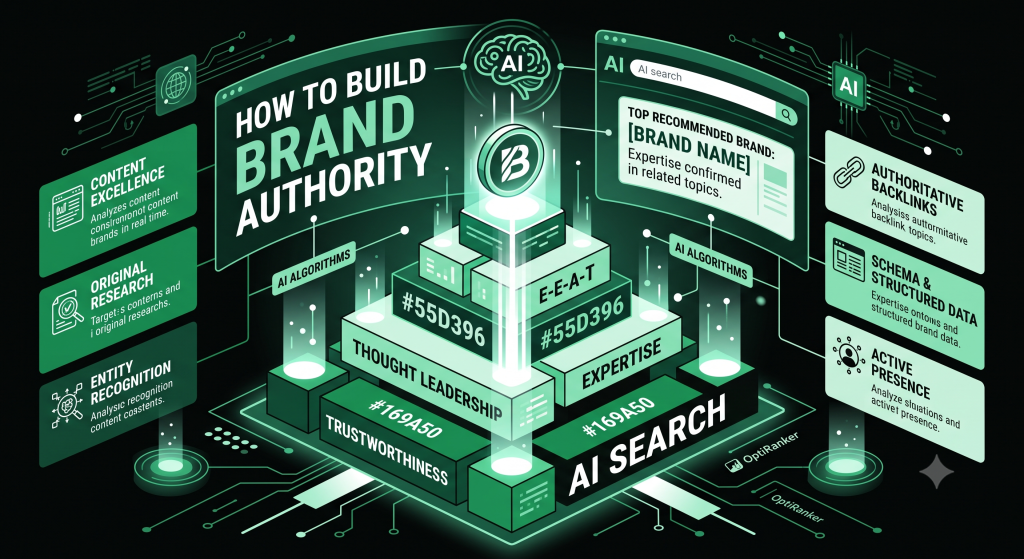
Brand authority in AI search means how consistently and credibly a business demonstrates expertise, trustworthiness, and relevance in the areas it claims to serve. AI-powered systems use multiple signals from across the web to understand a brand, but there is no single universal formula that determines what they will cite or recommend.
Authority is not something you declare. It is something others recognize because of what you publish, how you work, and how your customers and peers talk about you. In practical terms, it combines several things:
- Demonstrated expertise – content that shows genuine understanding, not surface-level summaries
- Consistency – the same name, services, and messaging everywhere your brand appears
- Trust signals – clear business information, authorship, and transparency about who is behind the content
- Recognition – mentions, links, and references from relevant and reputable sources
- Relevance – being clearly associated with specific topics rather than trying to cover everything
AI-powered search systems do not read your website the way a human does. They combine information from many sources including your site, third-party mentions, structured data, and public records. Your goal is not to decode a hidden algorithm. It is to make the information about your brand clear, accurate, and easy to connect across all the places it appears.
Why Brand Authority Matters for AI Search Visibility
When a generative AI system produces an answer, it draws on sources it has learned to associate with relevant topics. It is not evaluating just one page. It is making a judgement about which sources are coherent, credible, and consistent enough to include in a synthesised response.
A brand that is widely recognized in its field has a different starting position from a brand that appears only on its own website. Recognition comes from being mentioned, referenced, and discussed by others. It is also supported when the information about a brand is consistent everywhere it appears, so the system can connect the dots.
- Trust: Content is more likely to be used when it is accurate, well-sourced, and clearly written.
- Content quality: Depth and original insight tend to outlast surface-level information.
- Consistent information: Matching details across the web help systems form a clean picture of your brand.
- Expertise: Subject knowledge shown through detailed, specific content is easier to verify.
- Brand recognition: Familiar names carry more weight when a system is deciding what to reference.
- Reputation: Reviews, mentions, and public discussion contribute context that supports or undermines trust.
- Accuracy: Outdated or conflicting information can weaken how confidently a brand is described.
There is a clear chain at work: authority leads to trust, trust leads to better understanding, and better understanding creates more opportunities for visibility. That chain is not guaranteed, and no business can force an AI system to cite it. What you can do is improve the conditions that make recognition more likely.
How AI Search Systems Understand Brands
Generative AI systems build an internal understanding of a brand by pulling together information from many places. They do not rely on a single page or a single signal. Here are the main concepts involved, explained in plain language.
Entity Understanding
An entity is a distinct thing, such as a business, a person, or a product. Systems try to recognise that your brand is a specific entity with a name, a purpose, and a set of associated topics. Clear naming, a consistent description, and structured data help this process.
Contextual Relevance
Systems assess whether your content is relevant to the query being asked. A page about SEO is relevant to SEO questions. A page about SEO on a bakery website may be less relevant unless the bakery also does SEO consulting.
Topical Associations
The more consistently your brand publishes and is mentioned in connection with a topic, the stronger the association becomes. This is why breadth without depth rarely builds authority.
Consistent Brand Information
If your business name, address, phone number, services, and description differ across the web, systems may struggle to connect everything to a single entity. Consistency reduces ambiguity.
Third-Party Validation
Mentions and references from other reputable sources act as external confirmation that a brand is real, relevant, and worth paying attention to. These are not the only signal, but they carry weight.
Note: The exact weighting of these factors is not publicly disclosed by the companies that operate AI search systems. The explanations above describe general principles, not a guaranteed formula.
1. Define What Your Brand Wants to Be Known For
A brand cannot be an authority on everything. Attempting to cover too many unrelated topics dilutes the signal and makes it harder for systems and people to understand what you actually stand for.
Start by answering a few honest questions about your business:
- What problem do we solve?
- Who do we solve it for?
- What topics are we genuinely qualified to discuss?
- What makes our knowledge or approach useful?
- What do we want people to associate with our brand?
Write your answers down. If they are vague, your positioning will be vague too. Once you have a clear focus, that focus should guide your content plan, your service page wording, and the way you describe yourself everywhere online.
2. Build Topical Authority Around Your Core Expertise
Topical authority means being comprehensively useful across a specific subject area, not just publishing one article about it. A site with fifteen connected articles on a topic looks far more authoritative than one with fifteen unrelated posts.
For a digital marketing agency, a topic cluster might look like this:
- A pillar page explaining digital marketing strategy end to end
- Supporting articles on SEO, local SEO, content marketing, social media, Google Ads, and email marketing
- Deeper pieces on AI search optimization, AEO, and GEO
- Case studies showing how these approaches work in practice
- FAQs and glossaries that define key terms
Connect these pages with internal links so readers and systems can move naturally between related content. Update older pieces as your understanding and the industry evolve. The goal is not volume. It is coverage that genuinely helps someone understand a subject.
3. Create Original Content That Demonstrates Real Expertise
Generic content rarely builds authority because it adds nothing new. If your article repeats what is already widely available, there is little reason for a reader or a system to treat it as a notable source.
Content that tends to demonstrate real expertise includes:
- Original insights drawn from your own work and observations
- Expert opinions on industry developments
- Practical frameworks you actually use with clients
- Detailed guides that go deeper than surface-level explanations
- First-hand experience where it is genuine and relevant
- Case studies based on real projects
- Research where the sources are properly attributed
- Unique observations about problems your audience faces
The difference between repeating existing information and adding knowledge is usually the presence of perspective. Two articles can cover the same topic, but one is a summary while the other gives the reader something they can act on.
Important: Never fabricate experience, case studies, data, or client results. Authority built on false claims is fragile and can damage trust permanently.
4. Demonstrate E-E-A-T Throughout Your Website
E-E-A-T stands for Experience, Expertise, Authoritativeness, and Trustworthiness. It is a framework for thinking about what makes content credible. Here is how each part applies in practice:
Experience
Show relevant real-world experience where it genuinely exists. A marketing article written by someone who has managed campaigns carries more weight than one written from research alone.
Expertise
Demonstrate knowledge through accurate, detailed content. Explain your reasoning. Use specific examples instead of general statements.
Authoritativeness
Build recognition within your field. This comes from publishing consistently useful work, participating in industry conversations, and being referenced by others.
Trustworthiness
Maintain accuracy, transparency, and clear business information. Include contact details, be honest about what you do and do not offer, and correct mistakes when they happen.
5. Make Your Brand Information Clear and Consistent
Consistency helps both people and systems form an accurate picture of your business. If your brand name, description, and contact information differ across the web, it creates confusion that can weaken recognition.
Areas to keep consistent:
- Business name and any abbreviations
- Website URL
- Short and long business descriptions
- Phone number, email, and address
- Social media profile links
- Author names and roles
- Service names and descriptions
Consistency does not guarantee AI visibility. It does, however, remove ambiguity, which makes it easier for any system to understand who you are and what you do.
6. Strengthen Your Website's Trust Signals
Trust signals exist to help real visitors feel confident about your business. When they are genuine and clearly presented, they also help systems understand that your website belongs to a legitimate organization.
Practical trust signals to include:
- A clear About Us page that explains who you are and what you do
- Visible contact information including phone, email, and physical address if applicable
- A Privacy Policy and Terms and Conditions page
- Author information with relevant background where appropriate
- Editorial standards or content guidelines if you publish regularly
- Clear business identity including legal name and registration details where relevant
- A secure HTTPS website
- Accurate service descriptions that match what you actually deliver
- Testimonials only when they are genuine and verifiable
These elements are not tricks. They are the normal signals of a real, responsible business. Their purpose is to help visitors, and that is also what makes them useful in an AI-driven search environment.
7. Build a Strong Expert and Author Presence
When content is attributed to a real person with relevant expertise, it becomes more transparent and more credible. Readers know who is speaking. Systems have a clearer signal about the source of the information.
What a useful author presence includes:
- An author bio that explains relevant background and areas of focus
- Professional experience that relates to the content being published
- Clear specialization rather than vague general statements
- A note when content has been reviewed by a subject matter expert
- Consistent author information across all published pieces
Never invent credentials or experience. If a piece is written collaboratively or reviewed by someone else, say so accurately. Transparency about who produced the content is itself a trust signal.
8. Earn Relevant Brand Mentions and Quality Backlinks
Recognition from other sources helps confirm that your brand is relevant and worth paying attention to. Not all recognition is equal, though. A mention in a respected industry publication carries more weight than a link from a low-quality directory.
Ways to earn genuine recognition:
- Publishing original research or data that others can reference
- Offering expert commentary to journalists and publications
- Participating in industry events, panels, or podcasts
- Contributing guest articles to relevant, reputable sites
- Building partnerships with complementary businesses
- Creating genuinely useful resources that people choose to share
Avoid: buying spam links, using link farms, automated link schemes, or paying for fake publications. These tactics may produce short-term signals, but they damage credibility when discovered and undermine the trust that authority depends on.
9. Build a Consistent Presence Beyond Your Website
Your website is the center of your digital presence, but it is not the only place your brand appears. Profiles, listings, and mentions on other platforms contribute to how a brand is understood.
Relevant places to maintain an accurate presence:
- Professional social media profiles that match your business focus
- Industry directories where your business genuinely belongs
- Business listings with accurate contact and service information
- Relevant publications where you contribute or are mentioned
- Community platforms where your audience participates
The goal is accuracy, consistency, and genuine engagement, not being everywhere. A well-maintained presence on a few relevant platforms is more valuable than scattered profiles on every network.
10. Use Content to Answer Real Customer Questions
The questions your customers ask you directly are some of the most valuable content ideas you have. They reflect genuine confusion, genuine interest, and genuine search behavior.
Where to find these questions:
- Sales conversations and discovery calls
- Customer support tickets and live chat logs
- Your existing FAQ page
- Search queries that bring people to your site
- Social media comments and direct messages
- Industry discussions and forums
When you write answers, use a consistent structure:
- Answer the question directly in the first sentence or two
- Provide context for why the answer matters
- Add supporting details that help the reader understand
- Include an example where it clarifies the point
This format helps readers, supports SEO, and makes content easier for answer engines and AI systems to interpret.
11. Optimize Your Content for Answer Engines
Answer Engine Optimization (AEO) focuses on making information easy to extract and present as a direct answer. This applies to featured snippets, voice assistants, and AI-powered answer surfaces.
Practical AEO techniques:
- Use clear question-based headings where they match real queries
- Place a concise answer immediately after the heading
- Keep definitions short and specific
- Structure lists and steps in a logical order
- Use tables when comparing multiple items
- Include FAQ sections on service pages and important articles
- Maintain a logical heading hierarchy throughout the page
The underlying principle is simple: write to help a real person find and understand the answer. The formatting exists to support that goal, not to game a system.
12. Optimize Your Brand for Generative AI Search
Generative Engine Optimization (GEO) focuses on making content and brands understandable and useful within generative search experiences. It builds on the same foundations as SEO and AEO, with additional emphasis on clarity, depth, and trust.
Practical GEO strategies:
- Explain concepts clearly and define terms the first time you use them
- Include original insights that cannot be found elsewhere
- Cover topics in sufficient depth to demonstrate real understanding
- Keep factual information accurate and current
- Maintain a consistent brand identity across all content
- Strengthen entity associations by naming things precisely
- Publish expert-led content with visible authorship
- Earn reputable third-party mentions
- Use structured formatting that makes information easy to interpret
- Review and update content regularly
Important: No business can guarantee that an AI system will cite, mention, recommend, or include it in a generated response. GEO improves the overall opportunity for discoverability and understanding. It does not control the outcome.
13. Build a Reputation That Supports Brand Authority
Reputation and authority are closely connected. A brand that delivers consistently and treats customers well tends to accumulate positive signals over time. A brand that does not will struggle to build lasting trust.
Elements of reputation that support authority:
- A consistent, positive customer experience
- Genuine reviews collected through normal business activity
- Testimonials that are real and verifiable
- Professional responses to feedback, including criticism
- Transparency about pricing, process, and limitations
Avoid: fake reviews, paid fake testimonials, or manipulation of review platforms. These practices damage trust when discovered and can have serious consequences for your brand.
Reputation is built slowly and can be damaged quickly. That is why it deserves consistent attention rather than occasional campaigns.
14. Publish Consistently, But Prioritize Quality Over Quantity
Publishing frequency alone does not create authority. A steady stream of thin, repetitive articles can do more harm than good because it signals that your content is not particularly useful.
A more effective approach:
- Plan content around genuine audience needs
- Maintain quality control before publishing
- Update existing content when it becomes outdated
- Remove or consolidate content that no longer serves a purpose
- Improve high-performing pieces rather than always creating new ones
A smaller number of genuinely useful, well-maintained pieces will usually outperform a large volume of content that does not help anyone.
15. Keep Your Information Accurate and Updated
Outdated information creates confusion and can damage trust. It also creates a risk that AI systems pick up older details and describe your business inaccurately.
A simple review process:
- List your most important pages: services, about, contact, pricing, and top articles
- Review each one at least twice a year
- Check facts, statistics, dates, and service descriptions
- Update anything that has changed
- Add a visible ‘last updated’ date where relevant
- Fix broken links and outdated references
Accurate information supports trust. It also gives systems a clearer, more current picture of your brand.
16. Use Structured Data to Clarify Your Website
Structured data is code added to your pages that describes what the page contains in a format machines can interpret. It uses a shared vocabulary called Schema.org.
Relevant Schema types for most businesses include:
- Organization – describes your business
- LocalBusiness – for businesses with a physical location
- Person – for authors and team members
- Article – for blog posts and news content
- WebSite – describes your site
- BreadcrumbList – shows page hierarchy
- FAQPage – for pages with FAQs
Structured data helps systems understand your content more clearly, but it does not guarantee rankings or AI citations. It should always reflect what is actually on the page. Adding misleading markup creates confusion rather than clarity.
17. Measure Brand Authority and AI Search Visibility
Brand authority is not measured by a single number. It is a combination of signals that together indicate growing recognition and trust.
Useful indicators to track:
- Growth in branded search volume (people searching for your business name)
- Organic visibility for your core topics
- Quality backlinks from relevant sources
- Relevant brand mentions across the web
- Website engagement metrics such as time on page and return visits
- Conversion quality rather than just volume
- Reputation signals including review scores and sentiment
- Content performance across your top pages
For AI search visibility specifically, measurement methods vary depending on the platforms and tools available. Some tools now track brand mentions in AI-generated answers, but coverage is not complete and methods are still developing. Treat any single metric as one input among several, not as a definitive measure of AI authority.
Common Mistakes That Prevent Brands From Building Authority
Content that repeats what is already widely available adds little value. It does not demonstrate expertise or give readers a reason to return. Focus on adding perspective, insight, or practical detail that is specific to your experience.
Attempting to be relevant to everything dilutes your signal. Systems and readers struggle to understand what you actually stand for. Choose a focused set of topics where you have genuine knowledge and go deep.
Copying what competitors publish rarely builds authority because it adds nothing new to the conversation. Study what they do well, then find your own angle and perspective.
AI tools can help with drafting and editing, but content published without human review often contains inaccuracies, generic phrasing, and a lack of genuine perspective. Always review, fact-check, and add your own insight before publishing.
If your business name, description, or contact details differ across the web, it creates confusion. Systems and people may struggle to connect information to a single entity. Audit your online presence and align everything.
Content without visible authorship is less transparent and less credible. Add author bios, explain relevant experience, and be honest about who produced the content.
Spam links and link farms may produce temporary signals, but they damage credibility when discovered. Focus on earning genuine recognition through useful content and real relationships.
Old statistics, outdated advice, and stale service descriptions undermine trust. Set a regular review schedule and update content when things change.
Keyword research is useful, but content written purely to target keywords tends to feel unnatural and does not address what readers actually need. Start with the question, then consider keyword variations.
Authority is connected to reputation, and reputation is built through real experiences. Poor customer service, misleading claims, or difficult buying processes will undermine any content strategy.
Exaggerated promises damage trust. Avoid saying you are the best, the leading, or the number one unless you can substantiate it clearly. Specific, honest descriptions are more credible.
Authority is built over time through consistent, useful work. There is no shortcut. Businesses that understand this invest steadily and see results compound.
A Step-by-Step Framework for Building Brand Authority for AI Search
- Step 1: Define your core expertise. Identify the specific problems you solve and the topics you are genuinely qualified to discuss.
- Step 2: Identify your audience and their questions. List the questions customers ask before, during, and after buying.
- Step 3: Build topic clusters. Create a pillar page for each core topic and supporting articles that cover related questions in depth.
- Step 4: Improve your core website pages. Update your homepage, about page, service pages, and contact page for accuracy, clarity, and completeness.
- Step 5: Create expert-led content. Publish original insights, frameworks, and detailed guides that demonstrate real knowledge.
- Step 6: Add clear author and business information. Include bios, roles, contact details, and consistent descriptions everywhere.
- Step 7: Build relevant mentions and recognition. Pursue genuine opportunities to be referenced by reputable sources in your field.
- Step 8: Optimize content for SEO and AEO. Use clear headings, direct answers, structured formatting, and natural keyword usage.
- Step 9: Strengthen GEO readiness. Focus on depth, accuracy, entity clarity, and consistent brand identity.
- Step 10: Review accuracy and consistency. Audit your content and online profiles regularly. Fix anything outdated or contradictory.
- Step 11: Track performance. Monitor branded search, organic visibility, mentions, and engagement over time.
- Step 12: Improve continuously. Authority is a long-term effort. Review what works, refine your approach, and keep publishing useful content.
How Small Businesses Can Build Brand Authority Without a Huge Budget
A small business does not need a large budget to build meaningful authority. It needs focus, consistency, and a genuine understanding of its audience.
Affordable strategies that work:
- Specialize in a specific niche rather than trying to serve everyone
- Create genuinely helpful content that answers real customer questions
- Respond thoughtfully to questions in relevant communities
- Build local recognition through consistent listings and community participation
- Improve customer experience so people have a reason to speak well of you
- Collect genuine reviews through normal business activity
- Develop expert-led content that reflects your actual experience
- Build relationships with complementary businesses and local media
- Update existing content rather than always creating new pieces
Smaller businesses can compete by being more focused, more specialized, more personal, and faster to respond than larger competitors. These advantages are real, but they are not automatic. They require deliberate effort.
SEO, AEO, and GEO: How They Work Together to Build Authority
These three strategies are often discussed separately, but they overlap significantly and work best when treated as parts of a single effort.
| Strategy | Primary Focus | Example |
|---|---|---|
| SEO | Search visibility | Optimizing helpful content for search intent |
| AEO | Direct answers | Clear question-and-answer content |
| GEO | Generative search understanding | Comprehensive, contextual, trustworthy information |
SEO helps people find your content. AEO helps answer engines extract clear answers. GEO helps generative systems understand your brand and content well enough to consider including it. All three depend on the same foundation: accurate, well-structured, genuinely useful content that clearly demonstrates expertise.
The Future of Brand Authority in AI Search
It is difficult to predict exactly how AI search will develop. The technology is moving quickly, and the companies building these systems share limited detail about how their decisions are made.
What is reasonable to expect is continued movement toward conversational interfaces, more emphasis on trustworthy information, and greater attention to source transparency. Several trends are worth monitoring:
- AI systems are likely to place more value on original insights and first-hand experience
- Content quality and accuracy may become stronger differentiators as generic content becomes more common
- Brand reputation could play an increasing role in how systems decide what to reference
- Multimodal search including voice and visual inputs may expand how people ask questions
- Search behavior may continue shifting from browsing to asking, changing how visibility is measured
Businesses should monitor these developments without overreacting to every new feature or announcement. The foundations of trust, expertise, and useful content are unlikely to become obsolete regardless of how the interface evolves.
Final Thoughts
Building brand authority for AI search is not about finding a shortcut or decoding a hidden formula. It is about doing the work that has always mattered: developing real expertise, communicating it clearly, staying consistent, and earning trust over time.
The businesses best positioned for AI-driven search will not necessarily be the ones producing the most content. They will be the ones consistently providing the clearest, most useful, credible, and trustworthy information within the areas where they genuinely have expertise.
That is a long-term commitment, not a quick fix. But it is also the most durable approach, because it works whether someone finds you through a search engine, an answer box, an AI assistant, or a direct recommendation.
Key Takeaways
- Brand authority in AI search comes from demonstrated expertise, consistency, and trust, not from a single tactic.
- AI systems build understanding from many sources. Clear, accurate, consistent information across the web helps them connect the dots.
- Topical authority means going deep on a focused set of subjects, not covering everything superficially.
- Original insights and genuine experience are harder to replicate and more valuable as sources.
- E-E-A-T principles translate into practical actions: visible authorship, accurate content, clear business information, and real reputation.
- SEO, AEO, and GEO work together. They share the same foundation of useful, well-structured content.
- No business can guarantee inclusion in AI-generated answers. Focus on improving the conditions that make recognition more likely.
- Small businesses can compete by being focused, specialized, responsive, and genuinely useful to their audience.
- Authority is built over time through consistent effort, not through shortcuts or manipulation.
Frequently Asked Questions
Brand authority in AI search refers to how consistently and credibly a business demonstrates expertise, trustworthiness, and relevance in its areas of focus. It is built through useful content, consistent information, genuine recognition, and a strong reputation over time.
Focus on a specific set of topics, publish original and genuinely useful content, maintain consistent information across the web, demonstrate real expertise, earn relevant mentions, and keep your information accurate and updated.
Authority is one of several factors that can influence how AI systems understand and reference a brand. It does not guarantee visibility, but a recognizable, credible brand generally has more opportunities for recognition than an unknown one.
SEO focuses on ranking pages in search results. AEO focuses on making direct answers easy to extract. GEO focuses on making content and brands understandable within generative AI search experiences. All three share similar foundations.
Topical authority signals that your site covers a subject comprehensively. This helps both readers and systems understand that you have genuine expertise rather than surface-level knowledge.
Yes. Small businesses can build authority by specializing in a niche, creating genuinely helpful content, answering real customer questions, and maintaining a consistent, trustworthy presence.
There is no fixed timeline. Authority builds gradually through consistent effort. Businesses that publish useful content regularly and maintain accurate information typically see progress over months and years, not weeks.
Relevant, earned backlinks from reputable sources can support authority by acting as external validation. Low-quality or purchased links usually do more harm than good.
AI tools can help with drafting and editing, but content published without human review and genuine insight tends to lack the originality and credibility that authority requires. Use AI as a tool, not a replacement for expertise.
Authority is measured through a combination of indicators including branded search growth, organic visibility, quality backlinks, relevant mentions, engagement, reputation signals, and content performance. No single metric tells the whole story.
Consistency helps systems and people form an accurate picture of your brand. Inconsistent names, descriptions, or contact details create confusion and can weaken recognition.
Common mistakes include publishing generic content, trying to cover every topic, buying low-quality links, ignoring author expertise, publishing outdated information, and expecting instant results.
Ready to Build Your Brand Authority for AI Search?
Building authority for AI search takes time, but it is work that pays off across every channel. If you would like help identifying where your brand stands today and what to prioritize, OptiRanker works with businesses on SEO strategy, content planning, and AI search readiness.
We focus on practical improvements that strengthen your visibility and credibility without shortcuts or empty promises.