
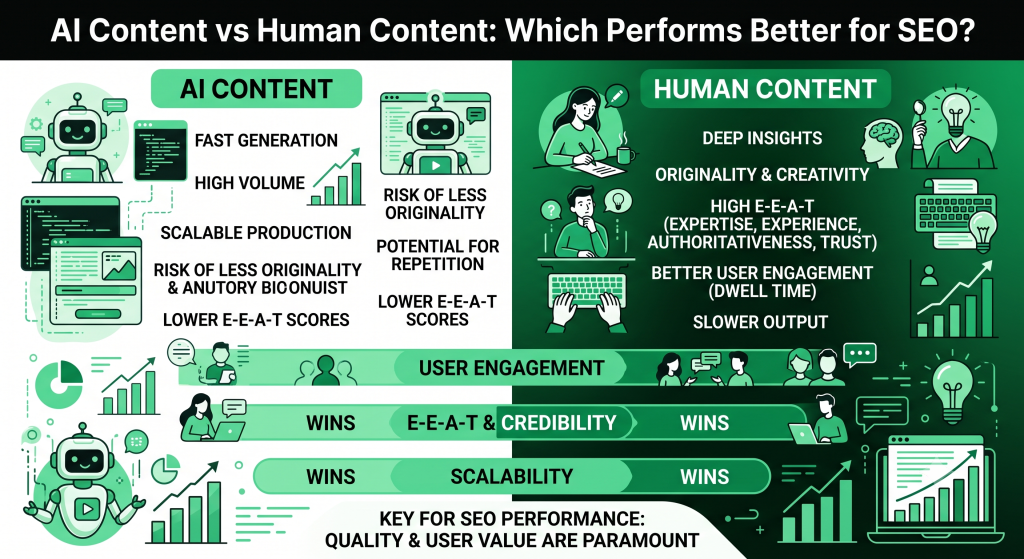
Introduction
A tool can now produce a thousand well-formed words in under a minute. A human writer with genuine expertise may take hours to produce the same length. Yet the human version often performs better in search. Meanwhile, some AI-assisted content clearly outperforms poorly written human articles.
This is the part most debates miss. The SEO question is not simply whether content was created by AI or a human. The question is whether the content genuinely satisfies the searcher better than the alternatives.
This guide compares AI-generated content, AI-assisted content, and human-written content in a practical way. It explains what actually drives search performance, where each approach has real advantages, and how businesses can build a workflow that combines efficiency with expertise.
AI Content vs Human Content: What Is the Difference?
Not all content falls neatly into one category. It helps to separate three distinct approaches.
- AI-generated content: Content produced primarily by AI with little or no meaningful human review. It is often fast and cheap, but usually requires heavy editing to be useful.
- AI-assisted content: Content where AI is used for research support, ideation, outlining, drafting, editing, or analysis, with significant human oversight throughout the process.
- Human-written content: Content primarily researched, developed, and written by a human, possibly with AI used for small tasks like grammar checking.
The table below compares the three approaches across the factors that matter most for SEO.
| Factor | AI-Generated | AI-Assisted | Human-Written |
|---|---|---|---|
| Speed | Very fast | Fast with review | Slower |
| Scalability | High | Moderate to high | Limited by capacity |
| Original insight | Often limited | Strong if humans add value | Typically strong |
| Personal experience | Rarely genuine | Possible with input | Genuine where present |
| Editing needs | Heavy | Moderate | Standard |
| Research support | Fast but needs verification | Strong with verification | Depends on writer |
| Consistency | Variable | Good with editing | Depends on writer |
| SEO potential | Variable | High with proper workflow | High with genuine expertise |
Can AI-Generated Content Rank on Google?
Yes, AI-generated content can rank in search results. Search engines evaluate content based on quality, usefulness, and relevance, not based on whether AI or a human produced it. That said, low-quality, inaccurate, or unhelpful content can struggle to rank regardless of how it was created.
The distinction that matters is between how content is produced and whether the resulting content is useful and compliant with search guidelines.
Google’s public guidance has been consistent for years: the company focuses on rewarding helpful, people-first content and reducing the visibility of content created primarily for search engines rather than users. This applies whether the content is written by a person or generated with AI.
That means AI-generated content is not automatically penalized simply because AI was used. It can perform well when it is accurate, useful, and appropriately reviewed. It can also fail when it is thin, repetitive, inaccurate, or produced purely to chase keywords.
Note: Search engine policies and algorithms change over time. For the most current guidance, consult official documentation from the search engines themselves.
What Makes Content Perform Well in Search?
Before comparing approaches, it helps to be clear about what search engines actually reward. These factors matter more than production method:
- Search intent: Does the content match what the searcher was actually looking for?
- Relevance: Is the topic clearly connected to the query being asked?
- Helpfulness: Does it solve a real problem or answer a real question well?
- Accuracy: Is the information factually correct and up to date?
- Original value: Does it offer something beyond what already exists?
- Expertise and experience: Does it reflect genuine knowledge and understanding?
- Trust: Is the source transparent and credible?
- User experience: Is the page fast, easy to read, and mobile-friendly?
- Technical accessibility: Can search engines crawl and understand the page?
- Topical coverage: Does the site address the topic comprehensively across related pages?
The rest of this comparison is judged against these factors rather than against the label of AI or human.
Advantages of AI-Generated Content for SEO
AI brings real advantages when it is used thoughtfully, not blindly.
Faster Content Production
Drafting and ideation can happen in minutes rather than hours. This helps teams move from concept to first draft quickly, leaving more time for review and refinement.
Content Scalability
With proper supervision, AI can support larger content programs. This is useful for covering a broad topic comprehensively, though it does not replace strategic thinking.
Brainstorming and Topic Ideation
AI can help generate topic ideas, content angles, outlines, and FAQ candidates. This speeds up the early stage of content planning.
Repurposing Existing Content
AI can help transform an existing article into social posts, summaries, FAQs, email drafts, and video scripts. This extends the reach of content you have already invested in.
Research Organization
AI can help sort and organize research notes, though any factual claim it produces still needs verification before publication.
Disadvantages and Risks of AI-Generated Content
The weaknesses of AI-generated content are real and worth understanding.
Generic or Repetitive Writing
AI often produces content that reads like many other pieces. Formulaic phrasing and predictable structure make it hard to stand out.
Factual Errors and Hallucinations
AI can state incorrect facts with confidence. Every claim needs verification before publication, especially anything specific, technical, or current.
Lack of First-Hand Experience
AI cannot have real experience. This limits how far it can go in demonstrating genuine expertise on topics where lived experience matters.
Lack of Original Insights
Summarizing existing information is not the same as adding new insight. Content that only repeats what is already available rarely earns strong visibility.
Overproduction of Low-Value Content
Because AI makes publishing easy, some sites produce large volumes of content without a clear audience need. This can dilute a site’s overall quality signal.
Brand Voice Problems
Raw AI output often does not sound like the business it is supposed to represent. Brand voice requires deliberate human attention.
Editorial and Fact-Checking Requirements
AI does not remove the need for editing, fact-checking, and quality review. It shifts the work rather than eliminating it.
Advantages of Human-Written Content for SEO
Human writers bring value that AI cannot replicate on its own.
First-Hand Experience
Real experience shows up in details, examples, and judgment that no AI can fake convincingly.
Original Perspectives
Humans can offer unique viewpoints based on their own work, research, and analysis.
Better Context and Judgment
Experienced writers understand nuance and know when a claim needs qualification or additional context.
Stronger Brand Voice
Human writers can capture the personality, tone, and values of a brand in a way that feels authentic.
Expert Interviews and Original Research
Human teams can gather information directly from experts, customers, employees, and industry professionals. This is difficult for AI to replicate meaningfully.
Disadvantages of Human-Written Content
Human content has real limitations too. Being human-written does not automatically mean high quality.
- Slower production: Humans take longer to research and write
- Higher cost: Skilled writers charge more than AI tools
- Limited scalability: Output depends on team capacity
- Research time: Thorough research takes hours or days
- Writer availability: Good writers are not always available when needed
- Inconsistent quality: Different writers produce different results
- Editing requirements: Even strong drafts benefit from editing
Human writers can also produce thin content, generic content, poorly researched pieces, keyword-stuffed articles, and incorrect information. The label of human-written does not guarantee quality any more than the label of AI-written guarantees failure.
AI Content vs Human Content: Detailed SEO Comparison
| Factor | AI-Generated | Human-Written |
|---|---|---|
| Search intent | Possible but needs guidance | Stronger with skilled writer |
| Accuracy | Needs verification | Depends on research |
| Originality | Often limited | Higher potential |
| Experience | Rarely genuine | Can be genuine |
| Expertise | Needs human input | Comes from writer |
| Scalability | High | Limited |
| Speed | Very fast | Slower |
| Cost | Lower upfront | Higher upfront |
| Brand voice | Needs editing | Stronger potential |
| Research | Fast but unverified | Thorough but slower |
| Editing | Heavy | Standard |
| Updates | Easy to regenerate | Requires planning |
| Personalization | Limited | Stronger |
| SEO potential | Variable | High when done well |
| AEO potential | Good with structure | Good with structure |
| GEO potential | Good with clarity | Good with clarity |
Why AI-Assisted Content May Be the Most Practical Approach for Many Businesses
A hybrid approach combines AI efficiency with human judgment. It is often the most practical option for businesses that want to publish quality content consistently without an unlimited budget.
Where AI supports humans:
- Research organization
- Topic ideation
- Outline drafting
- First-draft generation
- Content expansion
- Editing support
- Content repurposing
- SEO analysis
- FAQ generation
- Content audits
Where humans must remain heavily involved:
- Strategy and content planning
- Fact-checking
- Adding original insight and experience
- Conducting interviews
- Final editing and voice
- Ensuring accuracy
- Ethical judgment
- Publishing decisions
The distinction is between AI replacing human judgment and AI increasing human productivity. The second is where the real value lies.
How to Create AI-Assisted Content That Is Actually Valuable for SEO
- Step 1: Define the audience. Who is this content for and what do they already know?
- Step 2: Understand search intent. Are they looking to learn, compare, or buy?
- Step 3: Research the topic. Gather reliable sources and understand the current landscape.
- Step 4: Identify information gaps. What is missing from existing content on this topic?
- Step 5: Create a content brief. Define structure, key points, tone, and goals.
- Step 6: Use AI for brainstorming or drafting. Speed up the early stage without removing human oversight.
- Step 7: Add human expertise and original insights. This is where the content becomes genuinely valuable.
- Step 8: Fact-check everything important. Verify claims, statistics, and references before publishing.
- Step 9: Improve readability and structure. Short paragraphs, clear headings, and logical flow.
- Step 10: Optimize for SEO. Titles, meta descriptions, headings, internal links, and image alt text.
- Step 11: Optimize for AEO and GEO. Direct answers, clear definitions, and structured information.
- Step 12: Perform a final human editorial review. Voice, accuracy, brand fit, and whether it truly helps the reader.
How to Add Genuine Human Value to AI-Generated Content
A raw AI draft rarely performs as well as one that has been improved by a human. Here is what to add:
- First-hand examples from real projects, conversations, or experience
- Original observations that only someone working in your field would notice
- Expert interviews with named professionals
- Real customer questions drawn from sales or support conversations
- Unique frameworks that reflect how you actually approach the work
- Original data from surveys, tests, or client projects
- Screenshots that show tools, dashboards, or processes in action
- Case studies when they are genuine and you have permission to share
- Practical recommendations that reflect real trade-offs
- Honest limitations where the approach does not apply
- Brand voice that sounds like your business, not a generic assistant
Never invent personal experience, research, case studies, or customer results. Falsified value collapses the moment it is discovered.
How AI Content Can Support E-E-A-T
E-E-A-T stands for Experience, Expertise, Authoritativeness, and Trustworthiness. AI alone cannot fully establish these, but AI-assisted content can support them when a human adds the right elements.
Experience
Add genuine examples, processes, observations, and first-hand knowledge that only someone working in the field could describe.
Expertise
Ensure information is accurate and reflects real understanding, not a shallow summary of existing content.
Authoritativeness
Cover topics comprehensively and reference credible sources where appropriate. Topical depth matters.
Trustworthiness
Be transparent about claims, avoid exaggeration, and clearly attribute authorship where it adds clarity.
Simply adding an “expert author” label does not establish expertise. The content itself must demonstrate it.
AI Content vs Human Content for AEO (Answer Engine Optimization)
Both AI-assisted and human-written content can be structured for answer engines. The format matters more than the production method.
AEO best practices that apply regardless of how content is created:
- Use question-based headings that match real queries
- Give a concise answer immediately after the heading
- Define key terms clearly
- Use lists, tables, and steps where they improve clarity
- Include FAQ sections on relevant pages
- Keep paragraphs short and direct
A useful structure for important questions: Question to Direct Answer to Explanation to Example. This format is easier for readers to scan and easier for answer engines to extract. Clarity benefits both users and answer systems.
AI Content vs Human Content for GEO and AI Search
Generative Engine Optimization (GEO) focuses on making content easier for AI systems to understand, summarize, and reference. Again, the writing method matters less than the content’s clarity and usefulness.
What supports GEO regardless of production method:
- Clear context around every claim
- Entity clarity (specific names for concepts, brands, and people)
- Accurate, verifiable statements
- Original insights that add something new
- Structured content with logical headings
- Direct explanations rather than buildup
- Strong topical relevance
- Consistent brand information across the site
- Credible references where information comes from elsewhere
GEO is not about manipulating AI systems. It is about making useful information easier to understand, interpret, and reference. No approach guarantees visibility in AI-generated answers, but clear, accurate content improves the conditions for being understood.
Does Human-Written Content Always Beat AI Content?
No. Human-written content does not automatically outperform AI content. A poorly written human article can rank below a well-researched, carefully edited AI-assisted piece.
The comparison that matters is quality and usefulness against production method, not human against AI as labels.
A generic, inaccurate AI article can perform poorly. A shallow, poorly researched human article can too. What consistently performs is content that satisfies the searcher, provides accurate information, and offers something useful. How it was produced is secondary.
Does AI Content Always Save Money?
Not necessarily. AI may reduce the cost of producing a first draft, but it does not remove the other costs involved in publishing quality content.
Hidden costs to consider:
- Fact-checking time
- Editing for clarity and voice
- SEO review
- Brand and legal review
- Original research or interviews
- Content strategy and planning
- Quality assurance
A business that publishes raw AI output to save money often pays for it later in poor engagement, low trust, and content that needs to be rewritten. AI reduces drafting time without eliminating the need for skilled professionals in the workflow.
When Should You Use AI for Content?
AI is genuinely useful in specific scenarios where speed and organization matter more than original insight.
- Brainstorming and topic generation
- Outline creation
- First-draft generation to get past the blank page
- Content repurposing into social posts, summaries, or email drafts
- Summarizing research or existing material
- Organizing research notes
- FAQ ideation
- Editing assistance for grammar and clarity
- Content audits and gap analysis
Human oversight is essential in all of these. AI accelerates certain tasks, but it does not replace judgment, verification, or expertise.
When Should You Prioritize Human Writers?
Human-led content becomes essential when the topic requires judgment, experience, or original thinking that AI cannot provide.
- Topics requiring first-hand experience
- Expert judgment and nuanced analysis
- Original research or surveys
- Interviews and direct quotes
- Strong brand voice and storytelling
- Sensitive or high-stakes information
- Complex topics that require careful framing
- Content that needs to reflect unique business insight
- Customer-specific advice
The stronger the need for genuine experience and judgment, the more human involvement the content requires.
Common Mistakes Businesses Make With AI SEO Content
Fix: Treat AI output as a draft, not a finished piece. Edit for clarity, accuracy, voice, and structure before publishing.
Fix: Verify every factual claim, statistic, date, and name. AI can state wrong information with confidence.
Fix: Publish fewer, better pieces that address real audience needs. Volume without purpose dilutes quality signals.
Fix: Start with the question the searcher is asking, then build content around answering it. Keywords should support clarity, not dominate it.
Fix: Do your own research. Paraphrasing other sources adds nothing new and rarely earns visibility.
Fix: Consolidate thin content and update existing pages instead of publishing more of the same.
Fix: Match the format and depth the searcher expects. A tutorial will not satisfy someone looking for a definition.
Fix: Add genuine insight, examples, and observations that only your team could provide.
Fix: Never fabricate case studies, client results, or personal stories. Trust is difficult to rebuild.
Fix: Only use real reviews and testimonials. AI-generated social proof is unethical and damaging.
Fix: Use only genuine client work with permission. If you do not have a case study, explain the process instead.
Fix: Review important pages at least twice a year. Update statistics, refresh examples, and fix broken links.
A Practical AI + Human SEO Content Workflow
- Research: Human-led strategy with AI-assisted organization.
- Planning: Human defines goals. AI assists with ideas and outlines.
- Drafting: AI can assist with a first draft to speed up the process.
- Expertise: Humans add experience, examples, and original insight.
- Verification: Humans verify facts, sources, and any specific claims.
- Optimization: SEO specialist reviews on-page and technical elements.
- Editing: Human editor improves clarity, voice, and quality.
- Publishing: Final human approval before going live.
- Monitoring: Review rankings, traffic, engagement, conversions, and content performance.
How to Decide Which Content Approach Is Right for Your Business
Consider your budget, content volume, topic complexity, available expertise, brand requirements, time constraints, and risk level. This is a practical framework, not an absolute rule.
| Situation | Recommended Approach |
|---|---|
| Simple content ideation | AI-assisted |
| High-volume basic drafts | AI-assisted with human review |
| Expert thought leadership | Human-led |
| Original research | Human-led |
| Content repurposing | AI-assisted |
| Sensitive topics | Strong human oversight |
| Brand storytelling | Human-led |
| SEO content production | Hybrid approach |
How to Measure Whether Your Content Is Actually Performing
Content performance should be judged by real outcomes, not by production method. Track what matters to the business.
- Organic impressions
- Organic clicks
- Rankings for relevant queries
- Click-through rate
- Organic traffic
- Engagement (time on page, scroll depth, comments)
- Conversions
- Leads
- Revenue where measurable
- Assisted conversions
- Returning visitors
Rankings alone do not tell the complete story. A page can rank well and still fail to produce meaningful outcomes. Look at the full picture.
Which Performs Better for SEO?
There is no universal winner based solely on whether content was created by AI or a human. High-performing content tends to succeed when it meets search intent, provides genuine value, is accurate, original, and demonstrates relevant expertise.
For many businesses, the strongest practical approach is AI for efficiency plus humans for expertise, judgment, originality, and accountability.
This is not a guaranteed ranking formula. It is a practical workflow that tends to produce better content more consistently than either approach on its own.
Key Takeaways
- Search engines evaluate content quality, not the label of AI or human. Useful, accurate content can perform regardless of how it was produced.
- AI-generated content can rank when it is accurate, reviewed, and genuinely useful. It can fail when it is thin, repetitive, or unverified.
- Human-written content is not automatically superior. Poorly researched human articles can perform worse than well-edited AI-assisted pieces.
- Search intent, accuracy, originality, and trust matter more than production method.
- AI is strongest for research organization, ideation, drafting, and repurposing. Humans remain essential for expertise, judgment, and originality.
- Fact-checking and editorial review remain essential regardless of how content was created.
- A hybrid workflow combining AI efficiency with human expertise tends to produce the most consistent results.
- Never fabricate experience, testimonials, case studies, or statistics. Trust is difficult to rebuild once broken.
- AEO and GEO prioritize clarity and structure. Both AI-assisted and human content can be optimized for them.
- Measure content performance by business outcomes, not by production method or rankings alone.
Frequently Asked Questions
Yes, AI-generated content can rank when it is accurate, useful, and reviewed. Search engines evaluate content based on quality and relevance, not on whether AI was used. Low-quality, inaccurate, or unhelpful content may struggle regardless of how it was produced.
Not automatically. Human-written content can perform better when it reflects genuine expertise and experience. But poorly written human content can underperform well-researched AI-assisted content. Quality matters more than production method.
Google’s public guidance focuses on rewarding helpful, people-first content and reducing the visibility of unhelpful content. It does not penalize content simply because AI was used. For current guidance, consult official search engine documentation.
AI can help with drafting, ideation, and organization, but publishing raw AI output rarely produces strong results. A hybrid workflow that uses AI for efficiency and humans for expertise, fact-checking, and editing tends to work better.
AI-assisted content is created with AI tools supporting the process, such as research organization, outlining, drafting, or editing. Meaningful human oversight remains part of the workflow throughout.
AI-generated content is produced primarily by AI with little human review. Human-written content is primarily researched, developed, and written by a person. AI-assisted content sits between the two, combining AI productivity with human judgment.
Not on its own. AI lacks experience and cannot provide genuine insight. However, AI-assisted content can demonstrate E-E-A-T when a human adds real experience, verifies accuracy, and provides original perspective.
Add original insight, examples, and experience. Verify every factual claim. Improve structure, clarity, and voice. Ensure it matches search intent and answers the reader’s question better than existing content.
AEO depends on structure, not production method. AI-assisted or human-written content can both be optimized for answer engines by using question-based headings, direct answers, concise definitions, and well-formatted lists.
Both AI-assisted and human content can support GEO when they are clear, accurate, well-structured, and provide original value. GEO focuses on making content easy for AI systems to understand, summarize, and reference.
It depends on the content type. AI is useful for research support, ideation, and drafting. Human writers are essential for experience-driven, expert-led, or brand-critical content. A hybrid approach often works best.
Research and strategy led by humans. Drafting with AI assistance. Human additions of expertise and insight. Human fact-checking. SEO optimization. Final human editorial review before publishing. Monitoring performance and updating over time.
Need Help Building a Content Workflow That Works?
Whether you want to publish more content, improve quality, or get the most out of AI tools, OptiRanker works with businesses on content strategy, SEO, and AI-assisted workflows that keep quality high.
We focus on practical improvements that strengthen your content without shortcuts or empty promises.