
Introduction
A business can have twenty thousand followers and still struggle to pay its bills. Another business with a few hundred highly engaged followers can quietly be growing month after month. The difference rarely comes down to content quality alone. It usually comes down to whether the business has a plan for moving people from following to buying.
Followers are attention. Customers are outcomes. The gap between the two is the work this article is about. It covers the journey from follower to engaged audience member, then to lead, prospect, and customer, with practical strategies at each stage.
If you have been growing an audience but not seeing it translate into sales, the problem is almost always one of relevance, trust, or a missing next step. This guide helps you find and fix all three.
Why Having More Followers Does Not Automatically Mean More Customers
Follower count measures attention, not purchase intent. Someone who follows your page may be curious, may have stumbled on one post, or may simply have clicked follow on impulse. None of that guarantees they will buy.
The people in your audience are at very different stages:
- Followers – people who have chosen to see your content
- Engaged audience members – those who like, comment, share, or reply
- Leads – people who have taken an action indicating interest
- Prospects – leads who are evaluating whether to buy
- Customers – people who have made a purchase
A business with 1,000 followers who genuinely need what they sell will usually outperform a business with 100,000 followers who do not. This is not a rule, but it reflects a common pattern: relevance beats reach.
Relevance means the audience actually has the problem you solve. Purchase intent means they are ready to take action. Trust means they believe you can deliver. Timing means they need it now. A conversion requires all four to line up, which is why follower count alone tells you so little.
Understand the Customer Journey Before Trying to Sell
Not every follower is ready to buy. Treating them as if they are usually backfires. Understanding where each person is in the journey helps you send the right message at the right time.
Awareness
The follower discovers your business for the first time. They may not know what you sell yet.
Interest
They start engaging with your content. They like, comment, or save posts that are relevant to them.
Consideration
They evaluate whether your business can solve their problem. They compare options, read reviews, and ask questions.
Decision
They are close to buying. They need one more reason to trust you or one final push.
Conversion
They become a lead or a customer, depending on your business model.
Retention
They return, buy again, or recommend you to others. Loyalty compounds.
Most businesses make the mistake of treating everyone as if they are in the decision stage. This creates aggressive, sales-heavy content that drives away followers who were still just getting to know the brand. The right approach is to have content for every stage.
1. Attract the Right Followers Instead of Chasing Large Numbers
The type of follower you attract determines how easy they will be to convert later. Followers who match your ideal customer profile are more likely to engage, trust, and buy.
Start by defining your ideal customer clearly:
- Who are they? (age, location, occupation, life stage)
- What problem do they have that you can solve?
- What are they already searching for or talking about?
- What content do they consume and where?
- What objections would keep them from buying?
Then choose content and platforms that attract that specific person. A niche business talking only to its audience will attract fewer but more relevant followers. A broad business chasing viral moments often attracts people who will never buy. There is a tradeoff here, and most small businesses are better served by relevance.
2. Optimize Your Social Media Profile for Conversions
Your profile is often the first place a curious follower goes when they want to learn more. If it does not quickly answer who you help and what to do next, you lose the moment.
A conversion-focused profile should clearly communicate:
- Who you help
- What problem you solve
- What you offer
- Why people should trust you
- What action to take next
Practical profile checklist:
- Bio that states clearly who you help and how
- Professional profile image or logo
- Cover image that reinforces what you do
- Single clear link (website, landing page, or link-in-bio tool)
- Contact method visible (email, phone, or DM instructions)
- Highlights or featured content covering your services and best content
- Pinned posts that introduce the business or explain a key offer
- A call-to-action in the bio itself
A strong profile does not convert followers on its own. It removes confusion, which is the first step.
3. Create Content for Different Stages of the Buying Journey
Not every post should sell. If every piece of content asks for the sale, you will lose followers who were still getting to know you. If nothing ever sells, you will lose followers who were ready to buy.
A balanced content mix looks like this:
Awareness Content
Educational posts, industry insights, tips, short videos, and problem-focused content. Purpose: attract and inform the right people.
Consideration Content
Product explanations, comparisons, demonstrations, case studies, and behind-the-scenes content. Purpose: help people evaluate whether you fit their needs.
Conversion Content
Offers, consultations, free trials, lead magnets, clear CTAs, and product demonstrations. Purpose: help ready buyers take the next step.
Retention Content
Customer education, tips, community content, product updates, and loyalty-focused posts. Purpose: keep existing customers engaged and encourage repeat purchases.
A common starting split is 60 percent awareness, 20 percent consideration, 15 percent conversion, and 5 percent retention. Adjust based on your audience size and business model.
4. Build Trust Before Asking Followers to Buy
People rarely buy from a business they do not trust. On social media, trust is built slowly through consistency, transparency, and usefulness.
Practical trust builders:
- Educational content that helps without asking for anything
- Transparent communication about pricing, process, and limitations
- Behind-the-scenes looks at how you work
- Founder or team visibility where appropriate
- Genuine customer reviews and testimonials
- Case studies based on real work
- Product demonstrations that show what buyers actually get
- Consistent responses to comments and direct messages
Never use fake reviews, fabricated testimonials, or invented case studies. Trust built on falsehood collapses the moment it is discovered, and the damage is usually permanent.
5. Use Strong Calls to Action Without Sounding Too Salesy
A call to action (CTA) tells the follower what to do next. Vague CTAs like “check us out” usually fail because they ask for effort without promising a clear reward.
Better CTAs are specific and match the content. Some examples by intent:
- Learn more: “Read the full guide on our blog”
- Download: “Get the free checklist”
- Book: “Schedule a 15-minute consultation”
- Message: “Send us a DM with your question”
- Visit: “See the full menu on our website”
- Quote: “Request a free quote in 60 seconds”
- Trial: “Start your 14-day free trial”
- Shop: “Shop the new collection”
Match the CTA to the stage of the journey. A follower who just discovered you is not ready for a hard sell, but they may be ready for a free resource. A returning follower who has commented on five posts may be ready for a consultation.
6. Make It Easy for Followers to Take the Next Step
Every extra step between interest and action reduces the number of people who complete it. Friction is the enemy of conversion.
Where you send followers matters. Options include:
- Your website (for browsing and learning)
- A focused landing page (for a specific offer)
- A contact form (for enquiries)
- An email signup (for lead capture)
- WhatsApp or direct message (for immediate conversation)
- An online store (for direct purchase)
- A booking page (for appointments)
Ways to reduce friction:
- Keep forms short. Ask only for what you actually need.
- Use clear, obvious buttons that look clickable.
- Make sure pages load quickly on mobile.
- Ensure the landing page headline matches the promise in the post.
- Avoid unnecessary steps like account creation before a first contact.
- Include the next step directly in the social post itself where possible.
7. Use Lead Magnets to Turn Followers Into Leads
A lead magnet is something valuable you offer in exchange for contact information. It converts anonymous followers into identifiable leads you can follow up with.
Effective lead magnets solve a real problem and take little time to consume:
- A short guide or PDF
- A checklist or template
- A free consultation or audit
- A recorded webinar or workshop
- A discount or trial offer
- A calculator or interactive tool
- A resource library or swipe file
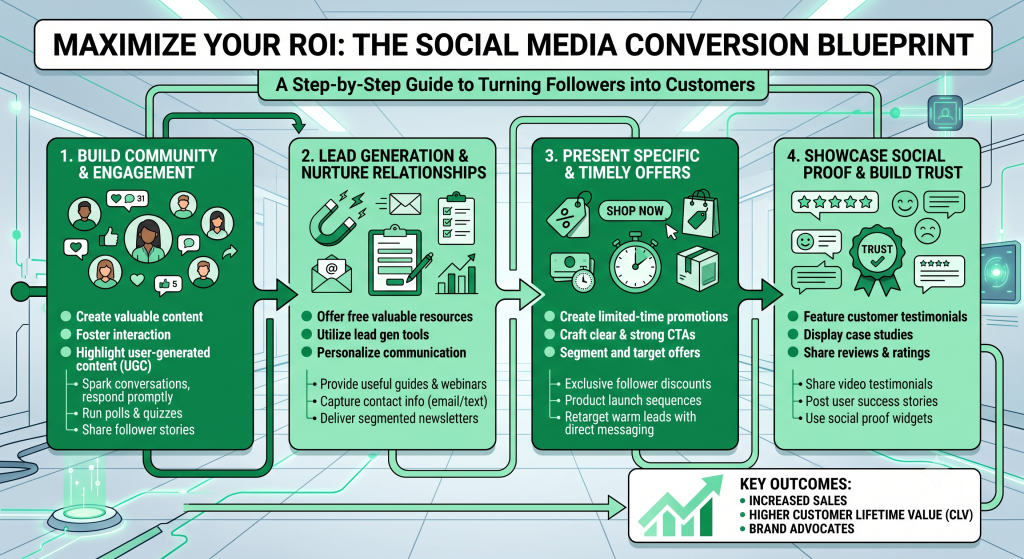
The flow looks like this: Social Content to Lead Magnet to Lead Capture to Follow-Up to Potential Customer. At each step, the person learns more about you and moves closer to a buying decision.
The lead magnet should be genuinely useful on its own. A weak lead magnet attracts people who were only interested in the freebie and damages trust when they realise it was not valuable.
8. Start Conversations Instead of Only Broadcasting Content
Social media is designed for two-way interaction. Businesses that only broadcast miss the signals that tell them who is interested and what they actually need.
Ways to invite conversation:
- Respond to comments thoughtfully rather than with generic replies
- Answer direct messages as a priority, not an afterthought
- Ask real questions in your posts
- Run polls, quizzes, or question-and-answer sessions
- Participate genuinely in community spaces your audience uses
- Listen for the words people use when describing their problems
Conversations give you two things no analytics dashboard can: the language your customers use, and the specific objections that keep them from buying. Both are gold when it comes time to write sales pages or offers.
Avoid sending unsolicited mass DMs or commenting with the same pitch on many posts. These tactics feel spammy and damage your reputation.
9. Use Social Proof to Reduce Customer Hesitation
Social proof gives potential customers a reason to trust you beyond what you say about yourself. It works because people look to others for guidance when making decisions.
Forms of social proof that work on social media:
- Genuine reviews from real customers
- Testimonials with names and, where possible, context
- Case studies that walk through a real problem and outcome
- User-generated content shared with permission
- Customer photos or videos showing the product in use
- Product demonstrations showing how something works
- Expert mentions or features where genuine
Present social proof honestly. Include full context where possible. Never buy fake followers or reviews, never invent testimonials, and never misrepresent a customer experience. Trust is your most valuable asset on social media, and it is very difficult to rebuild once broken.
10. Create a Simple Social Media Sales Funnel
A social media sales funnel is the set of steps that moves someone from seeing your content to making a purchase. It does not need to be complicated, but it does need to exist.
A simple seven-step funnel:
- Reach: Attract relevant people through content and, if budget allows, targeted ads.
- Engage: Create useful and interesting content that encourages interaction.
- Build trust: Demonstrate expertise, transparency, and consistency over time.
- Capture interest: Offer a lead magnet, consultation, product page, or other useful next step.
- Follow up: Continue the relationship through email, DMs, or retargeting.
- Convert: Help the prospect make an informed purchasing decision.
- Retain: Continue providing value after the sale to encourage repeat business.
Hypothetical example: A small bakery uses Instagram to share recipes and behind-the-scenes content (reach and engage). They offer a free downloadable baking guide (capture interest). People who download receive a weekly email with tips and one offer (follow up). The email drives them to place a custom cake order (convert). After purchase, the bakery sends a thank-you note with a discount on a future order (retain).
The funnel works because every step serves a purpose and each one flows naturally to the next.
11. Use Email Marketing to Continue the Relationship
Not every follower will buy the moment they discover you. Email gives you a way to keep the relationship going without relying on the algorithm to show your posts.
A simple email strategy:
- Build an email list through a lead magnet or signup incentive
- Send a welcome sequence that introduces you and delivers value
- Continue with educational emails that help without selling
- Introduce products or services when the time is right
- Follow up with people who expressed interest but did not buy
- Reward existing customers with useful content and occasional offers
Only email people who have given permission. Follow applicable regulations in your region, such as GDPR in Europe or CAN-SPAM in the United States. Spammy tactics damage your brand and can have legal consequences.
12. Use Retargeting Strategically
Retargeting shows ads to people who have already interacted with your business. It works because people who have seen your content before are more likely to recognise your brand when they see it again.
Who you might retarget:
- Visitors who viewed important pages on your website
- People who viewed a specific product but did not buy
- People who engaged with recent content
- People who started a form or checkout but did not finish
Keep it relevant and respectful:
- Match the message to the action they took
- Limit how often the same person sees the same ad
- Segment audiences so each group sees appropriate content
- Follow platform policies and privacy requirements in your region
Retargeting does not guarantee sales. It increases the chance of staying top of mind for someone who already showed interest.
13. Personalize Your Social Media Marketing
Personalization does not require complex technology. It means paying attention to the different needs within your audience and responding appropriately.
Ways small businesses can personalize:
- Create content for different audience segments (beginners vs advanced users, for example)
- Respond to comments and messages with reference to what the person said
- Offer different lead magnets for different problems
- Send follow-up emails based on what someone downloaded or clicked
- Recommend products based on what someone has viewed or bought before
Personalization should respect user privacy. Use information people have chosen to share or that has been collected transparently. Avoid tactics that feel intrusive or surveillance-like.
14. Focus on the Platforms Where Your Customers Actually Spend Time
Trying to dominate every platform usually means doing a poor job on all of them. Focus on the platforms where your ideal customers actually spend time and where your content format fits naturally.
Platform choice should depend on:
- Where your target audience spends time
- What your industry expects
- What content format you are strong at
- Where your customers prefer to buy
- What your business goals require
Quick overview of common platforms:
- Instagram: visual products, lifestyle, local businesses, and personal brands
- Facebook: community building, local businesses, and older audiences
- LinkedIn: B2B services, professional consulting, and thought leadership
- YouTube: in-depth education, tutorials, and long-form content
- TikTok: short-form video, younger audiences, and brand awareness
- Pinterest: visual discovery, home, food, fashion, and planning-heavy niches
No platform is universally best. The best one is the one where your audience already is and where you can consistently produce quality content.
15. Measure the Metrics That Actually Matter
Follower count and likes can feel satisfying, but they do not tell you whether your social media is growing the business. Focus on metrics that connect to real outcomes.
Vanity metrics (limited value on their own):
- Total follower count
- Likes without context
- Impressions without business outcomes
Business metrics (worth tracking closely):
- Website visits from social channels
- Qualified leads generated
- Conversion rate on your landing pages
- Cost per lead, where you invest in ads
- Sales attributed to social channels
- Customer acquisition cost
- Repeat purchases from social-acquired customers
Engagement still matters because it tells you whether your content resonates. Just interpret it alongside business outcomes. High engagement with no sales is a sign that you may be attracting the wrong audience or missing a clear next step.
Common Reasons Social Media Followers Do Not Become Customers
Fix: Define your ideal customer and create content that speaks directly to them. Relevance matters more than reach.
Fix: State clearly who you help and what problem you solve. Make it easy to understand in one sentence.
Fix: Rewrite your bio, add a clear link, pin your best content, and remove anything that creates confusion.
Fix: Add a specific CTA to posts. Tell people exactly what to do and what they will get.
Fix: Balance promotional posts with educational, entertaining, and community-focused content.
Fix: Match the ask to the journey stage. A new follower is not ready for a hard sell. Offer value first.
Fix: Create a lead magnet and a system to capture and follow up with interested people.
Fix: Respond to comments and messages promptly. Set expectations in your bio if you cannot reply immediately.
Fix: Make sure pages load quickly, work well on mobile, and clearly continue the promise from your post.
Fix: Reduce the number of steps required to buy or get in touch. Test the process yourself on a phone.
Fix: Add genuine reviews, case studies, transparent contact information, and clear policies.
Fix: Use email, DMs, or retargeting to stay in touch. Most people need multiple touchpoints before buying.
Fix: Track business outcomes like leads, sales, and customer acquisition cost, not just follower count and likes.
A Step-by-Step Strategy to Turn Social Media Followers Into Customers
- Step 1: Define your ideal customer. Who are they, what problems do they have, and where do they spend time online?
- Step 2: Audit your social media audience. Are the people following you actually able to buy from you? If not, adjust your content.
- Step 3: Optimize your profile. Bio, link, pinned posts, contact information, and clear CTA.
- Step 4: Create content for each journey stage. Awareness, consideration, conversion, and retention content all have a role.
- Step 5: Build trust consistently. Educate, be transparent, show your work, and answer questions honestly.
- Step 6: Add relevant calls to action. Match the CTA to the content and stage of the buyer's journey.
- Step 7: Send followers to a clear next step. Landing page, booking page, store, email signup, or WhatsApp.
- Step 8: Capture leads. Use a lead magnet or direct enquiry form to gather contact details.
- Step 9: Follow up and nurture relationships. Email, DM, or retargeting keeps you top of mind until the person is ready.
- Step 10: Measure and improve. Track business metrics, not vanity metrics, and refine your approach.
How AI Can Help Businesses Convert Social Media Audiences More Efficiently
AI tools can support various parts of social media marketing when used thoughtfully. They help with speed and organization, but they should never replace human judgment.
Ways AI can help:
- Content idea generation and brainstorming
- Audience research and segmentation
- Content repurposing across platforms
- Caption drafting and editing
- Performance data analysis
- Customer question analysis from comments and DMs
- Social listening at scale
- Personalization support at scale
- Workflow automation for repetitive tasks
Important: AI should support your strategy, not replace it. Always review AI-generated content before publishing, verify factual claims, protect customer privacy, maintain your brand voice, and avoid publishing low-quality automated content without editing.
How to Make Social Media Content More Visible in AI Search
AI-powered search systems are increasingly involved in how people discover information, brands, and products. Social media content can contribute to that visibility, though no business can guarantee inclusion in AI-generated answers.
Ways to make your content more useful for AI systems:
- Use clear and descriptive language in captions and video descriptions
- Explain your products and services accurately and specifically
- Create genuinely useful educational content
- Keep brand information consistent across platforms
- Answer common customer questions publicly where appropriate
- Build topical expertise by covering your subject in depth over time
- Connect social media content with your website where possible
- Use accurate business information (name, location, services)
- Add original insight that cannot be found elsewhere
Visibility depends on platforms, systems, relevance, authority, and evolving technology. The goal is not to chase algorithms. It is to be clear, useful, and consistent so that any system trying to understand your brand has accurate information to work with.
Final Thoughts
The goal is not simply to gain more followers. It is to build relationships with the right audience and guide interested people toward the next meaningful step.
Relevance, trust, value, and consistency matter more than any single tactic. So does measurement. If you cannot tell which content is driving leads and sales, you cannot improve what you are doing.
Start with one platform, one audience, and one clear next step. Build from there. Social media rarely converts in one step, but a well-designed journey turns attention into outcomes over time.
If your audience is engaged but not buying, the answer is almost never more posts. It is usually a clearer path from attention to action.
Key Takeaways
- Follower count measures attention, not buying intent. Relevant audience beats large audience.
- Understand the customer journey. Not every follower is ready to buy, and treating them all the same backfires.
- Optimize your profile. It should clearly state who you help, what you offer, and what to do next.
- Create content for every stage: awareness, consideration, conversion, and retention.
- Trust is built over time through transparency, usefulness, and consistency. Never fake social proof.
- Use clear, specific CTAs matched to the content and stage of the journey.
- Lead magnets turn anonymous followers into identifiable leads you can follow up with.
- Follow up through email, DMs, or retargeting. Most people need multiple touchpoints before buying.
- Focus on platforms where your customers actually are. Do not try to be everywhere.
- Measure business metrics like leads, sales, and customer acquisition cost, not just followers and likes.
Frequently Asked Questions
Focus on relevance, trust, and a clear next step. Attract the right audience, create content for each stage of the journey, build trust over time, use specific CTAs, capture leads with a useful offer, and follow up. Follower count is not the goal. Meaningful action from the right people is.
Common reasons include attracting the wrong audience, unclear value proposition, no clear CTA, asking for a sale too early, poor profile optimization, missing trust signals, or an unclear path from post to purchase. Diagnose which stage is broken before changing anything else.
A social media conversion funnel is the sequence of steps that moves someone from seeing your content to making a purchase. A simple version includes reach, engagement, trust building, lead capture, follow-up, conversion, and retention. Each step serves a purpose and flows naturally to the next.
Offer a lead magnet such as a free guide, checklist, consultation, or discount in exchange for contact information. Promote it through content and send interested followers to a simple landing page or form. Then follow up consistently through email or direct message.
There is no fixed rule, but promotional content usually works best when it is balanced with educational, entertaining, and community content. A common starting point is one promotional post for every three to five value-focused posts. Adjust based on what your audience responds to.
Content that demonstrates expertise, answers real questions, shows the product or service in use, and reduces hesitation tends to convert well. Case studies, testimonials, product demonstrations, and behind-the-scenes content often support conversion. Awareness content still matters because it brings in new people.
Not always. For a specific offer, a focused landing page usually works better than a general homepage because it matches the promise in the post. For general browsing, your website is fine. Match the destination to the intent behind the click.
Focus on one platform where your ideal customers spend time, build trust through consistent useful content, use specific CTAs, and make the path from post to purchase as simple as possible. Small businesses often have an advantage in being personal, responsive, and specialized.
Track website visits from social channels, qualified leads, conversion rate on landing pages, cost per lead if running ads, sales attributed to social, and customer acquisition cost. Follower count and likes have some value but should be interpreted alongside business outcomes.
AI can assist with content ideas, audience research, content repurposing, caption drafting, and performance analysis. It should support, not replace, human strategy, judgment, and customer understanding. Always review AI-generated content before publishing and verify any factual claims.
There is no fixed timeline. It depends on your industry, offer, price point, and how well you build trust. Some people buy quickly. Most need multiple touchpoints over weeks or months. Consistency matters more than speed.
No. A smaller, highly relevant audience often produces better results than a large, uninterested one. Focus on reaching the right people and serving them well rather than chasing follower count.
Need Help Turning Your Social Media Audience Into Customers?
If your social media audience is engaged but not converting, the issue is usually in the journey, not the content itself. OptiRanker works with businesses on social media strategy, content planning, lead generation, and conversion optimization.
We focus on practical improvements that help the right audience take meaningful action, without shortcuts or empty promises.