
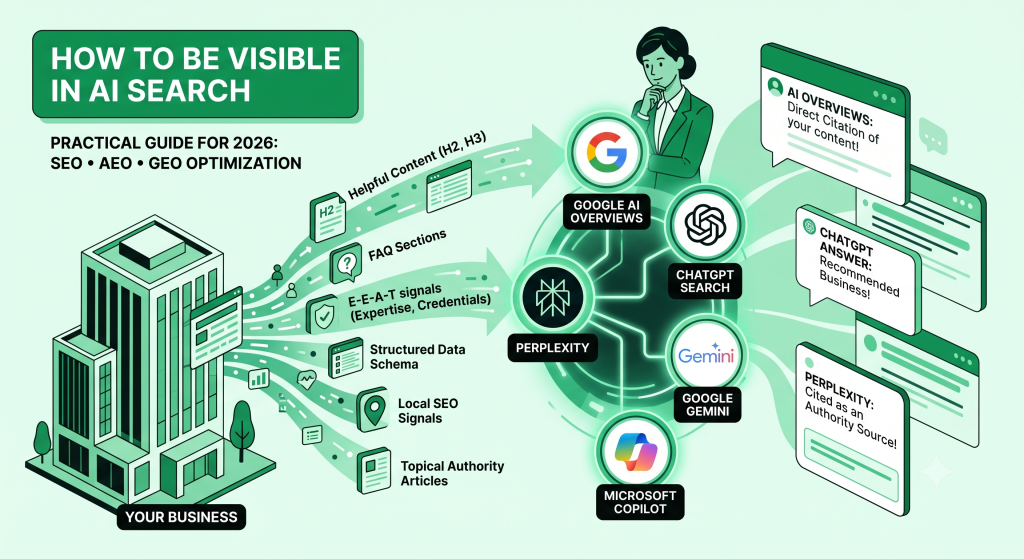
More people are asking AI-powered systems questions instead of scrolling through traditional search results. They open ChatGPT, Gemini, Perplexity, or Google’s AI Overviews and type things like “best digital marketing agency for a small business” or “how do I improve my Google rankings?” The AI gives them a direct answer. Sometimes it mentions specific businesses. Sometimes it doesn’t.
That shift creates a new visibility opportunity for businesses. It’s not about replacing SEO. It’s about extending your search strategy so your business can be discovered, cited, or recommended across both traditional search and AI-powered search experiences.
This guide explains how AI search works, how AI systems find information about your business, and exactly what you can do to increase the chances of being visible. No guarantees. No shortcuts. Just practical steps you can start using today.
What Is AI Search?
AI search is a type of search experience where artificial intelligence generates a direct answer to your question instead of just showing a list of links. It synthesizes information from multiple sources, provides a conversational response, and often includes citations or links to the sources it used.
Common examples include:
- Google AI Overviews and AI Mode — AI-generated summaries that appear at the top of Google search results for many queries.
- ChatGPT Search — OpenAI’s search feature that lets models access up-to-date information from the internet and provide answers with sourced citations.
- Google Gemini — Google’s AI assistant that can search the web and generate conversational answers.
- Microsoft Copilot — Microsoft’s AI-powered search and chat experience integrated into Bing and Windows.
- Perplexity — An AI search engine that provides direct answers with cited sources.
The key difference from traditional search: AI search doesn’t just rank pages. It reads, synthesizes, and generates. Your business needs to be part of the information that AI systems can find, understand, and trust.
Why AI Search Visibility Matters for Businesses
AI search visibility matters because more people are using AI tools to research products, services, and businesses before they make decisions. If your business isn’t part of the information those tools draw from, you’re invisible to a growing segment of potential customers.
Here’s what AI visibility can influence:
- Brand discovery — When someone asks an AI tool for a recommendation in your industry, you want your business to be mentioned.
- Customer research — People increasingly use AI to compare options before contacting a business.
- Local business discovery — AI Overviews now appear in a significant share of local searches.
- Brand authority and trust — Being cited by AI systems signals credibility to potential customers.
- Referral traffic — AI-generated answers often include links to sources, which can drive qualified visitors to your website.
- Consideration-stage visibility — AI search is often used during the research phase, before a customer is ready to buy.
None of this is guaranteed. Visibility depends on relevance, authority, crawlability, content quality, trust, reputation, query context, freshness, competition, and the systems each platform uses. But the businesses that invest in understanding AI search today are building an advantage for tomorrow.
SEO vs AEO vs GEO: What's the Difference?
SEO, AEO, and GEO are related approaches that overlap. They are not completely separate marketing systems. Think of them as layers of the same strategy.
| Approach | Full Name | Focus | Primary Goal |
|---|---|---|---|
| SEO | Search Engine Optimization | Visibility in traditional search results | Rank higher and earn organic clicks |
| AEO | Answer Engine Optimization | Structuring content to answer questions clearly | Be the source AI systems extract answers from |
| GEO | Generative Engine Optimization | Optimizing for generative AI search experiences | Be cited, mentioned, or recommended by AI |
SEO is about being found in search results. It focuses on keywords, rankings, backlinks, technical health, and user experience.
AEO is about making your content easy for AI systems to extract and present as a direct answer. It focuses on clear definitions, direct answers, structured formatting, and question-led headings.
GEO is about improving your visibility across generative AI search platforms like ChatGPT, Google AI Overviews, Perplexity, and Copilot. It focuses on entity clarity, content structure, authoritative mentions, and technical accessibility.
Google’s official guidance confirms that the best practices for SEO continue to be relevant for generative AI search because these features are rooted in Google’s core Search ranking and quality systems. AEO and GEO are not replacements for SEO. They are extensions of it.
How AI Search Finds Information About Your Business
AI search systems don’t magically know about your business. They rely on a combination of crawling, indexing, and reasoning about information from across the web. Here’s what matters:
- Crawlable website content — AI systems need to be able to access your pages. If your robots.txt file blocks AI crawlers like GPTBot, ClaudeBot, or PerplexityBot, your content won’t be part of their training or retrieval process.
- Indexable pages — Your important pages need to be indexed by search engines.
- Clear business information — Your business name, services, location, and expertise should be easy to find and understand on your website.
- Consistent brand information — Your business details should be consistent across your website, Google Business Profile, social profiles, directories, and third-party mentions.
- Relevant topical content — AI systems look for content that demonstrates depth and relevance on topics related to your business.
- Trusted third-party references — Mentions and citations from authoritative sources help AI systems verify and trust information about your business.
- Reviews where relevant — Customer reviews on platforms like Google Business Profile can influence how AI systems describe your business.
- Local signals — For local businesses, consistent NAP (Name, Address, Phone) data, local citations, and Google Business Profile signals matter.
- Authoritative mentions — Being referenced by credible industry publications, news outlets, or experts strengthens your brand’s authority.
- Structured data where appropriate — Schema markup can help AI systems understand your content.
- Website architecture and internal links — A clear site structure helps AI systems understand the relationships between your pages.
No single trick or tactic guarantees inclusion in AI answers. AI visibility is the result of many signals working together.
15 Practical Ways to Make Your Business More Visible in AI Search
Here are 15 actionable tactics you can use to improve your chances of being visible in AI search.
1. Build a Technically Accessible Website
What it means: Make sure AI crawlers can access your website content without barriers.
Why it matters: If AI systems can’t crawl your site, they can’t learn about your business.
How to implement: Check your robots.txt file and ensure you’re not accidentally blocking legitimate AI crawlers.
Example: A local plumbing company discovered their robots.txt was blocking GPTBot. After allowing it, their business started appearing in ChatGPT responses for “plumber near me” queries within a few months.
2. Create Genuinely Helpful, People-First Content
What it means: Write content that real people find useful, not content designed primarily to manipulate search algorithms.
Why it matters: Google’s Helpful Content system evaluates whether content appears to be written primarily for people.
How to implement: Focus on solving real problems for your customers. Write in a natural voice.
Example: Instead of writing “7 Tips for First-Time Homebuyers” (commodity content), write a first-hand account that provides unique insight.
3. Answer Specific Customer Questions
What it means: Create content that directly addresses the questions your customers are asking.
Why it matters: AI search is conversational. People ask questions. AI systems look for content that provides clear, direct answers.
How to implement: Use question-led headings. Answer the question in the first 1–3 sentences.
Example: A digital marketing agency created a page titled “How Much Should a Small Business Spend on SEO?” and answered the question directly in the first paragraph.
4. Build Topical Authority
What it means: Create comprehensive content that covers your topic area in depth.
Why it matters: AI systems look for sources that demonstrate deep knowledge.
How to implement: Identify your core topics. Create pillar pages and cluster pages, linked together with internal links.
Example: A B2B software company created a comprehensive guide plus 20 related articles. Over time, AI systems started citing their content as a leading source.
5. Demonstrate First-Hand Experience
What it means: Share your actual experiences, not just general information that anyone could write.
Why it matters: Google’s E-E-A-T framework includes Experience as a key signal.
How to implement: Include case studies, personal stories, lessons learned, and real-world examples from your business.
Example: A consultant wrote about a failed client project. This content performed better in AI search than generic advice articles.
6. Strengthen E-E-A-T Signals
What it means: Build Experience, Expertise, Authoritativeness, and Trustworthiness signals across your website.
Why it matters: E-E-A-T is the framework Google uses to evaluate content quality.
How to implement: Add author bios with credentials. Link to your professional profiles. Include testimonials and case studies.
Example: A financial advisor added detailed author bios for each blog post. Their content started appearing more often in AI-generated answers.
7. Keep Business Information Accurate and Consistent
What it means: Ensure your business name, address, phone number, services, and other key details are consistent everywhere.
Why it matters: Consistency helps AI systems verify that information about your business is correct.
How to implement: Audit your website, Google Business Profile, social media profiles, and directory listings.
Example: A restaurant had different hours listed across platforms. After standardizing, they noticed more accurate AI-generated descriptions.
8. Build Authoritative Brand Mentions and Digital PR
What it means: Get your business mentioned or cited by credible third-party sources.
Why it matters: AI engines weigh third-party earned coverage more heavily than owned content.
How to implement: Pitch stories to industry publications. Participate in expert roundups. Speak at conferences.
Example: A startup founder was quoted in a major tech publication. Months later, their company started appearing in ChatGPT responses.
9. Strengthen Local SEO
What it means: Optimize your presence for local searches.
Why it matters: AI Overviews now appear in a significant share of local searches.
How to implement: Claim and optimize your Google Business Profile. Ensure NAP consistency. Create location-specific landing pages.
Example: A dental office optimized their Google Business Profile. They started appearing in AI-generated local recommendations.
10. Use Structured Data Correctly
What it means: Add Schema.org markup to help search engines and AI systems understand your content.
Why it matters: Structured data can help AI systems parse your content and identify key facts.
How to implement: Use JSON-LD format. Add Organization, LocalBusiness, Article, Person, Product, Service, and FAQ schema where appropriate.
Example: An e-commerce store added Product schema to all product pages. Their products started appearing more frequently in AI-generated shopping recommendations.
11. Improve Internal Linking and Site Architecture
What it means: Create a clear, logical structure for your website with meaningful internal links.
Why it matters: A well-organized site helps AI systems understand relationships between your content.
How to implement: Use descriptive anchor text. Link from pillar pages to cluster pages. Use breadcrumbs.
Example: A law firm reorganized their website so that each practice area had a main page linked to related articles and FAQs.
12. Keep Important Content Updated
What it means: Regularly review and update your key pages to ensure accuracy and freshness.
Why it matters: Recency is a major signal for AI systems.
How to implement: Set a schedule to review your most important pages. Update statistics, examples, and recommendations.
Example: A SaaS company updated their pricing page quarterly. After each update, they noticed a temporary increase in AI citations.
13. Create Original Research, Examples, Data, or Insights
What it means: Produce content that offers unique information not available anywhere else.
Why it matters: Generic content is weak. AI systems and human readers both value original information.
How to implement: Conduct surveys. Analyze your own data. Share proprietary insights.
Example: A marketing agency analyzed 500 client campaigns and published a report on which tactics produced the best ROI.
14. Optimize Content for Conversational Queries
What it means: Write content that matches how people actually talk when they ask AI systems questions.
Why it matters: AI search is conversational.
How to implement: Use natural language. Include long-tail question variations. Create FAQ sections.
Example: A business consultant created a page titled “What Should a Startup Do Before Running Google Ads?” and covered the exact questions founders were asking.
15. Make Important Information Easy to Understand and Extract
What it means: Structure your content so that key facts, definitions, and answers are easy to find.
Why it matters: AI systems break pages into individual passages and evaluate each one.
How to implement: Use clear headings. Write short paragraphs. Include definitions. Use bullet points and numbered lists.
Example: A health and wellness website restructured their articles to start each section with a one-sentence summary of the answer.
Want to improve your visibility across Google and AI-powered search?
Create Content AI Systems Can Understand
Creating content that AI systems can understand doesn’t mean writing robotically. It means being clear, organized, and direct. The same principles that make content easy for humans to read also make it easier for AI to process.
Here’s how to structure content for both people and AI:
- Clear headings — Use descriptive H2s and H3s that tell readers (and AI) what each section covers.
- Short paragraphs — Break up text into digestible chunks.
- Definitions — When introducing a concept, define it clearly in the first sentence or two.
- Direct answers — Answer the question in the heading immediately, then provide context.
- Lists — Use bullet points and numbered lists for steps, features, and examples.
- Tables — Use tables for comparisons, specifications, and structured data.
- Relevant examples — Concrete examples make abstract concepts easier to understand.
- Supporting evidence — Cite sources for claims that could change over time.
- Context — Don’t just state facts. Explain why they matter.
- Consistent terminology — Use the same terms for the same concepts throughout your content.
Most importantly: write for humans first. AI systems are increasingly good at understanding natural language. Content that helps a human reader also helps AI systems.
Create Content That Deserves to Be Cited
There’s a difference between content written to rank and content worth referencing. Ranking content often follows formulas. Referencing content offers something unique.
AI systems are trained to identify useful, trustworthy information. Generic content that restates what’s already available elsewhere is less likely to be cited.
Here’s how to create content that deserves to be cited:
- Original research — Conduct surveys, analyze data, and publish findings that don’t exist elsewhere.
- Case studies — Document real projects with real results. Show the process, not just the outcome.
- First-hand experiences — Share what you’ve actually done, not just what you’ve read.
- Expert commentary — Offer analysis and opinions based on your expertise.
- Unique frameworks — Develop your own methodologies or approaches to solving problems.
- Industry data — Compile and analyze data that others can reference.
- Comparisons — Compare products, services, or approaches in a way that helps readers make decisions.
- Calculations — Show your work. Explain how you arrived at a conclusion.
- Proprietary insights — Share knowledge that comes from your specific experience.
- Real-world results — When you have legitimate results to share, share them.
Google’s guidance emphasizes creating “non-commodity content” — content that provides unique expert or experienced takes that go beyond common knowledge. That’s the kind of content AI systems are more likely to cite.
Build Your Brand as an Entity
AI systems don’t just think in keywords. They think in entities — distinct, well-defined concepts with verifiable relationships to other concepts. Your business is an entity. The more clearly AI systems understand who you are, what you do, and how you relate to your industry, the better they can represent you accurately.
Here’s what contributes to entity clarity:
- Business name — Use the same name consistently everywhere.
- Services — Clearly describe what you offer.
- Location — If you serve specific areas, make that clear.
- Expertise — Demonstrate what you’re an expert in through content, credentials, and third-party recognition.
- Founders/team — Include information about the people behind the business.
- About page — Create a comprehensive About page.
- Contact information — Make it easy to find and verify your contact details.
- Author information — Add detailed author bios to your content.
- Social profiles — Link to your social media profiles from your website.
- Business profiles — Claim and optimize your Google Business Profile.
- Industry mentions — Get mentioned in industry publications and directories.
- Reviews — Encourage customer reviews on relevant platforms.
- Consistent descriptions — Use similar language to describe your business across all platforms.
Consistency helps search systems understand who you are and what you do. Inconsistency creates confusion and reduces trust.
Local Businesses: How to Improve AI Search Visibility
Local businesses face a unique challenge and opportunity in AI search. AI Overviews now appear in a significant share of local searches.
Here’s what local businesses can do:
- Optimize your Google Business Profile — Complete every section, add photos regularly, post updates, and respond to reviews.
- Maintain NAP consistency — Your Name, Address, and Phone number should be identical across every platform.
- Encourage and respond to reviews — Reviews help AI systems understand your reputation.
- Create location-specific landing pages — If you serve multiple areas, create individual pages.
- Develop location-specific content — Write about local events, news, or issues related to your industry.
- Build local citations — Get listed in local directories and chambers of commerce.
- Get involved in the community — Sponsor local events and build relationships with local media.
- Pursue local media mentions — Local news coverage can strengthen your local authority signals.
- Clearly define your service area — Make it easy for AI systems to understand exactly where you operate.
- Create helpful local content — Write guides, tips, or resources that are specifically useful to people in your area.
These tactics don’t guarantee AI recommendations, but they strengthen the signals AI systems use to evaluate local businesses.
Technical SEO for AI Search
Technical SEO is the foundation of AI search visibility. If AI systems can’t crawl, index, and understand your website, nothing else matters.
Here’s what to check:
- Crawlability — Ensure AI crawlers like GPTBot, ClaudeBot, PerplexityBot, and Google-Extended are allowed in your robots.txt file.
- Indexability — Check Google Search Console to make sure your important pages are indexed.
- Robots.txt — Review it regularly. Blocking AI crawlers means your content won’t be part of their knowledge.
- XML sitemap — Submit an up-to-date sitemap to search engines.
- Canonical URLs — Use canonical tags to avoid duplicate content issues.
- Internal linking — Create a logical internal linking structure.
- Page speed — Fast-loading pages are easier for crawlers to access.
- Mobile usability — Most searches happen on mobile devices.
- HTTPS — Secure your website with HTTPS.
- Structured data — Add Schema.org markup to help search engines understand your content.
- JavaScript rendering — Make sure important content is accessible even if JavaScript doesn’t render.
- Search Console — Use Google Search Console to monitor your site’s performance.
- Accessible important content — Don’t hide key information behind forms or logins.
Technical SEO is foundational. It’s not a magical shortcut to AI visibility, but without it, everything else is harder.
Structured Data & Schema Markup
Structured data is a standardized format for providing information about a page and classifying its content. Schema.org is the vocabulary that most search engines use.
Structured data helps search engines and AI systems understand what your content is about. It can make it easier for them to extract key facts and identify entities.
Important: Google states that structured data is not required for AI Overviews or AI Mode, and there is no special Schema.org markup that website owners need to add for generative AI search. However, structured data can still help AI systems understand your content more reliably.
Appropriate schema types include:
- Organization — For your business entity
- LocalBusiness — For local businesses with a physical location
- Article — For blog posts and news articles
- Person/Author — For author information
- Product — For e-commerce products
- Service — For service-based businesses
- FAQ — For frequently asked questions pages
- BreadcrumbList — For site navigation structure
Structured data should accurately represent visible page content. Don’t mark up information that isn’t visible to users. Follow search engine guidelines and use the JSON-LD format.
How to Optimize for AI Questions
AI search is conversational. People ask full questions. Optimizing for these questions means creating content that directly answers them.
Here are examples of conversational queries and how to create content that answers them:
Query: “What is the best digital marketing agency for a small business?”
Create a page that explains what small businesses should look for in a digital marketing agency. Include criteria, red flags, and questions to ask.
Query: “Which SEO agency helps local businesses?”
If you specialize in local SEO, create content that explains how local SEO works, what local businesses need, and how to choose an SEO partner.
Query: “How can I improve my Google rankings?”
Create a comprehensive guide that covers the fundamentals of improving Google rankings. Answer the question directly in the first paragraph.
Query: “What should a startup do before running Google Ads?”
Create a checklist or step-by-step guide that answers this specific question. Cover keyword research, landing pages, tracking setup, budget planning, and common mistakes.
The key is to create content that’s genuinely useful to someone asking that question, not just content that mentions the keywords.
What NOT to Do
Some tactics that might have worked in the past can damage your visibility and trust today. Here’s what to avoid:
- Keyword stuffing — Overloading content with keywords makes it harder to read and signals that you’re writing for algorithms, not people.
- AI-generated spam — Mass-producing low-quality content with AI tools can lead to penalties and erode trust.
- Fake reviews — Buying or fabricating reviews violates platform guidelines.
- Fake testimonials — Fabricating customer quotes is dishonest.
- Fake statistics — Inventing data to support your claims is unethical.
- Manipulative backlinks — Buying links or participating in link schemes violates search engine guidelines.
- Hidden text — Text that’s invisible to users but visible to search engines is a spam tactic.
- Cloaking — Showing different content to search engines than to users is deceptive.
- Doorway pages — Creating pages solely to rank for specific keywords provides a poor experience.
- Duplicate mass-produced content — Publishing the same content across multiple pages adds no value.
- Fake author expertise — Claiming credentials you don’t have undermines trust.
- Misleading claims — Overpromising results damages credibility.
- Creating content solely to manipulate AI systems — Trying to game AI systems rather than genuinely helping users is a short-term strategy that will likely backfire.
These approaches can damage trust with both users and search systems. The goal should be to create genuine value, not to manipulate algorithms.
Can AI-Generated Content Help With AI Search?
AI can be a useful tool in your content workflow, but it’s not a replacement for human expertise.
AI can assist with:
- Research — Gathering information and identifying topics to cover
- Outlines — Structuring content before writing
- Brainstorming — Generating ideas and angles
- Editing — Checking grammar, clarity, and readability
- Content briefs — Creating guidelines for writers
- Summarization — Condensing long content into key points
- Repurposing — Adapting content for different formats
But businesses should add:
- Human expertise — Knowledge that comes from experience
- Original insights — Perspectives that aren’t available elsewhere
- First-hand experience — Stories and examples from real work
- Fact checking — Verifying claims against authoritative sources
- Editorial judgment — Deciding what’s worth publishing
- Brand perspective — Your unique voice and point of view
Google’s guidance emphasizes creating “non-commodity content” that provides unique value. Content that could easily be produced by a generative AI model is less likely to stand out. AI-written content doesn’t automatically rank poorly, but it needs human expertise to be genuinely useful and distinctive.
How to Measure AI Search Visibility
Measuring AI search visibility is still evolving, but there are several things you can monitor.
- Organic impressions — Track impressions in Google Search Console to see how often your pages appear in search results.
- Organic clicks — Monitor clicks to understand how much traffic you’re getting from search.
- Search queries — Review the queries that bring people to your site. Look for conversational, question-based queries.
- Branded searches — Track searches for your brand name. Increases can indicate growing awareness.
- Referral traffic — Monitor traffic from AI platforms like ChatGPT, Perplexity, and Gemini. Filter referrals by AI engine domains in Google Analytics.
- Mentions — Track mentions of your brand across the web, including unlinked mentions.
- Leads and conversions — Monitor how many leads and conversions come through your website.
- Assisted conversions — Track how AI referrals contribute to conversions later in the customer journey.
- Search Console data — Use the new generative AI performance reports in Google Search Console.
- Analytics — Set up custom reports in Google Analytics to track AI referral traffic.
- Rankings — Track traditional search rankings where relevant, but don’t rely solely on them.
AI visibility measurement is still evolving. Not every AI mention or citation is directly measurable. Combine multiple data sources to build a complete picture.
30-Day AI Search Visibility Action Plan
Here’s a practical 30-day plan to start improving your AI search visibility.
Days 1–7: Technical and Entity Audit
- Check your robots.txt file and ensure AI crawlers are allowed
- Verify that your important pages are indexed in Google Search Console
- Review your XML sitemap for accuracy
- Check for canonical tag issues
- Audit your Google Business Profile (if local)
- Ensure NAP consistency across all online listings
- Review your About page and author bios for completeness
- Check that your site is mobile-friendly and loads quickly
Days 8–14: Content and Question Research
- Identify the questions your customers are asking
- Use AI tools to see what questions people ask about your industry
- Review your existing content for gaps
- Create a list of content topics based on customer questions
- Plan a content calendar for the next 90 days
- Identify opportunities to add first-hand experience to existing content
Days 15–21: Content Optimization and Authority Building
- Update your most important pages with answer-first formatting
- Add FAQ sections to key pages
- Implement structured data where appropriate
- Improve internal linking between related pages
- Add author bios with credentials to your content
- Identify opportunities for digital PR and expert commentary
- Reach out to industry publications for mentions
Days 22–30: Digital PR, Local SEO, Measurement and Improvement
- Pitch a story or expert quote to relevant publications
- Update local citations and directory listings
- Encourage satisfied customers to leave reviews
- Set up tracking for AI referral traffic in Google Analytics
- Check Google Search Console for AI performance data
- Test how your business appears in AI search tools
- Review what’s working and adjust your approach
- Schedule ongoing content updates and PR outreach
Frequently Asked Questions
What is AI search?
AI search is a search experience where artificial intelligence generates a direct answer to your question instead of just showing a list of links. Examples include Google AI Overviews, ChatGPT Search, Perplexity, and Microsoft Copilot. These systems synthesize information from multiple sources and provide conversational answers with citations.
How do I get my business into AI search results?
There’s no guaranteed way to get into AI search results, but you can improve your chances by creating technically accessible, helpful content that answers customer questions, building authoritative brand mentions, maintaining consistent business information, and strengthening E-E-A-T signals. Focus on being genuinely useful rather than trying to game AI systems.
Is SEO still important for AI search?
Yes. Google’s official guidance confirms that SEO best practices continue to be relevant for generative AI search because these features are rooted in Google’s core Search ranking and quality systems. AI Overviews and AI Mode use the same infrastructure as traditional search.
What is GEO?
GEO stands for Generative Engine Optimization. It’s the practice of structuring your content and digital presence so that AI-powered search platforms can retrieve, cite, and recommend your brand when answering user questions. GEO focuses on entity clarity, content structure, and authoritative mentions.
What is AEO?
AEO stands for Answer Engine Optimization. It’s the practice of structuring information so that AI systems can accurately synthesize and present it as a direct answer. AEO focuses on clear definitions, direct answers, question-led headings, and structured formatting.
Does schema markup help with AI search?
Structured data can help AI systems understand your content, but Google states that schema markup is not required for AI Overviews or AI Mode. There is no special Schema.org markup for generative AI search. However, structured data can improve how reliably AI systems parse and interpret your content.
Can ChatGPT recommend my business?
ChatGPT can mention businesses in its responses, but there’s no guaranteed way to make this happen. ChatGPT draws from web content it can access. Being mentioned in authoritative third-party sources, having a crawlable website, and providing clear, consistent business information can improve your chances of being mentioned.
How can I get my website cited by AI?
Create content that’s worth citing: original research, first-hand experience, unique insights, and clear, extractable answers. Make sure your site is crawlable by AI systems. Build authoritative mentions across the web. Keep your content updated. Focus on being genuinely useful rather than trying to trick AI systems.
Does Google AI search replace traditional SEO?
No. Google’s AI Overviews and AI Mode are built on the same ranking and quality systems as traditional search. The best practices for SEO continue to be relevant. AI search is an evolution of search, not a replacement. Businesses should think about search visibility across both traditional and AI-powered experiences.
How long does AI search optimization take?
AI search optimization is an ongoing process, not a one-time task. Some improvements, like technical fixes, can show results relatively quickly. Building authority and earning mentions takes longer — typically months. AI systems also change frequently, so visibility requires ongoing attention.
Does AI-generated content help with GEO?
AI can assist with research, outlines, editing, and repurposing, but content should include human expertise, original insights, first-hand experience, and editorial judgment. Content that could easily be produced by an AI model is less likely to stand out. Use AI as a tool, not a replacement for genuine expertise.
How important are online reviews?
Online reviews help AI systems understand your reputation and verify information about your business. For local businesses, reviews on Google Business Profile are particularly important. Respond to reviews professionally, and encourage satisfied customers to share their experiences.
Does local SEO matter for AI search?
Yes. AI Overviews appear in a significant share of local searches. For local businesses, optimizing your Google Business Profile, maintaining NAP consistency, and building local citations can improve your chances of being visible in AI-powered local search results.
How do I measure AI search visibility?
Track organic impressions and clicks in Google Search Console, monitor referral traffic from AI platforms in Google Analytics, watch branded searches, and use the new generative AI performance reports in Search Console. AI visibility measurement is still evolving, so combine multiple data sources.
Final Thoughts
AI search is changing how people discover businesses. The businesses that adapt will be the ones that understand how AI systems find, evaluate, and cite information — and that invest in creating genuinely useful content and building authoritative online presence.
There’s no guaranteed formula. Visibility depends on many factors, including relevance, authority, crawlability, content quality, trust, reputation, query context, freshness, competition, and the systems used by each platform. But by focusing on the fundamentals — helpful content, technical accessibility, consistent brand information, and authoritative mentions — you can improve your chances of being visible.
Want to improve your visibility across Google and AI-powered search? Optiranker can help you build an SEO, AEO, and digital marketing strategy designed around your business goals. We don’t promise guaranteed rankings or AI recommendations, but we can help you build a strong foundation for long-term search visibility.
This article was written by the Optiranker team and reviewed for accuracy. Sources include Google Search Central documentation, OpenAI documentation, and other authoritative first-party sources.