
Competing With Big Brands Isn't About Budget — It's About Focus
If you run a small business, you’ve probably felt it: a larger competitor spends more on ads, dominates search results, and has a marketing team you can’t afford. It’s easy to assume you can’t compete. But that assumption is wrong — or at least, incomplete.
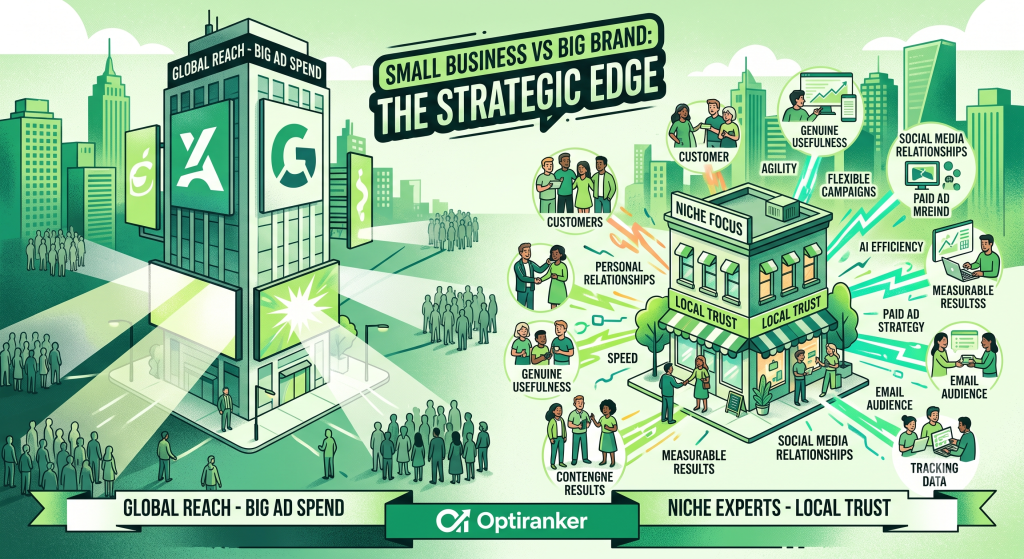
Big brands win on reach. Small businesses win on relevance, speed, personal relationships, and local trust. Digital marketing evens the playing field because it rewards focus, consistency, and genuine usefulness more than raw budget.
This guide walks you through 12 practical strategies that small businesses use to compete with larger competitors online. Every tactic is realistic, affordable, and designed to work even if you’re a one-person marketing team.
Can Small Businesses Really Compete With Big Brands?
Yes — but not by trying to outspend big brands. Small businesses compete by being faster, more personal, more focused, and more local than larger competitors who can’t move as quickly or personalize at scale.
Competing doesn’t mean winning everywhere. It means winning where you’re strongest:
- Focus — You can serve a narrow audience extremely well instead of chasing everyone.
- Speed — You can test an idea and launch it in days. A big company needs committee approvals.
- Personalization — You can remember customer names, preferences, and history.
- Local relevance — You can rank in your city or region where national chains struggle.
- Customer relationships — Loyal customers who feel connected to your business become your best marketers.
- Niche expertise — You can become the go-to expert in a specific area rather than a generalist.
A local bakery can’t out-advertise a national brand. But it can own the morning commute crowd in its neighborhood, build a loyal email list, and get featured in local media — things the national brand will never prioritize.
Why Digital Marketing Gives Small Businesses an Advantage
Digital channels removed most of the barriers that used to favor big companies. Today, a well-run small business can reach a specific audience, measure results precisely, and adjust quickly — all without a huge budget.
- Lower barriers to entry — You can start with a website, a Google Business Profile, and a social page for almost nothing.
- Precise targeting — Digital ads and content let you reach specific people by location, interest, or behavior.
- Measurable results — You can track exactly what brings in traffic, leads, and sales.
- Flexible campaigns — You can pause, adjust, or scale campaigns weekly instead of being locked into annual contracts.
- Faster experimentation — Small budgets let you test ten ideas quickly; big brands often can’t.
- Cost control — You can cap daily ad spend and only pay for results you can track.
The advantage isn’t access — it’s agility. A small business can respond to a customer question, launch a new service, or pivot a campaign in a day. A larger company usually can’t.
12 Practical Strategies Small Businesses Can Use Right Now
Each strategy below is practical, budget-friendly, and focused on outcomes that matter — not vanity metrics. You don’t need to do all 12 at once. Pick two or three, execute them well, and add more as you grow.
1. Focus on a Specific Niche Instead of Trying to Reach Everyone
Big brands often speak to everyone. That’s a weakness, not a strength — because broad messaging rarely resonates deeply with anyone.
Why it works: A focused niche lets you speak directly to a specific person’s problem, which makes your marketing more relevant and your offer more compelling.
How to do it:
- Identify the specific customer segment you serve best (e.g., “eco-conscious parents in Austin” instead of “families”).
- Write copy, create content, and design offers around that segment’s exact needs.
- Refuse to be everything to everyone — this is a strength, not a limitation.
Example: A fitness trainer who specializes in “postnatal strength for new moms” will out-market a general personal trainer in that niche, even against a big gym chain.
2. Build a Strong and Memorable Brand Identity
A strong brand isn’t about budget — it’s about consistency and clarity. Big brands spend millions reinforcing their identity. You can build yours with discipline.
What to focus on:
- Clear positioning — One sentence that explains who you serve and why you’re different.
- Consistent messaging — Same tone, same promise, everywhere you show up.
- Brand voice — Decide if you’re warm, professional, playful, or direct — and stick with it.
- Visual identity — Logo, colors, and fonts used consistently across your site, social, and print.
- Unique value proposition — The specific thing you do better or differently than competitors.
Example: A local coffee roastery built its entire brand around “small-batch, single-origin, roasted weekly.” Every post, label, and email reinforces that promise. Customers remember it because it’s specific — not because it’s loud.
3. Invest in Local SEO to Compete Where Big Brands Are Less Personal
Local SEO is one of the highest-ROI channels for small businesses. When someone searches “plumber near me” or “best bakery in [city],” you want to be the answer.
Actionable steps:
- Optimize your Google Business Profile — Add accurate hours, services, photos, and respond to every review.
- Use local keywords — Include your city, neighborhood, and service area in page titles and content.
- Create location pages — If you serve multiple areas, build a dedicated page for each.
- Encourage customer reviews — Ask satisfied customers to leave a review on Google. Respond to all feedback professionally.
- Build local backlinks — Get listed in local directories, chambers of commerce, and community sites.
- Keep NAP consistent — Your Name, Address, and Phone number should match everywhere online.
Example: A family-owned hardware store outranks a national chain for “hardware store in [neighborhood]” because it has a fully optimized Google Business Profile, dozens of local reviews, and community mentions — signals the chain doesn’t prioritize.
4. Create Helpful Content That Answers Real Customer Questions
Content marketing is how you build trust before someone buys. Big brands publish a lot, but they often can’t match the specificity of a small business that actually talks to customers every day.
Content types that work well:
- Blog articles answering common questions in your niche
- Buying guides that help customers choose between options
- FAQs on your service pages
- How-to content that solves a specific problem
- Comparison content (e.g., “Option A vs Option B” for your customers)
- Videos — short explainers, demos, behind-the-scenes
- Case studies showing real customer outcomes
- Educational resources like checklists or templates
Example: A bookkeeper wrote a blog post titled “Do I Need a Bookkeeper or an Accountant? A Simple Guide.” It ranks on Google, gets cited in ChatGPT answers, and brings in leads every month — all from a single, genuinely useful article.
5. Use SEO to Build Long-Term Organic Visibility
SEO compounds. Every page you optimize keeps working for you, month after month. That’s something paid ads can never do.
A practical small-business SEO approach:
- Target long-tail keywords — Specific phrases like “best vegan bakery in Portland” are easier to rank for and convert better.
- Match search intent — Understand what the searcher actually wants (info, comparison, purchase).
- Build topic clusters — Create a pillar page and supporting articles that link to each other.
- Use internal links — Connect related pages so search engines understand your site structure.
- Focus on helpful content — Google rewards content that answers questions well.
- Handle technical basics — Fast pages, mobile-friendly design, clean URLs, and an XML sitemap.
- Earn quality backlinks — Get mentioned by local media, industry blogs, or directories.
- Update content regularly — Refresh pages with new information each year.
Example: A solo consultant targets “fractional CFO for SaaS startups.” Within 6 months of publishing focused content, they rank for long-tail terms and get consistent inbound leads — without spending on ads.
6. Use Social Media to Build Real Customer Relationships
Social media isn’t about follower count — it’s about connection. Small businesses can be more authentic, more responsive, and more human than big brands.
What to focus on:
- Pick the right platforms — Be where your customers actually are. Don’t try to be everywhere.
- Engage in real conversations — Reply to comments and DMs personally.
- Post educational content — Teach something useful instead of just selling.
- Show behind-the-scenes — People connect with faces, process, and stories.
- Encourage user-generated content — Repost customer photos and reviews.
- Use short-form video — Reels, Shorts, and TikToks get higher organic reach than static posts.
Example: A local florist replies to every comment within an hour and posts daily behind-the-scenes videos. Customers feel like they know the owner personally — something a national chain can’t replicate.
7. Use Paid Advertising Strategically Instead of Trying to Outspend Big Brands
You can’t outspend a big brand, but you can out-target them. Focused, high-intent campaigns often outperform larger, broader ones.
Smart paid advertising tactics:
- Target narrow audiences — Smaller, more specific audiences convert better.
- Use geographic targeting — Only pay for ads shown in your service area.
- Bid on high-intent keywords — Focus on phrases like “hire,” “buy,” “near me,” “best.”
- Use retargeting — Show ads again to people who already visited your site.
- Control budget tightly — Start small, measure, and scale what works.
- Track conversions — Never run a campaign without knowing what a lead costs.
Important: Paid advertising should be measured by return, not volume. A $200 campaign that generates 5 qualified leads is far better than a $2,000 campaign that generates 10 unqualified ones. There are no guarantees — test carefully and cut what doesn’t work.
8. Use AI Tools to Improve Marketing Efficiency
AI tools won’t replace good marketing — but they can help a small team do the work of a larger one. Used well, they save time on repetitive tasks so you can focus on strategy and customers.
Where AI helps:
- Content research — Gather topic ideas and industry questions
- Content ideation — Brainstorm angles and outlines
- Drafting — Generate first drafts (always edit before publishing)
- Customer research — Analyze reviews and feedback at scale
- Data analysis — Spot trends in your traffic and conversions
- Email marketing — Personalize subject lines and segmentation
- Social media planning — Generate post ideas and repurpose content
- Customer support — Draft responses to common questions
Important: AI should support human expertise, not replace it. Always fact-check, add your own perspective, and edit for your brand voice. Content published without human oversight damages trust with both customers and search engines.
9. Use Email Marketing to Build an Audience You Own
Social platforms change algorithms. Ad costs rise. But your email list is yours — no algorithm stands between you and your customers.
How to build it:
- Create a lead magnet — A free checklist, guide, template, or discount code in exchange for an email.
- Send a regular newsletter — Weekly or bi-weekly, with useful content.
- Personalize campaigns — Segment by interest, purchase history, or location.
- Focus on retention — Nurture existing customers; repeat business is cheaper than new acquisition.
- Ask for the next step — Every email should have one clear action.
Example: A local yoga studio built a 2,000-person email list with a free “Beginner’s Yoga Starter Guide.” A single weekly email drives a steady stream of class bookings — traffic they fully control.
10. Deliver a Better Customer Experience Than Bigger Competitors
Customer experience is the greatest competitive advantage a small business has. Big brands optimize for scale; you can optimize for the individual.
Where small businesses win:
- Faster responses — Reply to inquiries in hours, not days.
- Personal service — Remember names, preferences, and past orders.
- Flexibility — Accommodate special requests big companies can’t.
- Real support — Talk to a human who can solve problems, not a script.
- Personalization — Recommend based on the customer’s actual needs, not a template.
- Relationships — Build long-term trust, not one-off transactions.
Example: An independent insurance agent calls clients on their renewal date to check in personally. Customers stay for decades — not because the price is lowest, but because they feel looked after.
11. Build Trust Through Reviews, Testimonials, and Social Proof
Trust is the currency of small business. New customers often choose a smaller business specifically because it feels more trustworthy than a distant corporation.
How to build trust:
- Customer reviews — Ask happy customers to review you on Google, Yelp, or industry sites.
- Testimonials — Feature real quotes on your website and sales pages.
- Case studies — Show specific problems you solved and how.
- User-generated content — Share photos and posts from real customers.
- Reputation management — Respond to negative reviews calmly and professionally.
Important: Never buy, fake, or fabricate reviews or testimonials. It violates platform guidelines, damages trust, and can lead to penalties. Authentic social proof always wins.
12. Track Data and Improve What Works
Guessing wastes money. Tracking tells you exactly what’s working so you can do more of it — and cut what isn’t.
Metrics worth tracking:
- Website traffic — How many people visit, and from where
- Organic visibility — Which keywords bring visitors via Google Search Console
- Conversion rate — What percentage of visitors take action
- Cost per lead — What you spend to get each lead
- Customer acquisition cost (CAC) — Total marketing spend divided by new customers
- Engagement — Time on page, email opens, social interactions
- Return on marketing investment (ROMI) — Revenue generated vs money spent
Example: A landscaper tracked two Google Ads campaigns. Campaign A brought 20 leads at $15 each. Campaign B brought 8 leads at $60 each. Cutting Campaign B and doubling Campaign A reduced cost per lead by 60%.
Want a digital marketing plan built for your small business?
Optiranker helps small businesses build affordable SEO, content, and digital marketing strategies designed to compete — without needing a big brand’s budget.
Common Digital Marketing Mistakes Small Businesses Should Avoid
Small businesses often lose momentum because of avoidable mistakes. Here are the most common ones — and how to sidestep them.
- Trying to target everyone — Broad audiences dilute your message. Focus narrowly instead.
- Copying large competitors — Their strategy assumes their budget and scale. Yours shouldn’t.
- Ignoring local search — Local SEO is one of the cheapest, highest-ROI channels for small businesses.
- Posting on social without a strategy — Random posts rarely build momentum. Plan around customer questions.
- Focusing only on follower count — Engagement and conversions matter more than vanity metrics.
- Ignoring email marketing — Your email list is an asset you fully own.
- Not tracking conversions — You can’t improve what you don’t measure.
- Expecting immediate SEO results — SEO typically takes 3–6 months to gain traction. Be patient.
- Publishing low-quality AI content without editing — Unedited AI content damages trust and rarely ranks well.
- Using inconsistent branding — Mixed messaging, logos, or tone confuse customers and weaken recognition.
Avoiding these mistakes can save you months of wasted effort and money.
A Simple Digital Marketing Strategy for Small Businesses
Here’s a 10-step plan you can apply over 90 days to build a foundation that competes.
Step 1: Define Your Ideal Customer
Write a one-page profile of who you serve best — their goals, fears, budget, and where they spend time online.
Step 2: Identify Your Competitive Advantage
Ask: what do we do differently, faster, or better than our bigger competitors? Turn that into your core message.
Step 3: Improve Your Website
Ensure pages load fast, work on mobile, and clearly explain what you offer and who it’s for.
Step 4: Optimize Local and Organic Search Visibility
Claim your Google Business Profile, add local keywords, create location pages, and get listed in relevant directories.
Step 5: Create Helpful Content
Publish articles, guides, and FAQs that answer real customer questions. Focus on usefulness over volume.
Step 6: Build a Social Media Presence
Choose one or two platforms where your customers spend time. Post consistently with a mix of education, personality, and offers.
Step 7: Test Paid Campaigns Carefully
Start small. Test one platform, one audience, and one message at a time. Measure cost per lead and scale what works.
Step 8: Build an Email List
Offer a lead magnet, send regular value, and gradually convert readers into customers.
Step 9: Track Results
Use Google Analytics and Google Search Console to see what drives traffic, leads, and sales.
Step 10: Improve Continuously
Review monthly. Double down on what’s working and cut what isn’t. Consistency is what builds momentum.
How Small Businesses Can Use AI Search to Increase Visibility
AI-powered search tools like Google’s AI Overviews, ChatGPT, Perplexity, and Microsoft Copilot are changing how people find businesses. Instead of clicking through ten blue links, users get conversational answers — sometimes with specific businesses mentioned.
You can improve your chances of being understood and referenced by AI-powered systems by doing the following:
- Publish clear, accurate information — AI systems favor content that’s easy to parse and factually correct.
- Answer common customer questions directly — Structure content so answers are easy to extract.
- Use structured headings — H2s and H3s help AI understand what each section covers.
- Demonstrate expertise — Add author bios, credentials, and experience signals.
- Build topical authority — Create a cluster of related content on your core topics.
- Keep business info consistent — NAP, service descriptions, and About content should match everywhere.
- Create original content — First-hand experience and unique insights are harder to fake.
- Use schema markup appropriately — Structured data can help, though it doesn’t guarantee anything.
- Maintain a consistent online presence — Reviews, mentions, and profiles all reinforce your entity.
Important: No strategy guarantees inclusion in AI-generated answers. Visibility depends on relevance, authority, crawlability, content quality, and how each AI system works. Focus on being genuinely useful rather than trying to game AI systems.
Frequently Asked Questions
Can a small business compete with a big brand online?
Yes — not by outspending them, but by focusing on a specific niche, serving customers better, and using digital channels that reward relevance over budget. Small businesses typically win on personalization, local SEO, speed, and relationships.
What is the best digital marketing strategy for a small business?
There isn’t one single best strategy. For most small businesses, a combination of local SEO, helpful content, one or two social platforms, email marketing, and careful paid testing works well. Start with what your customers actually use.
How much should a small business spend on digital marketing?
Spending varies widely by industry and stage. A common starting point is 5–15% of revenue, but many small businesses start with a modest monthly budget and scale what works. Focus on return, not total spend.
Is SEO worth it for small businesses?
Yes, especially for businesses with local or niche audiences. SEO builds long-term visibility that compounds over time. It usually takes 3–6 months to gain traction, so consistency matters more than speed.
How can a small business compete with a big company on Google?
Target long-tail keywords, optimize your Google Business Profile, create local content, and earn reviews. Big brands often ignore specific local and niche terms — that’s where small businesses win.
Is local SEO important for small businesses?
Very. For businesses serving a specific area, local SEO is often the highest-ROI channel. It drives calls, walk-ins, and website visits from people ready to buy nearby.
Can AI help small businesses with marketing?
Yes, for research, brainstorming, drafting, editing, customer insights, and analytics. But AI should support human expertise — not replace it. Always fact-check, add context, and edit for your brand voice.
How long does digital marketing take to show results?
Paid ads can show results within days. SEO, content marketing, and social growth typically take 3–6 months to gain momentum. Email marketing results depend on list size and engagement. Digital marketing is a long game — consistent effort compounds.
Which social media platform is best for a small business?
The one your customers actually use. B2B businesses often do well on LinkedIn; B2C on Instagram, TikTok, or Facebook. Choose one or two platforms and post consistently rather than spreading thin.
How can a small business build brand awareness?
Be consistent. Use the same voice, colors, and message everywhere. Publish helpful content regularly, engage with your community, and encourage reviews. Brand awareness grows through repetition and reliability, not budget alone.
Final Thoughts
Small businesses don’t need to copy big brands to compete. You don’t need their budget, their scale, or their team. What you need is clarity, consistency, and focus on the customers you serve best.
Big brands win on reach. You win on relevance, responsiveness, and relationships. Digital marketing amplifies those advantages — but only if you show up consistently and genuinely try to be useful.
Pick two or three strategies from this guide. Execute them well for 90 days. Track what works. Adjust. Repeat. That’s how small businesses build visibility and momentum that big brands can’t easily replicate.
This article was written by the Optiranker team and reviewed for accuracy. Sources include Google Search Central documentation, Google Analytics documentation, and other authoritative first-party sources.
Ready to compete with bigger brands?
Optiranker builds affordable SEO, content, and digital marketing strategies for small businesses ready to grow. No guarantees, no fluff — just focused work designed around your goals.