
Think about the last question you typed into a search bar. Did you scroll through ten blue links and compare them one by one? Or did you ask an AI assistant, read the summary it gave you, and move on with your day?
For a growing number of people, it is the second option. Search behaviour is shifting from browsing to asking. Instead of collecting sources, users now expect a single, well-written answer that pulls together information from multiple places.
That shift changes something fundamental for businesses. Being on page one is no longer the only goal. What matters now is whether AI systems understand your content well enough to include it, summarise it, and mention your brand in the answers they generate.
That is exactly where Generative Engine Optimization comes in. In this guide, you will learn what GEO is, how it works, how it differs from SEO and AEO, and what practical steps you can take to make your website more visible in AI-powered search.
Quick Answer: What Is Generative Engine Optimization (GEO)?
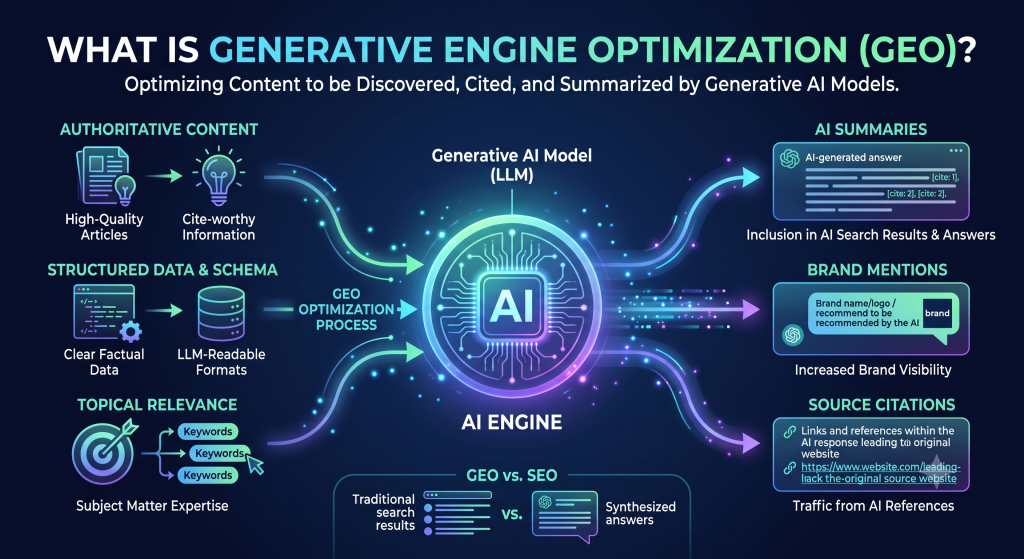
Generative Engine Optimization (GEO) is the practice of creating, structuring, and improving content so that generative AI systems such as AI assistants and AI-powered search engines can understand it, trust it, and cite it in their generated answers. Instead of optimizing only for ranked links, GEO optimizes for inclusion inside AI-generated responses.
In simple terms, traditional SEO asks: ‘Can people find my page?’ GEO asks a slightly different question: ‘Will an AI system use my content when it writes an answer?’
Both questions matter. But as AI-generated summaries become more common, the second one is becoming harder to ignore.
What Is Generative Engine Optimization (GEO)?
Generative Engine Optimization is a digital marketing approach focused on making your content visible, usable, and citable inside AI-generated answers.
A generative engine is any system that produces a written response instead of a list of links. This includes conversational AI assistants, AI-powered search experiences, and search features that summarise results at the top of the page.
These systems do not simply match keywords to pages. They read, interpret, and combine information from many sources, then generate a response in natural language. GEO is the work of making sure your content is one of the sources that shapes that response.
- Increases the chance of your brand being mentioned in AI-generated answers
- Builds recognition as a credible source within your topic
- Improves how accurately AI systems describe your products or services
- Supports long-term brand visibility even when users never click a link
- Strengthens the same content foundations that already help traditional SEO
A simple example
Imagine someone asks an AI assistant: ‘What is the best way to choose a digital marketing agency for a small business?’ The assistant generates a short list of things to consider including pricing models, reporting transparency, relevant experience, and questions to ask during a consultation. If your website has a genuinely helpful, clearly structured article on exactly that topic, an AI system may draw on it when forming the answer. You may not get a click, but you may get a mention. That mention is brand visibility in AI search, and it is exactly what GEO is designed to earn.
Why Is Generative Engine Optimization Important?
GEO matters because the way people find information has changed, and the way visibility is earned has changed with it.
- Search has become conversational. Users now type or speak full questions instead of short keywords. Content that answers real questions clearly performs better in both traditional and AI-driven search.
- AI-generated answers reduce clicks. When a summary appears at the top of a results page, many users never visit a website. If your content is not part of that summary, your reach shrinks even if your rankings have not changed.
- Brand visibility is being decided elsewhere. AI assistants mention brands by name. Whether you are described accurately, and whether you are mentioned at all, depends on how well your content is understood.
- Trust and authority carry more weight. Generative systems favour content that is accurate, well-sourced, and clearly written by someone who knows the subject. Vague or thin content rarely gets cited.
- Discoverability is expanding beyond Google. People find answers through AI assistants, chat interfaces, and app-based search experiences. GEO helps your content travel across all of those surfaces.
- Accuracy protects your reputation. If AI systems pick up outdated or incomplete information from your site, they may describe your business incorrectly. Keeping content current is a form of brand protection.
How Does Generative Engine Optimization Work?
Generative Engine Optimization works by making your content easier for AI systems to understand, verify, and reuse. There is no single trick. It is a combination of content quality, structure, and clarity.
- 1. Create genuinely useful content. AI systems favour information that helps people. Content that solves a real problem, answers a real question, or explains a real process has a better chance of being used.
- 2. Give direct answers. State the answer early, then explain it. A clear two-sentence answer near the top of a section is far easier for an AI system to extract than a long build-up.
- 3. Build topical authority. Cover your subject in depth across multiple related articles. When your site consistently addresses a topic, it becomes a more obvious source to draw from.
- 4. Use structured content. Headings, subheadings, bullet points, numbered lists, and tables help both readers and machines understand how information is organised.
- 5. Improve entity clarity. Be specific about who you are, what you do, and what you are talking about. Name your services, locations, and concepts clearly instead of relying on vague phrasing.
- 6. Demonstrate expertise and trustworthiness. Show who wrote the content, when it was updated, and what it is based on. Transparency signals reliability.
- 7. Support claims with reliable information. Where you make a factual statement, give context. Avoid unsupported superlatives such as 'the best' or 'guaranteed number one' without evidence.
- 8. Keep content accurate and updated. AI technologies evolve quickly. Reviewing and refreshing your content regularly keeps it from becoming misleading.
- 9. Answer real user questions. Mine your inbox, sales calls, and support tickets for the questions customers actually ask. Those questions make excellent headings and FAQ entries.
GEO vs SEO: What Is the Difference?
SEO and GEO share a foundation but aim at different outcomes. SEO targets ranked links. GEO targets inclusion in generated answers.
| Area | Search Engine Optimization (SEO) | Generative Engine Optimization (GEO) |
|---|---|---|
| Main objective | Rank a page high in search results | Get your content understood, trusted, and cited in AI answers |
| Search environment | Traditional search engine results pages | AI assistants, AI-powered search, generative answer interfaces |
| Type of results | List of links and rich results | A synthesised written answer, sometimes with source references |
| User behaviour | Scanning, comparing, and clicking results | Asking a question and reading a single response |
| Content structure | Keyword-focused pages with clear headings | Question-led, well-structured, easily extractable content |
| Keywords | Primary and secondary keyword targeting | Natural language, entities, and conversational phrasing |
| Authority | Backlinks and domain strength | Demonstrated expertise, accuracy, and source reliability |
| User intent | Matched by page type and keyword | Matched by answering the underlying question fully |
| Visibility measurement | Rankings, impressions, clicks, traffic | Brand mentions in AI answers, citation frequency, share of AI voice |
| Role of AI | Ranks and indexes content | Reads, interprets, summarises, and generates new content |
The important thing to understand is that GEO and SEO are not competitors. They are two layers of the same strategy. The content foundations that make a page rank well, including clear structure, useful information, credible sourcing, and good technical health, are the same foundations that make it usable by a generative engine. Strong SEO makes GEO easier. Good GEO strengthens the authority signals that support SEO.
SEO vs AEO vs GEO
Three terms get used together often, and they are easy to mix up. Here is a straightforward breakdown.
| Factor | SEO | AEO | GEO |
|---|---|---|---|
| Primary goal | Rank pages in search results | Win featured snippets and answer boxes | Be included in AI-generated answers |
| Platforms | Google, Bing, other search engines | Search engines, voice assistants, answer boxes | AI assistants, AI search, generative chat platforms |
| Content focus | Keywords, page relevance, links | Concise direct answers to specific questions | Comprehensive, well-structured, trustworthy content |
| Search behaviour | Keyword-based browsing | Question-based searching | Conversational, multi-part questioning |
| Optimization approach | On-page SEO, technical SEO, link building | FAQ formatting, snippet-friendly answers, schema | Entity clarity, topical depth, accuracy, structure |
| Type of visibility | Position in a ranked list | A highlighted answer on the results page | A mention or citation inside a generated response |
Here is how they fit together in practice. SEO gets your pages found and indexed. AEO makes specific answers easy to lift. GEO makes your broader body of content useful to a system that writes its own answers. A page optimised for all three tends to look like this: a clear question-based heading, a short direct answer in the first two sentences, deeper explanation underneath, structured subheadings, and supporting details that demonstrate real expertise.
How to Optimize Your Website for Generative AI Search
These twelve steps form a practical Generative Engine Optimization strategy you can start applying today. You do not need to do all of them at once. Start with the ones your website is missing most.
- 1. Understand your audience's real questions. Write down the questions customers ask before they buy. Look at your contact form messages, sales calls, live chat logs, and support emails. These are the exact queries AI assistants are answering on your behalf.
- 2. Create helpful, comprehensive content. Depth beats word count. A 900-word article that fully answers a question is more valuable than a 3,000-word article that circles it.
- 3. Answer questions directly. Put a clear, one-to-three sentence answer immediately under each question-based heading. Then expand.
- 4. Build topical authority. Publish a cluster of related articles around your core topics rather than scattered one-off posts.
- 5. Use a clear heading structure. One H1 per page. Logical H2 sections. H3s only where they genuinely break down a sub-point.
- 6. Improve entity and topic clarity. Name things precisely. Say 'Generative Engine Optimization (GEO)' the first time rather than assuming the reader knows the acronym.
- 7. Add relevant examples. Concrete examples give AI systems something specific to reference and give readers something they can apply.
- 8. Keep information accurate and updated. Add a visible 'last updated' date and actually refresh old content.
- 9. Strengthen brand credibility. Show real authorship, link to your about page, publish genuine expertise, and be consistent about how you describe your business.
- 10. Use structured data where relevant. Schema markup such as Article, FAQPage, HowTo, and Organization helps machines interpret your content.
- 11. Improve technical website quality. Fast loading, mobile-friendly layouts, secure connections, and crawlable pages remain essential.
- 12. Build a complete content ecosystem. Connect your blog posts, service pages, case studies, and FAQs with sensible internal links.
Best Content Formats for GEO
Some formats naturally suit AI-driven discovery because they are structured, specific, and easy to extract information from.
- Detailed guides. Long-form guides that cover a topic end to end give AI systems a complete picture.
- FAQs. Question-and-answer formatting matches how people actually search.
- How-to articles. Step-by-step instructions are highly extractable. Numbered steps make them easy to summarise accurately.
- Comparison articles. Content that compares options, tools, or approaches answers a common decision-making query.
- Expert insights. Original commentary and professional observations add something that cannot be found elsewhere.
- Case studies. Real examples with context demonstrate credibility and show how a method works in practice.
- Research-based content. Original data, surveys, and analysis give other sources a reason to reference you.
- Glossaries and definitions. Clear definitions of industry terms help AI systems understand your subject area.
- Step-by-step tutorials. Tutorials with screenshots, checklists, or templates provide practical value that readers bookmark and share.
Common GEO Mistakes to Avoid
Most GEO problems come from the same handful of errors. Avoiding them puts you ahead of a large portion of the competition.
Write naturally. Repeat your main topic where it makes sense, not where it creates awkward sentences. AI systems interpret meaning; they are not fooled by density.
AI tools can help you draft, outline, and edit. They cannot supply your experience, your client insights, or your point of view. Add something only you could say.
Verify facts before publishing. Check statistics, dates, and technical claims. If you are unsure, say so or leave it out.
Ask what the reader is actually trying to do. A page about ’email marketing’ could be aimed at beginners, agencies, or enterprise teams. Pick one and serve it well.
Use short sentences, plain language, and one idea per paragraph. If a reader has to read a sentence twice, rewrite it.
Break up long blocks of text with subheadings, lists, and tables. Structure helps humans scan and helps machines parse.
Schedule regular reviews of your top-performing and most-visited pages. Update statistics, refresh examples, and add a visible revision date.
Replace ‘the best agency in the country’ with something provable, such as a specific service, process, or result you can describe honestly.
GEO builds on SEO. Site speed, crawlability, internal linking, and clean URLs still matter. Skipping the basics undermines everything layered on top.
How Can Small Businesses Benefit From GEO?
GEO is not reserved for large brands with big budgets. In some ways, small businesses have an advantage: they can move faster, speak more specifically, and answer niche questions that larger competitors overlook.
- Visibility without a huge audience. A single well-structured article that answers a specific question can be cited by an AI assistant.
- Brand awareness in conversations. When an AI assistant mentions your business while answering a relevant question, that is exposure at the exact moment they need help.
- Authority through specificity. Deep expertise in a narrow area is easier to build than broad authority across an entire industry.
- Trust built through clarity. Honest, detailed, plainly written content stands out and builds credibility.
- Discoverability across more surfaces. One good article can do work in several places.
- Customer education that reduces friction. When prospects already understand what you do, sales conversations start further along.
Practical recommendations for limited resources
- Pick three to five core topics and commit to them for six months
- Answer one real customer question per article
- Add a short direct-answer paragraph under every question-based heading
- Keep an FAQ section on your main service pages
- Update your five most important pages twice a year
- Use plain language because clarity costs nothing and helps everyone
- Link related articles together so your content library builds over time
The Future of Generative Engine Optimization
It is difficult to predict exactly how AI search will develop. The technology is moving quickly, and the companies building these systems share limited detail about how their ranking and citation decisions are made.
What is reasonable to expect is continued movement toward conversational interfaces. Users will likely ask more complex, multi-part questions, and AI systems will likely become better at combining information from multiple sources.
The most sensible approach is to stay informed without overreacting. Do not rebuild your entire strategy every time a new AI feature launches. Instead, keep investing in the things that have always worked and that AI systems clearly reward: accurate, well-structured, genuinely helpful content written by people who understand their subject.
Key Takeaways
- Generative Engine Optimization (GEO) is the practice of making content understandable, trustworthy, and citable for AI-powered search and generative systems.
- GEO does not replace SEO. It extends it. The same content foundations support both.
- SEO targets ranked links, AEO targets direct answer boxes, and GEO targets inclusion in AI-generated responses.
- Direct answers placed early in a section are easier for both readers and AI systems to use.
- Topical authority built through connected, in-depth content outperforms scattered one-off posts.
- Entity clarity, which means naming your services, topics, and concepts precisely, helps AI systems connect information to your brand.
- Accuracy and freshness matter. Outdated content can lead to inaccurate descriptions of your business.
- Structured formatting such as headings, lists, and tables improves extraction for machines and scanning for humans.
- Small businesses can compete effectively by owning specific niches and answering real customer questions.
- No GEO tactic is guaranteed. Focus on genuine helpfulness, and treat AI search as an evolving field to monitor.
Frequently Asked Questions
Generative Engine Optimization (GEO) is the practice of creating and structuring content so that generative AI systems such as AI assistants and AI-powered search tools can understand it, trust it, and cite it when generating answers. It focuses on being included in AI-generated responses, not just ranking in a list of links.
In digital marketing, GEO refers to the set of content, structure, and credibility practices aimed at improving brand visibility inside AI-generated answers. It sits alongside SEO and AEO as part of a modern search visibility strategy.
SEO focuses on ranking a page in search results to earn clicks. GEO focuses on getting your content understood and referenced inside an AI-generated answer, where a user may never click through to a website. SEO targets positions; GEO targets mentions and citations.
AEO (Answer Engine Optimization) targets direct answer formats such as featured snippets and voice assistant responses, usually for a single specific question. GEO targets broader inclusion in generative AI answers that synthesise information from multiple sources.
No. GEO depends on many of the same foundations as SEO, including crawlable pages, clear structure, credible content, and technical health. Abandoning SEO to focus only on GEO would likely reduce your overall visibility rather than improve it.
Start by answering real customer questions directly, organising content with clear headings, building depth around a few core topics, keeping information accurate and updated, and maintaining strong technical website quality. Structured data and internal linking help as well.
More people are getting answers from AI systems instead of browsing links. If your content is not part of those answers, your brand may be left out of the conversation entirely. GEO helps protect and grow visibility in that environment.
Detailed guides, FAQs, how-to articles, comparison posts, expert insights, case studies, research-based content, glossaries, and step-by-step tutorials tend to perform well because they are structured, specific, and genuinely useful.
No. Small businesses often benefit because they can move quickly, focus on a narrow niche, and answer specific questions that larger competitors overlook. Depth in a specialised area can be more valuable than broad reach.
GEO is likely to evolve alongside AI search itself. Expect continued movement toward conversational interfaces, more source transparency, and better attribution. Businesses should monitor these changes while continuing to invest in accurate, well-structured, genuinely helpful content.
Conclusion
Generative Engine Optimization is not a replacement for good marketing. It is a reminder of what good marketing has always been: answering real questions, explaining things clearly, and being genuinely useful to the people you are trying to reach.
What has changed is where that usefulness gets rewarded. Rankings still matter. But increasingly, so does being the source an AI system trusts enough to mention by name.
The businesses that adapt well will not be the ones chasing every new AI trend. They will be the ones that keep their content accurate, their structure clean, their expertise visible, and their focus on the reader.
If you are unsure where to start, begin with your most important service page. Add a clear answer to the question your customers ask most. Then build outwards from there.
Need help making your website visible in both traditional and AI-powered search? OptiRanker is a digital marketing agency that works with businesses on SEO strategy, content planning, and AI search readiness. Get in touch to talk through where your visibility stands today and what to improve first.